

 Team Out of Town
Caught by an NCAP Camera? What Metro Manila Drivers Need to Know
The No Contact Apprehension Policy, or NCAP, is back in parts of Metro Manila, and drivers need to understand how the system works before getting behind the wheel.
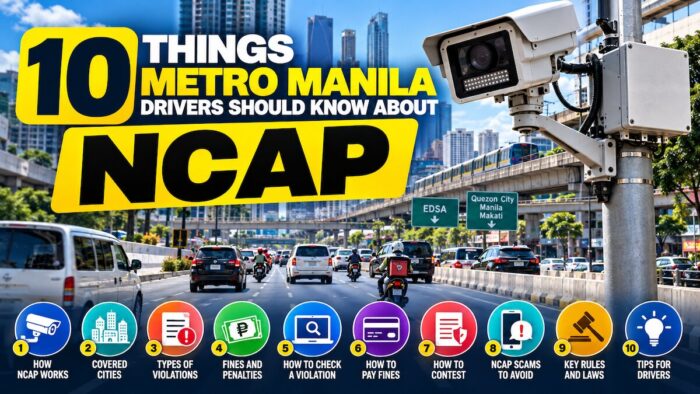
Things Metro Manila Drivers Should Know About NCAP
The latest implementation differs from the NCAP motorists experienced before the 2022 suspension. The Metropolitan Manila Development Authority has continued camera-based enforcement on major roads under its jurisdiction, while several cities have now resumed their own NCAP systems following developments at the Supreme Court.
As of October 2026, Manila, Quezon City, Muntinlupa, and San Juan have resumed city-level NCAP enforcement. Parañaque deferred its planned implementation, while Valenzuela temporarily suspended NCAP because of ongoing road construction.
For Metro Manila drivers, this means you can receive a notice for a traffic violation even if no traffic enforcer stops your vehicle.
Here are 10 important things every driver should know about NCAP.
1. NCAP Can Catch You Without a Traffic Enforcer Stopping You
The biggest thing drivers need to understand about NCAP is how different it is from traditional traffic apprehension.
Under the system, cameras and other approved technology capture images or videos of vehicles allegedly committing traffic violations. A traffic enforcer does not necessarily have to stop the vehicle at the time of the offense.
The recorded information can then be reviewed and processed before a traffic enforcer issues a Notice of Violation.
This means you could continue driving after committing a violation without realizing your vehicle was recorded.
The system uses CCTV cameras, digital cameras, and other technology to identify traffic violations. The objective is to supplement traffic enforcement, particularly in areas where physical traffic enforcers cannot monitor every vehicle.
For drivers, the practical lesson is simple. Don’t assume you are safe from a ticket just because no traffic enforcer is standing beside the road.
2. NCAP Is Now Being Implemented Through Both MMDA and City Systems
Metro Manila drivers also need to understand that NCAP is not a single camera system.
The MMDA operates its own NCAP enforcement on major roads under its jurisdiction. Separately, individual local governments can operate city-level NCAP systems.
The Supreme Court’s 2026 decision removed the remaining temporary restraining order affecting the city-level NCAP systems involved in the case. The Court dismissed the consolidated petitions because subsequent developments, particularly the Metro Manila Traffic Code of 2023, had changed the legal and regulatory landscape. The Court also emphasized that its dismissal did not declare the challenged old NCAP ordinances valid or constitutional.
This distinction matters because the agency or city that issued your violation determines where you check the record, pay the fine, and contest the citation.
Where Is NCAP Currently Active?
As of October 2026, the situation is changing quickly.
| Area | NCAP Status |
|---|---|
| Manila | Implemented |
| Quezon City | Implemented |
| Muntinlupa | Implemented |
| San Juan | Implemented |
| Parañaque | Deferred |
| Valenzuela | Temporarily suspended |
| MMDA major roads | NCAP enforcement continues |
Manila, Quezon City, Muntinlupa, and San Juan resumed city-level NCAP implementation on October 5, 2026. Parañaque subsequently deferred its implementation, while Valenzuela suspended its rollout because of ongoing road construction and changing traffic conditions.
This list can change, so drivers should check the latest announcement from the relevant city before assuming NCAP is or isn’t active on a particular road.
3. You Need to Know Who Issued the Violation
This is one of the most important practical points for Metro Manila drivers.
MMDA-captured violations are handled differently from those issued by a city-operated NCAP system.
For MMDA violations, motorists can check records through the MMDA’s NCAP services. The MMDA’s current system lets motorists search by plate number and MV file number, or other available vehicle information.
The concerned local government handles city-issued violations.
This distinction matters when checking a citation, making payment, requesting documents, or filing a protest.
If you receive an NCAP notice, first check the issuing authority. Don’t assume every Metro Manila NCAP citation is an MMDA ticket.
4. NCAP Covers More Than One Type of Traffic Violation
NCAP enforces traffic laws, rules, and regulations through camera-based monitoring.
Depending on the implementing authority and the roads covered, motorists may be recorded for violations involving traffic signals, lane discipline, road markings, prohibited movements, and other traffic regulations.
The Metro Manila Traffic Code of 2023 provides a common framework for traffic rules, penalties, and procedures across Metro Manila.
Drivers should therefore avoid thinking of NCAP as a system that only catches motorists who beat red lights.
Traffic signs and pavement markings remain important.
If a road has a designated lane, turn restriction, loading restriction, stop line, yellow box, or other traffic control, follow the posted rules even when no traffic enforcer is visible.
5. Your Vehicle Can Receive a Notice Even If You Were Not Driving It
NCAP is connected to the vehicle and its registered information.
The system captures the vehicle involved in the alleged violation, and the notice can be associated with the registered vehicle owner. For example,
Quezon City’s NCAP framework allows notices to be sent to the registered owner’s address based on LTO records.
This creates an important responsibility for vehicle owners.
If you lend your car to a family member, employee, friend, or another authorized driver, make sure that person understands Metro Manila traffic rules.
The owner should also keep registration information and contact details up to date.
A vehicle owner should not assume an NCAP notice will automatically identify or contact the person who actually drove the car.
6. You Can Check NCAP Violations Online
The return of NCAP comes with more digital services for motorists.
The MMDA’s current May Huli Ka system allows motorists to check violations using their plate number and MV file number. It also lets motorists obtain a copy of the Notice of Violation and check payment information.
The MMDA has also integrated NCAP services into the eGovPH app, allowing motorists to check violation records and payment status through the government digital platform.
This is particularly useful for drivers who rarely receive physical notices immediately after an alleged violation.
However, motorists should remember that MMDA and city-level NCAP systems can use different portals and procedures.
If you believe you received a city-issued violation, check the official system of the city where the violation occurred.
7. Do Not Pay an NCAP Fine Through a Suspicious Text Message
The return of NCAP has also created an opportunity for scammers.
The MMDA has warned motorists about fake text messages and websites pretending to be part of the NCAP system.
According to the MMDA warning reported by the Philippine Information Agency, legitimate MMDA NCAP text notifications use the official sender ID “MMDA_NCAP.” The agency said genuine notifications do not contain payment links, reply options, SMS contact information, or the registered vehicle owner’s name.
This is an important reminder because traffic violations involve vehicle information and money, making them attractive targets for phishing scams.
If you receive a suspicious NCAP message, do not click the link.
Instead, independently access the official MMDA or relevant LGU system and check whether your vehicle has an actual violation.
8. You Have the Right to Contest a Violation
An NCAP notice does not mean you have to blindly accept the citation.
If you believe the recorded violation is incorrect, you can use the appropriate contest or protest procedure.
For MMDA-issued violations, the current May Huli Ka system allows motorists to file a contest with the Traffic Adjudication Division within 10 working days of receiving the Notice of Violation. The system also offers an online filing option.
City-level NCAP systems can have their own procedures and deadlines.
If you intend to dispute a violation, do not ignore the notice.
Keep copies of relevant documents, photographs, dashcam footage, receipts, travel records, or other evidence that may help establish what happened.
A dashcam can be particularly useful when disputing a traffic citation because it can record the vehicle’s movement and road conditions at the time.
9. NCAP Fines Follow the Metro Manila Traffic Code Framework
One major change in the renewed implementation is using the Metro Manila Traffic Code of 2023 as a common framework for traffic rules, penalties, and procedures.
The Supreme Court cited this important development when it dismissed the consolidated NCAP petitions.
Participating local governments have said traffic fines will follow the standardized framework.
For drivers, this means the same violation should be understood under the Metro Manila-wide traffic code rather than treated as an entirely different offense simply because it occurred in another city.
However, motorists should still check the actual Notice of Violation because the amount due, issuing authority, and payment procedure depend on the specific citation.
10. The Best Way to Avoid NCAP Is Still Simple: Follow the Road Rules
The most practical NCAP strategy does not involve memorizing camera locations.
It involves becoming more disciplined behind the wheel.
Drivers should:
- Stop completely at red lights.
- Follow lane markings.
- Observe road signs.
- Avoid illegal turns.
- Stay within designated lanes.
- Do not block intersections.
- Follow yellow-box markings.
- Avoid prohibited loading and unloading areas.
- Observe pedestrian crossings.
- Follow speed restrictions.
- Avoid using prohibited road movements to save a few minutes.
- Give yourself enough time to reach your destination without rushing.
Camera enforcement changes the likelihood of being caught, but the traffic rules still apply.
If you drive as though every major intersection has a camera, you are less likely to violate the rules.
NCAP Camera Locations: What Drivers Should Know
Many motorists search for exact NCAP camera locations before driving through Metro Manila.
Knowing where cameras are located can help, but drivers should not treat an unofficial camera map as a complete list.
The MMDA has cameras on major roads under its jurisdiction, while individual cities can operate their own camera systems on selected roads and intersections.
The current rollout also means that coverage can change as LGUs expand or modify their systems.
Instead of relying entirely on a camera list, drivers should pay attention to traffic signs, lane markings, signal lights, and road restrictions.
A camera location guide can complement safe driving habits. It should not replace them.
What Happens After an NCAP Violation?
The process generally involves several stages.
First, the camera or other approved technology records the alleged traffic violation.
The appropriate authority then reviews and processes the record.
If the authority confirms the violation, it can issue a Notice of Violation to the registered vehicle owner.
The motorist can then check the violation, review the available information, pay the applicable fine, or contest the citation if there is a valid reason to dispute it.
For MMDA-issued violations, the current online system allows motorists to request a copy of the notice, pay the fine through available channels, and submit a contest.
City-issued violations follow the procedures established by the concerned LGU.
What Metro Manila Drivers Should Keep in Their Car
Drivers who regularly travel around Metro Manila should consider keeping a few items and records accessible.
These include:
- Updated driver’s license
- Vehicle registration documents
- Insurance information
- Emergency contact numbers
- Dashcam footage
- Parking receipts when relevant
- Photos or videos of unusual road conditions
- Records related to authorized vehicle users
A dashcam can be particularly useful when traffic conditions, roadworks, temporary signs, or unusual lane arrangements create confusion.
Drivers should also make it a habit to check their vehicle’s traffic records through official government channels instead of waiting indefinitely for a physical notice.
Why NCAP Matters to Everyday Drivers
NCAP changes the way motorists interact with traffic enforcement.
Under conventional enforcement, a driver generally knows about a violation because an enforcer stops the vehicle or issues a citation.
With camera-based enforcement, drivers may learn about a violation only later.
This makes defensive driving and attention to road signs even more important.
It also means vehicle owners need to monitor their records, particularly if multiple people regularly use the same car.
The return of city-level NCAP also means Metro Manila drivers need to understand the difference between MMDA enforcement and local government enforcement.
Frequently Asked Questions About NCAP in Metro Manila
1. What is NCAP in the Philippines?
The No Contact Apprehension Policy is a camera-based traffic enforcement system that records vehicles allegedly committing traffic violations without requiring a traffic enforcer to physically stop the vehicle at the time of the offense. Cameras, digital systems, and other approved technology capture images or videos that are reviewed and processed before issuing a Notice of Violation. The system supplements traditional traffic enforcement and promotes compliance with traffic rules.
2. Which Metro Manila cities currently implement NCAP?
As of October 2026, Manila, Quezon City, Muntinlupa, and San Juan have resumed city-level NCAP implementation. Parañaque deferred its planned rollout, while Valenzuela temporarily suspended implementation because of ongoing road construction. Separately, the MMDA continues camera-based enforcement on major roads under its jurisdiction. Because local implementation can change, motorists should verify the latest announcement from the relevant LGU before relying on an older NCAP city list.
3. Can I be fined by NCAP even if a traffic enforcer did not stop me?
Yes. That is the fundamental purpose of no-contact enforcement. Cameras and other technology can record an alleged traffic violation without requiring an enforcer to flag down the vehicle. The appropriate authority can then review and process the evidence and may issue a Notice of Violation. Drivers should therefore follow traffic signs, signals, lane markings, and other road regulations even when they do not see traffic personnel nearby.
4. How can I check if my vehicle has an NCAP violation?
For MMDA-issued NCAP violations, motorists can use the MMDA’s current May Huli Ka system and enter the required vehicle information, such as the plate number and MV file number. The MMDA also offers NCAP services through the eGovPH app. City-issued violations can have separate online systems operated by the concerned LGU. If you are checking a violation, make sure you are using an official government platform rather than a website or link sent through an unsolicited text message.
5. Can I contest an NCAP violation?
Yes. Motorists who believe that an NCAP citation was issued incorrectly can contest the violation through the appropriate procedure. For MMDA-issued citations, the current May Huli Ka system allows you to file a contest with the Traffic Adjudication Division within 10 working days of receiving the Notice of Violation. City-level systems may have their own procedures, deadlines, and requirements. Drivers who plan to contest a citation should keep supporting evidence, including dashcam footage, photographs, and documents relevant to the incident.
6. Are NCAP fines the same throughout Metro Manila?
The Metro Manila Traffic Code of 2023 provides a common framework for traffic rules, penalties, and procedures across the metropolitan area. Participating LGUs have said that NCAP fines will follow this standardized framework. However, drivers should still check the Notice of Violation because the issuing authority, specific offense, amount due, and payment instructions depend on the citation. Standardized penalties do not mean every traffic offense carries the same fine.
7. How do I know if an NCAP text message is legitimate?
Motorists should be extremely careful with unsolicited NCAP messages. The MMDA has warned about fake texts and websites designed to impersonate its NCAP system. The agency said legitimate MMDA NCAP text notifications use the official sender ID “MMDA_NCAP” and do not contain payment links, reply options, SMS contact information, or the registered vehicle owner’s name. The safest approach is to avoid clicking links in unexpected messages and independently check your record through an official government platform.
8. Who receives the NCAP Notice of Violation?
The registered vehicle owner is generally central to the NCAP notification process because the system identifies the vehicle through registration information. For example, Quezon City’s NCAP framework allows it to issue Notices of Violation to registered owners using the appropriate LTO database. This means vehicle owners should take traffic compliance seriously even when they allow other people to drive their vehicles. If several people use the same car, the owner should make sure every authorized driver understands the applicable traffic rules.
9. Does NCAP operate on every road in Metro Manila?
No. NCAP coverage depends on the implementing authority and on which roads or intersections are equipped and designated for camera-based enforcement. The MMDA operates cameras on major roads under its jurisdiction, while cities can set up their own monitored locations. An older online camera map may also be inaccurate because coverage can change as systems expand, adjust, or are temporarily suspended. Drivers should therefore treat traffic signs and road markings as the primary guide instead of assuming that only roads with visible cameras are enforced.
10. What is the best way to avoid an NCAP violation?
The best way to avoid an NCAP citation is to follow traffic rules consistently. Stop at red lights, respect lane markings, avoid prohibited turns, keep intersections clear, observe speed limits, follow loading and unloading restrictions, and pay attention to temporary road signs. Drivers should also avoid relying on the absence of a visible traffic enforcer as permission to make a questionable maneuver. NCAP cameras can operate without an officer physically stopping the vehicle, so disciplined driving remains the most reliable way to avoid penalties.
Practical NCAP Checklist for Metro Manila Drivers
Before driving through Metro Manila, remember these points:
- Check whether NCAP is currently implemented in your destination city.
- Know whether you are traveling on an MMDA-covered road.
- Follow traffic lights and road signs.
- Stay within the correct lane.
- Keep intersections and yellow boxes clear.
- Do not make prohibited turns.
- Watch for temporary road signs during construction.
- Check official government channels for possible violations.
- Never pay through suspicious links received by text.
- Keep dashcam footage when available.
- Contest questionable violations within the applicable deadline.
- Check whether the citation came from the MMDA or an LGU.
- Keep your vehicle registration information updated.
What This Means for Metro Manila Drivers
The return of NCAP makes traffic enforcement across Metro Manila more technology-driven.
The biggest adjustment for drivers is psychological. You can no longer assume a violation matters only when a traffic enforcer sees it and stops you.
Cameras can record traffic behavior, and the resulting notice can arrive later.
The current system also requires motorists to identify which authority issued the violation. MMDA-issued citations and city-issued NCAP violations can involve different checking, payment, and contest procedures.
For daily commuters, private vehicle owners, motorcycle riders, delivery drivers, and professional drivers, the safest approach is to treat every major intersection as an actively enforced traffic zone.
Follow the signs. Follow the lane markings. Give yourself enough time to drive without rushing.
That approach can save you from an NCAP notice and, more importantly, help make Metro Manila roads safer.
Follow #TeamOutofTown on Facebook, Twitter, Instagram, Bloglovin, and Pinterest for more travel ideas.
Also read:
- How to Apply for RFID Sticker for SLEX, NLEX, CAVITEX, Etc. (EasyTrip & Autosweep)
- How To Renew Passport For OFWs – A Complete Guide
- How to Renew Your Motorcycle Registration in the Philippines
- Updated LTO Student Permit Requirements and Procedure 2023
- A Complete Guide to Driver’s License Renewal in the Philippines
- NCAP Cameras in Metro Manila Cities: What Motorists Need to Know