

 Melo Villareal
NCAP Scam Alert: How to Identify Fake Traffic Violation Text Messages in the Philippines
The return and expansion of the No Contact Apprehension Policy (NCAP) in Metro Manila has created a new opportunity for scammers to impersonate government agencies and trick motorists into clicking fake payment links.
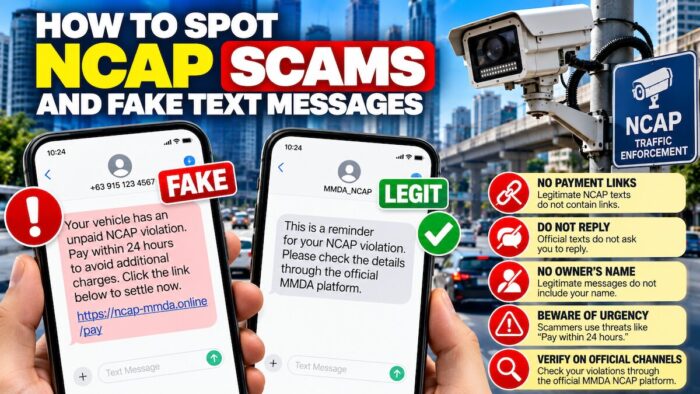
How to Spot NCAP Scams and Fake Text Messages
The Metropolitan Manila Development Authority (MMDA) has repeatedly warned motorists about fraudulent NCAP text messages and websites designed to look like legitimate government services. These scams often claim that a driver has an unpaid traffic violation and must settle it immediately to avoid additional penalties or problems with a driver’s license or vehicle registration.
The good news is that legitimate NCAP notifications have identifiable characteristics.
Knowing these warning signs can help motorists avoid losing money or giving scammers access to personal and financial information.
How NCAP Scams Work
NCAP scams typically start with an unexpected text message claiming your vehicle has a traffic violation.
The message may say that you have an unpaid fine, an overdue violation, or a problem with your vehicle record. It may then provide a link that claims you must pay immediately.
The website behind the link may look convincing. It can use government logos, similar colors, official-sounding language, and forms that ask for personal or payment information.
The goal is usually to make the recipient act before checking whether the message is legitimate.
The MMDA has specifically warned about fraudulent NCAP messages that use alarming language and questionable links. One example reported by the agency involved a fake notice claiming that a motorist committed distracted-driving violations and had only 24 hours to pay through an embedded link.
That sense of urgency is a major warning sign.
1. Check the Sender ID
When you receive an NCAP text, the first thing to check is the sender.
The MMDA has stated that “MMDA_NCAP” is the official sender ID for legitimate MMDA NCAP text notifications. The official notification system does not use an ordinary mobile phone number as the sender.
Be cautious if an NCAP message comes from:
- An ordinary mobile number
- An unfamiliar sender ID
- A random series of numbers
- A sender using a name that looks similar to MMDA
- An account claiming to be “NCAP Violations”
- An unfamiliar website or organization
However, do not rely on the sender name alone.
Scammers can use increasingly sophisticated techniques, so the safest approach is to independently verify the alleged violation through an official government platform.
2. A Legitimate NCAP Text Does Not Contain a Payment Link
This is one of the MMDA’s most important warnings.
Official MMDA NCAP text notifications do not contain payment links.
A scam message may say:
“Click here to settle your NCAP violation.”
It may then direct you to a website that looks like an official government portal.
Do not click.
Instead, open your browser and manually enter the official MMDA NCAP website address.
The current MMDA May Huli Ka system allows motorists to check NCAP violations using vehicle information such as the plate number and MV file number.
The key distinction is that you should start the verification yourself rather than letting the text message tell you where to go online.
3. Watch Out for Messages That Demand Immediate Payment
Scammers want victims to act quickly.
A fake NCAP message may say:
- “Pay within 24 hours.”
- “Your license will be suspended.”
- “Your vehicle registration will be blocked.”
- “Pay immediately to avoid penalties.”
- “Final warning.”
- “Your account will be reported.”
- “Click now to avoid additional charges.”
These messages are designed to create panic.
The MMDA has warned motorists about fraudulent NCAP messages that use urgent language and suspicious payment links.
Stop and verify before doing anything.
The MMDA has also stated that NCAP fines are fixed and do not carry interest or late-payment penalties.
That makes messages threatening immediate additional charges particularly suspicious.
4. Do Not Reply to an NCAP Text
Legitimate MMDA NCAP real-time notifications do not ask motorists to reply.
The MMDA has identified the absence of reply instructions as a characteristic of its legitimate notifications. Official NCAP alerts also do not provide SMS contact information for motorists to use in responding to the message.
If a text says:
“Reply YES to confirm payment.”
or
“Reply to speak with an agent.”
Do not respond.
Do not provide your plate number, driver’s license information, OTP, banking information, or other personal information through the text conversation.
5. Check the Message for Suspicious Links
Fake NCAP messages often contain links that imitate government websites.
A link may look official at first glance, but the actual website address can be completely different.
For example, scammers can create websites with words such as:
- MMDA
- NCAP
- traffic
- violation
- payment
- government
inside the web address to make the page look legitimate.
The presence of the word “MMDA” in a website address does not automatically make it an official MMDA website.
The Cybercrime Investigation and Coordinating Center has warned that malicious links in messages can lead users to phishing websites designed to steal sensitive information, including passwords, banking information, and one-time passwords.
The safest approach is to avoid clicking links in unsolicited messages.
6. Verify the Violation Yourself
If you receive an NCAP notification and think it might be legitimate, do not use the link provided in the message.
Instead, access the official MMDA NCAP service independently.
The current May Huli Ka platform allows motorists to check a violation using their plate number and MV file number. You can also search using the plate number and ticket number.
The MMDA also integrated NCAP services into the eGovPH app, allowing motorists to check violation records and payment status through the government digital platform.
This creates a simple rule:
Message first -> verify independently -> pay only through official channels.
Do not reverse the process by clicking a payment link first and checking the violation later.
7. A Real NCAP Notification Does Not Include Your Registered Owner Name
Another useful warning sign is the information included in the text.
According to the MMDA, legitimate NCAP text notifications do not include the registered vehicle owner’s name. They also don’t include payment links, reply instructions, or SMS contact information.
This can feel counterintuitive because a personalized message may appear more legitimate.
Scammers can use personal information obtained from different sources to make their messages look convincing.
Do not assume that a message is genuine simply because it contains your name, plate number, or other vehicle information.
Verify through the official system instead.
8. Be Careful With Fake Government Websites
A sophisticated NCAP scam may go beyond a text message.
The scammer may create a website that copies the look of a government service.
The page could contain:
- Government logos
- Official-looking colors
- Fake violation records
- Fake payment forms
- Fake customer service numbers
- Fake reference numbers
- A countdown timer
- Credit card or online banking forms
The purpose is to convince you that you are completing an ordinary government transaction.
Do not enter sensitive information simply because a website looks professional.
The MMDA’s official May Huli Ka platform lets motorists securely view violation information, evidence, payment status, and contest information.
When in doubt, close the suspicious page and access the official government service independently.
9. Never Give an OTP to Someone Claiming to Be From NCAP
An OTP should never be treated as a routine traffic violation requirement.
Be particularly careful if a suspicious NCAP message or person asks for:
- Bank account information
- Credit card details
- Debit card information
- Online banking passwords
- OTPs
- PINs
- E-wallet passwords
- Authentication codes
The National Telecommunications Commission has warned that scammers use deceptive messages to pressure people into revealing sensitive information. Authorities recommend verifying suspicious communications through official channels instead of relying on the message itself.
If someone asks for your OTP, stop the transaction.
10. Know Where to Report an NCAP Scam
If you receive a suspicious NCAP message, do not simply delete it immediately.
Take a screenshot first.
Keep the message, sender information, website address, and any other relevant evidence.
The MMDA says suspected NCAP scam messages can be reported through the MMDA Hotline 136 or through the agency’s official social media accounts.
For broader text and online scams, motorists can also report suspicious activity to the appropriate government authorities.
The National Telecommunications Commission promotes the B.I.R.D. approach:
- Block the sender.
- Ignore the message.
- Report the incident.
- Delete the scam message.
How to Check If You Really Have an NCAP Violation
If you receive an NCAP notification, follow these steps:
Step 1: Do Not Click the Text Message
Leave the message unopened or do not interact with its links.
Step 2: Check the Sender
Look for the official MMDA NCAP sender ID, but remember that sender information should not be your only verification method.
Step 3: Open the Official MMDA Service Yourself
Manually access the official MMDA NCAP service instead of clicking the link in the message.
Step 4: Enter Your Vehicle Information
The current May Huli Ka system allows motorists to search using their plate number and MV file number.
Step 5: Review the Violation
If a legitimate record exists, review the available violation details and Notice of Violation.
Step 6: Pay Through an Official Channel
The MMDA’s current platform offers digital payment options once it finds a valid violation record.
Step 7: Contest If You Believe the Citation Is Wrong
If you disagree with an MMDA citation, the current May Huli Ka system allows motorists to file a contest with the Traffic Adjudication Division within 10 working days from receipt of the Notice of Violation.
What If You Already Clicked a Fake NCAP Link?
Do not panic, but act quickly.
If you clicked a suspicious link but didn’t enter any information, close the page and don’t go back.
If you entered personal information, change the affected passwords immediately.
If you provided banking or e-wallet information, contact your financial institution through its official customer service channel and explain what happened.
If you disclosed an OTP or authentication code, contact the relevant bank or financial service provider immediately.
Take screenshots of the suspicious message and website before deleting anything.
If you transferred money without authorization, report the transaction to your financial institution and the appropriate authorities as soon as possible.
What If You Already Paid a Fake NCAP Website?
If you entered payment information or transferred money to a scammer, contact your bank, card issuer, or e-wallet provider immediately.
Provide the transaction reference number, date, amount, recipient details, screenshots, and copies of the scam message.
Do not continue communicating with the scammer.
Do not pay another amount because the scammer claims you need to “unlock” or “refund” the original transaction.
Save all evidence for reporting.
How to Protect Your Vehicle Information
NCAP scams become more convincing when scammers have access to accurate vehicle information.
Motorists should therefore avoid publicly posting complete copies of vehicle registration documents, driver’s licenses, and other documents containing sensitive information.
When sharing documents online, remove information that is unnecessary for the intended purpose.
The MMDA’s current NCAP system itself processes vehicle and personal information as part of its official functions, which is another reason motorists should use official platforms rather than unofficial websites claiming to provide NCAP services.
The Difference Between a Real NCAP Alert and a Fake Text
| Feature | Legitimate MMDA NCAP Alert | Possible Scam |
|---|---|---|
| Sender | MMDA_NCAP | Unknown number or suspicious sender |
| Payment link | No | Often included |
| Reply instruction | No | Often included |
| SMS contact information | No | May be included |
| Registered owner name | No | May be included |
| Urgent payment demand | No | Common red flag |
| Verification | Official MMDA system | Link supplied by sender |
| Payment | Official payment channels | Unknown website or account |
| Website | Independently accessed official service | Suspicious or unfamiliar domain |
The MMDA has specifically identified the absence of payment links, reply options, SMS contact information, and the registered vehicle owner’s name as characteristics of legitimate real-time NCAP notifications.
Common NCAP Scam Messages to Watch Out For
Scammers can change their wording, but these types of messages should immediately make motorists cautious:
“You have an unpaid NCAP violation. Pay within 24 hours.”
“Your driver’s license is subject to suspension due to an unpaid NCAP fine.”
“Your vehicle registration will be blocked unless you settle your traffic violation.”
“Click this link to verify your NCAP violation.”
“Reply to this message to prevent further penalties.”
“Your NCAP ticket has been forwarded to LTMS.”
The wording can change, but the pattern remains similar: create fear, demand immediate action, and direct the recipient to a link.
Why NCAP Scams Are Dangerous
A fake traffic violation message can cause more damage than an unnecessary payment.
A phishing website can potentially collect passwords, financial information, identification details, and authentication codes.
A scammer can also use information collected from one transaction to target the victim again.
That is why motorists should treat an unexpected NCAP message as a verification task, not an emergency.
Take a moment.
Check the sender.
Avoid the link.
Verify independently.
Only then decide what to do.
Frequently Asked Questions About NCAP Scams
1. What is the official sender ID for MMDA NCAP text messages?
The MMDA has stated that MMDA_NCAP is the official sender ID for its legitimate NCAP text notifications. The agency’s real-time SMS alerts do not use an ordinary mobile phone number. However, motorists should still verify any alleged violation through the official MMDA system rather than relying exclusively on the sender ID. Legitimate notifications do not contain payment links, reply instructions, SMS contact information, or the registered vehicle owner’s name.
2. Does a real NCAP text message contain a payment link?
No. The MMDA has specifically warned motorists that legitimate NCAP notifications do not contain payment links. This is one of the clearest signs that a message may be fraudulent. If a text asks you to click a link and immediately pay an NCAP fine, do not click it. Instead, independently access the official MMDA NCAP service and check whether a violation actually exists. Never allow an unsolicited text message to determine which website or payment page you use.
3. How can I check if I really have an NCAP violation?
You can independently check MMDA NCAP records through the official May Huli Ka system. The current platform lets motorists search by plate number and MV file number, or by plate number and ticket number. The MMDA has also integrated NCAP services into the eGovPH app. These official options are safer than clicking a link contained in an unsolicited text message.
4. What should I do if I receive a suspicious NCAP text?
Do not click any link, reply to the sender, or provide personal or financial information. Take a screenshot of the message and verify whether you actually have an NCAP violation through the official MMDA system. If the message is fraudulent, the MMDA advises the public to report suspicious NCAP messages through Hotline 136 or its official social media accounts. You can then block and delete the message after preserving the evidence needed for reporting.
5. Can scammers fake an MMDA NCAP website?
Yes. Scammers can create websites designed to look like legitimate government portals. These pages can copy logos, colors, layouts, and official-sounding language. Their objective can be to collect personal information, passwords, payment details, or OTPs. The safest practice is to avoid clicking unsolicited links and instead manually access the official government service. Cybersecurity authorities have repeatedly warned that malicious links can lead to phishing websites that imitate trusted organizations.
6. Will a legitimate NCAP message include my name?
The MMDA says its legitimate real-time NCAP text notifications do not include the registered vehicle owner’s name. This is one characteristic motorists can use to evaluate a suspicious message. However, scammers can obtain personal information from different sources, so seeing your name or vehicle information does not prove that a message is genuine. Always verify the alleged violation through an official government platform before making a payment or providing additional information.
7. Can I get an NCAP message even if I do not have a violation?
Yes, scammers can send fake NCAP messages to people who have no traffic violation. Their strategy is to create a believable scenario that encourages the recipient to click a link or make an immediate payment. That is why receiving an NCAP message doesn’t automatically mean you have a legitimate violation. Check your record independently through the official MMDA system. If no legitimate record exists and the message contains suspicious links or payment instructions, treat it as a scam.
8. What should I do if I already clicked a fake NCAP link?
If you clicked the link but didn’t enter any information, close the website and avoid interacting with it again. If you entered passwords, banking details, card information, or authentication codes, immediately contact the affected financial institution or service provider through its official channel. Change compromised passwords and monitor your accounts for suspicious activity. Keep screenshots and transaction records because they can support reports to authorities and financial institutions. Acting quickly can reduce the potential damage.
9. Does the MMDA ask motorists to pay NCAP fines through text messages?
Legitimate MMDA NCAP notifications do not include payment links. The official May Huli Ka platform lets motorists verify a violation before paying, and payment options become available once a valid violation record is found. If a text message directs you to a payment website, especially under a tight deadline, do not use the supplied link. Access the official system independently and verify the record first.
10. Where can I report an NCAP scam?
The MMDA says you can report suspicious NCAP text messages through Hotline 136 or its official social media accounts. Motorists should preserve screenshots and other evidence before deleting the message. For broader text-scam concerns, the National Telecommunications Commission also recommends blocking, ignoring, reporting, and deleting suspicious messages. If money or sensitive information has already been compromised, contact your bank or financial service provider immediately and report the incident to the appropriate authorities.
NCAP Scam Safety Checklist
Before paying an NCAP violation, ask yourself:
- Did the message come from MMDA_NCAP?
- Does the message contain a payment link?
- Does it ask you to reply?
- Does it provide an SMS contact number?
- Does it contain your registered vehicle owner’s name?
- Does it threaten immediate penalties?
- Did you independently check the violation?
- Are you using an official government platform?
- Are you being asked for an OTP or banking password?
- Can you verify the violation without using the link in the message?
If something feels wrong, stop.
Do not click.
Do not reply.
Do not pay.
Verify first.
For Metro Manila motorists, that simple habit can prevent a fake NCAP notice from becoming a real financial loss.
Follow #TeamOutofTown on Facebook, Twitter, Instagram, Bloglovin, and Pinterest for more travel ideas.
Also read:
- How to Apply for RFID Sticker for SLEX, NLEX, CAVITEX, Etc. (EasyTrip & Autosweep)
- How To Renew Passport For OFWs – A Complete Guide
- How to Renew Your Motorcycle Registration in the Philippines
- Updated LTO Student Permit Requirements and Procedure 2023
- A Complete Guide to Driver’s License Renewal in the Philippines
- NCAP Cameras in Metro Manila Cities: What Motorists Need to Know
- 10 Things Metro Manila Drivers Should Know About NCAP