

 Melo Villareal
Lost Your Philippine Passport Overseas? A Filipino Traveler’s Guide to Reporting It and Getting Home
Losing your passport while traveling overseas can turn an exciting trip into a stressful situation. I experienced this firsthand when I lost my Philippine passport in Madrid during my first visit to Spain. It made me realize how important it is to know the right steps to take when a passport goes missing far from home.
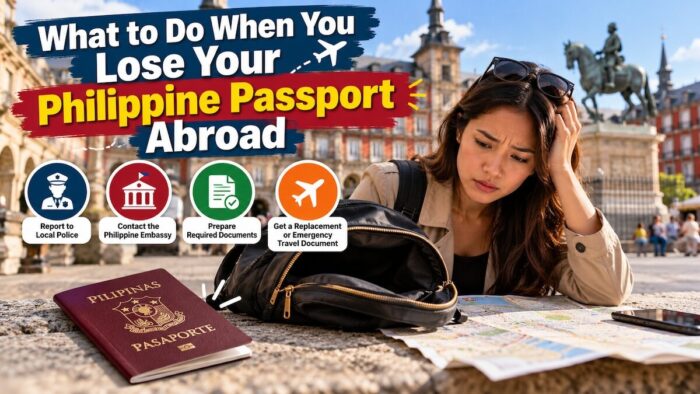
What to Do When You Lose Your Philippine Passport Abroad
Your passport is more than an identification document. You need it for international travel, immigration checks, and your return journey. Losing it can affect your itinerary, flight arrangements, visa status, and travel plans.
The good news is that Filipino travelers have options. The Philippine Embassy or Consulate can guide you through reporting the loss, applying for a replacement passport, or obtaining an emergency travel document if you need to return to the Philippines.
Act promptly, protect your other documents, and follow the instructions of the Philippine foreign service post responsible for your location.
1. Stay Calm and Check Whether Your Passport Is Really Missing
Before reporting your passport as lost, take a few minutes to retrace your steps. Check your hotel room, bags, jacket pockets, travel organizer, taxi, train seat, and any place where you last presented your passport.
Contact your hotel, restaurant, transportation provider, or the venue you recently visited to ask whether someone turned it in. If you used a luggage locker or left your belongings with a hotel, check with the staff.
However, do not spend hours searching if you suspect theft or believe someone took your bag. Report the incident promptly and contact the Philippine Embassy or Consulate for guidance.
If your passport was stolen together with your wallet, phone, or other identification documents, secure your bank accounts and mobile payment apps as soon as possible. Ask your bank to block affected cards and contact your mobile provider if your phone is missing.
2. Report the Loss or Theft to the Local Police
If your passport was stolen, file a report with the local police. Even if you simply misplaced it, ask the Philippine Embassy whether you need a police report.
A police report provides an official record of what happened. You may also need one when applying for a replacement passport or emergency travel document.
When filing the report, provide as much accurate information as possible, including:
- Your full name and nationality.
- Your Philippine passport number, if available.
- The date, approximate time, and location of the incident.
- Whether the passport was lost, stolen, or taken with other belongings.
- Other missing documents or valuables.
Request a copy of the police report and keep it in a safe place. If the report is issued in the local language, check whether the Philippine Embassy requires an English translation.
For example, in Spain, the Philippine Embassy in Madrid lists a written police report, known locally as a denuncia, with an English translation among the additional requirements for a lost or mutilated passport application. Requirements may differ at other embassies and consulates.
3. Contact the Nearest Philippine Embassy or Consulate
After reporting the incident, contact the Philippine Embassy or Consulate responsible for the country you are visiting. Consular officers can explain the requirements for a replacement passport and assess whether you qualify for an emergency travel document.
Use the official website or verified contact details of the Philippine foreign service post. Explain that your passport is missing, provide your current location, and tell the consular officer when you need to travel.
Prepare to answer these questions:
- When and where did you lose your passport?
- Was it lost or stolen?
- Do you have a photocopy or digital copy of the passport?
- Do you have another government-issued identification document?
- When is your next international flight?
- Are you planning to continue traveling to another country or return directly to the Philippines?
If you lost your passport in Spain, contact the Philippine Embassy in Madrid.
Philippine Embassy in Madrid, Spain
- Address: Calle Guadalquivir 6, 28002 Madrid, Spain
- Telephone: +34 917 82 38 30
- Passport services: +34 910 55 22 31 or +34 917 82 38 36
- Consular emergency hotline: +34 616 49 18 61
- Email: madridpe.consular@dfa.gov.ph
The Embassy lists weekday office hours, excluding Philippine and Spanish holidays. Contact the Consular Section to confirm the correct procedure and current requirements before visiting.
If you are traveling outside Spain, contact the Philippine Embassy or Consulate accredited to your location. If you are unsure which office handles your case, consult the Department of Foreign Affairs through its official consular channels.
4. Prepare the Documents for a Lost Passport Application

The required documents depend on the country, the embassy or consulate handling your case, and whether your lost passport was still valid.
For a lost Philippine passport in Spain, the Philippine Embassy in Madrid lists the following requirements for a lost or mutilated passport application:
- Personal appearance of the applicant.
- Completed passport application form.
- Affidavit of Loss or Mutilation.
- Payment of the applicable passport replacement and notarization fees.
- Police report with an English translation.
- Photocopy of the lost passport, if available.
- Original and photocopy of a Philippine Statistics Authority (PSA)-issued birth certificate if the passport copy is unavailable.
- Other supporting documents, such as a PSA marriage certificate when applicable, residence documentation, or other identification.
The Embassy may request additional documents based on your circumstances. Check its current requirements before attending your appointment.
What if you do not have a copy of your passport?
Do not panic. Tell the embassy that you don’t have a copy of your passport. Prepare alternative documents to establish your identity and Filipino citizenship, such as your PSA birth certificate, government-issued IDs, or other official records.
A digital copy of your passport’s information page can help if you saved it in secure cloud storage or email. A copy does not replace the original passport, but it may help the consular officer verify your details.
If someone steals your wallet and all your identification documents, explain the situation when you contact the embassy. Ask which alternative documents or verification procedures you can use.
What is an Affidavit of Loss?
An Affidavit of Loss is a sworn statement explaining the circumstances surrounding the missing passport. It typically identifies the document and describes when, where, and how it was lost or stolen.
Provide truthful details. If you don’t know exactly how the passport disappeared, state what you do know and explain the circumstances accurately. The embassy can advise you on the required format and notarization procedure.
5. Decide Whether You Need a Replacement Passport or an Emergency Travel Document
This is one of the most important decisions after losing your passport. Your best option depends on whether you intend to continue your trip or return directly to the Philippines.
The Philippine Passport Act, Republic Act No. 11983, recognizes two types of emergency travel documents: emergency passports and emergency travel certificates. An emergency passport can help eligible Filipino travelers complete their intended overseas travel before returning to the Philippines or their overseas residence. An emergency travel certificate is intended for eligible Filipinos returning to the Philippines who have lost their passports abroad or cannot be issued a regular passport.
| Your situation | What to ask the embassy |
|---|---|
| You plan to continue visiting other countries | Whether you qualify for a replacement or emergency passport that supports your intended itinerary |
| You need to return directly to the Philippines | Whether an emergency travel certificate or another travel document is appropriate |
| Your flight leaves soon | Whether urgent consular processing is possible and what proof of travel is required |
| You have a residence permit or visa for another country | Whether replacing your passport affects your documentation or travel arrangements |
Important: Do not assume that an emergency travel document permits travel to every destination or transit through every country. Some documents are valid only for a direct, one-way journey to the Philippines. Confirm the permitted route and requirements with the embassy and your airline before changing your plans.
For example, the Philippine Embassy in Madrid states that its travel document is for eligible Filipino citizens who need to return to the Philippines but cannot wait for a regular passport. It is valid for a one-way, direct flight to the Philippines. The Embassy says applicants must appear in person and submit the required documents, and no appointment is required for this service.
6. Book an Appointment for Passport Replacement
If you need a replacement passport, check whether the embassy requires an appointment. Do not assume you can walk in for all passport services.
The Philippine Embassy in Madrid directs passport applicants to the Global Online Appointment System. Applicants select Europe as the region, Spain as the country, and PE MADRID as the site. The Embassy also instructs applicants to confirm the provisional schedule within one hour of receiving the notice, or the booking may be cancelled.
Appointment procedures differ by location and service. Ask the consular section whether it can accommodate urgent cases and whether you should bring original documents, photocopies, printed forms, photographs, or cash for payment.
If you are scheduled to leave the country soon, mention your departure date in your first message. Do not book a new international flight based only on an estimated processing time.
7. Contact Your Airline and Review Your Travel Plans
Losing your passport may affect your next flight, hotel booking, or onward travel. Contact your airline as soon as you know you cannot present your original passport.
Ask about changing your flight and whether you can travel using the document the embassy plans to issue. Airlines must verify that passengers have the travel documents required for their itinerary, so they may not accept an emergency document for every international route.
Also review the following:
- Hotels: Ask whether you can change your booking if consular processing takes longer than expected.
- Tours and transportation: Check cancellation policies and contact providers about missed departures.
- Travel insurance: Review whether your policy covers document replacement, theft, additional accommodation, or trip interruption.
- Visa requirements: Confirm whether you need a new visa or updated documentation after receiving a replacement passport.
- Transit stops: Verify that the replacement or emergency document is accepted for your route, including any transit country.
Keep receipts for additional expenses. If you plan to file an insurance claim, the insurer may request a police report, proof of the missing passport, receipts, and evidence of itinerary changes.
8. Check What Happens to Your Visa or Residence Permit
A lost passport may also mean losing the physical document containing your visa or entry stamps. The effect depends on the country, your immigration status, and whether you have a separate residence permit or electronic visa record.
If you are traveling in the Schengen Area, contact the relevant immigration authority or consulate for advice about replacing or documenting your visa. Do not assume that the visa automatically transfers to a replacement passport.
If you hold a residence permit, work authorization, or long-term visa, ask the issuing authority whether you need to report the passport loss separately or update your records. Keep copies of your permit and any visa approval notices if you have them.
Before crossing another border, confirm which documents you must carry. A police report and an embassy-issued document may help explain your circumstances, but they do not automatically replace every immigration document required for travel.
9. Protect Yourself From Identity Theft
A stolen passport contains personal information that could be misused. After reporting the theft, take steps to protect your identity and other accounts.
- Notify the police and the Philippine Embassy or Consulate.
- Contact your bank if your wallet, cards, or other financial information was also stolen.
- Secure your email account and mobile banking applications if your phone is missing.
- Change passwords for important accounts if you suspect someone accessed your device.
- Keep copies of your police report and consular correspondence.
- Store replacement documents separately from your remaining travel documents.
If someone later returns your passport after you formally report it lost, contact the Philippine Embassy or Consulate before using it. Follow its instructions about whether the document remains valid or must be surrendered.
10. How to Prepare for Future International Trips
Losing a passport is stressful, but a few precautions can make the process easier if it happens again.
Before leaving home:
- Save a secure digital copy of the information page of your passport.
- Keep a photocopy separate from the original.
- Store your embassy’s contact details on your phone and in your email.
- Keep a copy of your travel insurance policy and emergency assistance number.
- Save copies of your visa, residence permit, flight bookings, and hotel reservations.
- Use a secure travel wallet, and avoid carrying your passport when local rules don’t require it.
During your trip:
- Check that you have your passport after airport, immigration, hotel, and transport transactions.
- Keep your passport in a secure location when you are not using it.
- Be especially attentive in crowded transport hubs, busy tourist areas, and places where pickpocketing is a concern.
- Keep your original passport separate from your backup copies and other valuables.
A passport copy will not replace the original, but it can help you establish your identity and speed up discussions with consular officials.
Frequently Asked Questions About Losing a Philippine Passport Abroad
1. What should I do first if I lose my Philippine passport overseas?
First, check your immediate surroundings and contact the hotel, transportation provider, or establishment where you last had your passport. If you suspect theft, report it to the local police as soon as possible. Then contact the nearest Philippine Embassy or Consulate for instructions. Ask whether you need a police report, an Affidavit of Loss, and an appointment. If you have an upcoming flight, tell the consular officer your departure date so they can explain the available options for your circumstances.
2. Can I return to the Philippines without my Philippine passport?
Yes, eligible Filipino citizens may be able to return using an emergency travel certificate or another travel document issued by the Philippine Embassy or Consulate. Under Republic Act No. 11983, an emergency travel certificate is for Filipinos returning to the Philippines who lost their passports overseas or cannot obtain a regular passport. Requirements and processing times depend on your case. Contact the responsible embassy before booking or boarding a flight, and confirm that your airline accepts the document for your exact route.
3. How long does it take to replace a lost Philippine passport abroad?
Processing time depends on the embassy or consulate, the completeness of your documents, and whether additional verification is necessary. The DFA lists an additional 15-business-day clearing period for certain lost valid passports processed in the Philippines. That period should not be assumed to apply identically to every overseas application. Ask your local embassy for its current processing estimate, particularly if your passport was stolen shortly before your scheduled departure. Do not make nonrefundable travel arrangements until the consular officer explains what is possible.
4. Do I need a police report if I simply misplaced my passport?
Contact the Philippine Embassy or Consulate to confirm the requirements for your specific situation. A police report is especially important if your passport was stolen, and some passport replacement procedures require one even if your passport was lost. In Madrid, the Embassy lists a written police report with an English translation among the additional requirements for a lost or mutilated passport application. Even if you believe you misplaced your passport rather than having it stolen, report the circumstances honestly and ask the consular section what documentation it requires.
5. Can I continue traveling to other countries after losing my passport?
Possibly, but you must first confirm which document the embassy can issue and what travel it permits. A replacement passport or emergency passport may suit certain onward journeys, subject to applicable requirements. An emergency travel certificate for returning to the Philippines may permit only a direct, one-way trip home. Transit countries and airlines may also impose document requirements. Explain your full itinerary to the consular officer before changing your bookings, and verify entry and transit requirements with the relevant authorities.
6. What documents should I bring to the Philippine Embassy for a lost passport?
Requirements vary, so check the embassy’s official instructions before your visit. Depending on your case, you may need a completed passport application, an Affidavit of Loss, a police report, a copy of the missing passport, a PSA birth certificate, valid identification, and other supporting documents. If you lost your passport in Spain, the Philippine Embassy in Madrid requires personal appearance and lists a police report with an English translation among its additional requirements. Bring original documents and photocopies where requested. If you lack identification because your wallet was stolen, contact the embassy to discuss alternative verification procedures.
7. Will my Schengen visa remain valid if my Philippine passport is lost?
Do not assume your visa arrangements remain unchanged after you lose your passport. The correct procedure depends on your visa status, the issuing country, and whether you have a separate residence permit or electronic record. Contact the relevant consulate or immigration authority to report the loss and ask how to document your visa status. If you are traveling through the Schengen Area, explain your itinerary and obtain instructions before crossing another border. Keep copies of your visa approval, police report, and replacement travel document, but remember that copies do not automatically substitute for required original documents.
8. What should I do if someone finds and returns my lost passport?
Contact the Philippine Embassy or Consulate before using a passport that you previously reported as lost. Once you report a passport missing, it may be cancelled or subject to other procedures, so recovering the physical booklet does not automatically mean you can use it for international travel. Explain when and where you recovered it, and follow the consular officer’s instructions. Ask the relevant office whether the passport remains valid and whether you need to surrender it or complete additional documentation before traveling.
Final Travel Advice for Filipino Passport Holders
Losing my Philippine passport in Madrid during my first visit to Spain taught me to take travel-document security seriously. A missing passport can disrupt a carefully planned itinerary, but acting promptly and contacting the right authorities can help you understand your options.
If it happens to you, report the incident, secure your remaining belongings, contact the Philippine Embassy or Consulate, and confirm whether you need a replacement passport or an emergency travel document. Keep your police report and supporting documents, and verify every flight or border requirement before continuing your journey.
Most importantly, save a secure copy of your passport and the contact details for your nearest Philippine Embassy before your next international trip. Those simple preparations can make a difficult travel situation easier to manage.
Like, follow, and subscribe to OutofTownBlog.com on Facebook, Twitter, Instagram, and Pinterest, and Team Out of Town on YouTube for more DFA Appointment Tips.
Read:
- DFA Announces Birth Certificate Is No Longer Required To Renew Passport
- New Passport Application Process: Requirements + Guide to DFA Schedule Appointment
- DFA Courtesy Lane: Who are allowed to use the DFA passport express lane?
- The Quick Guide to Getting Your Passport in Cebu
- Philippine Passport Renewal Requirements + Guide to DFA Online Appointment