

 Melo Villareal
NAIA Immigration Guide for Filipinos: 15 Questions Immigration Officers May Ask Before Your Flight
Traveling abroad from the Philippines means going through immigration before you reach your boarding gate. At Ninoy Aquino International Airport (NAIA), Bureau of Immigration officers check passengers’ travel documents and may ask questions about their trip.
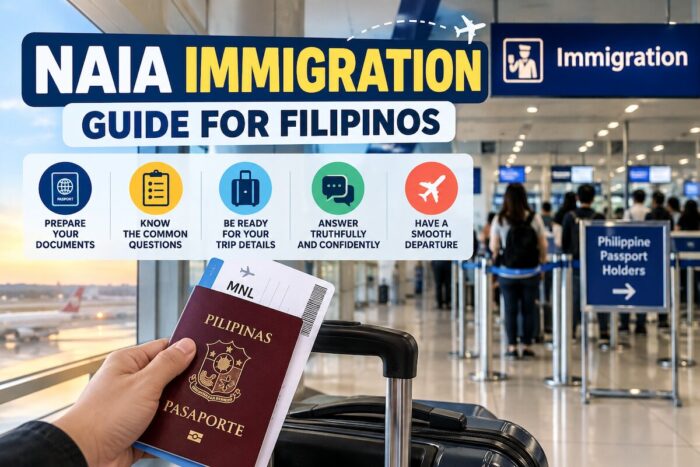
NAIA Immigration Guide for Filipinos
For most Filipino tourists, the immigration interview is straightforward. Officers may verify your travel purpose, destination, itinerary, accommodation, financial arrangements, and return plans. Additional documents may apply depending on your destination, visa, employment status, travel arrangements, or personal circumstances.
The best approach is simple: know your itinerary, understand your travel arrangements, and answer questions truthfully and consistently.
What Happens at NAIA Immigration?
After airline check-in and security procedures, international passengers proceed to immigration. A Bureau of Immigration officer checks the passenger’s documents and asks questions when necessary.
The questions can vary. A first-time traveler may receive more questions about the trip, while a frequent traveler with a straightforward itinerary may have a shorter interview.
Immigration officers also conduct departure checks as part of border control and efforts to prevent human trafficking, illegal recruitment, and other violations.
Here are 15 questions you should be prepared to answer.
1. Where Are You Going?
This is one of the most basic questions.
State the country and, if necessary, the city you are visiting. Your answer should match your airline ticket, itinerary, visa, and other travel documents.
Example:
“I’m going to Tokyo, Japan.”
If you are visiting several destinations, explain your itinerary clearly.
“I’m flying to Tokyo first, then traveling to Osaka and Kyoto before returning to Manila.”
2. What Is the Purpose of Your Trip?
Immigration officers may ask why you are traveling.
Common answers include:
- Tourism
- Visiting family or friends
- Business
- Attending a conference
- Studying
- Employment
- Visiting a partner or spouse
- Medical travel
- Transit
Give a direct and truthful answer.
If you are traveling for tourism, you can simply say:
“I’m traveling for a holiday.”
If you are attending an event, mention the event and its purpose.
3. How Long Will You Stay?
Know your exact travel dates.
You should be able to state when you are leaving the Philippines and when you plan to return.
For example:
“I’ll be in Japan for seven days. I’m returning to Manila on October 10.”
Your answer should be consistent with your return ticket and itinerary.
4. Where Will You Stay?
Be ready to provide the name of your hotel, resort, hostel, or accommodation.
You do not necessarily need to memorize the complete address, but keeping your booking confirmation accessible on your phone can make it easier to provide details.
If you are staying with relatives or friends, know their name, address, and relationship to you.
5. Who Are You Traveling With?
The officer may ask whether you are traveling alone or with someone.
You could be traveling with:
- Your spouse
- Parents
- Children
- Friends
- Colleagues
- A tour group
If you are traveling with friends, know their names and basic details about the trip.
If you are traveling alone, simply say so.
6. Is This Your First Time Traveling Abroad?
First-time international travelers may be asked additional questions to establish the purpose and circumstances of their trip.
There is no reason to be nervous about answering this question.
If it is your first international trip, say so.
If you have traveled abroad before, provide accurate information about your previous trips if asked.
7. What Do You Do for a Living?
An immigration officer may ask about your occupation, particularly when verifying the circumstances of your trip.
You can answer with your profession or employment status.
For example:
“I’m a marketing manager.”
Or:
“I’m self-employed.”
If you are a student, say that you are a student and be prepared to provide your school identification if relevant.
8. Who Is Paying for Your Trip?
Know how your trip is being funded.
You may be paying for the trip yourself, or another person or organization may be covering some or all of your expenses.
Possible arrangements include:
- Self-funded
- Employer-sponsored
- Parents paying for the trip
- A relative sponsoring the trip
- A partner paying for the trip
- An organization covering business travel
If someone else is sponsoring your trip, understand the arrangement and relationship.
9. How Much Money Did You Bring for the Trip?
You may be asked about your travel budget or financial capacity, particularly if questions arise about how you will support yourself abroad.
Know your approximate budget and how you intend to pay for expenses.
You can explain whether you have:
- Cash
- Credit cards
- Debit cards
- Prepaid travel cards
- Access to funds through your bank
Avoid inventing an amount simply because you think it sounds sufficient. Give truthful information.
10. Do You Have a Return Ticket?
For tourist trips, be ready to show your return or onward ticket.
Keep your booking confirmation accessible on your phone. A printed copy can also serve as a backup.
11. Where Are You Going After This Destination?
This question can come up when you have a multi-country itinerary.
For example:
“I’m flying to Singapore for four days, then continuing to Kuala Lumpur for three days before returning to Manila.”
Know the sequence of your destinations, accommodation, transportation, and return date.
12. Do You Know Anyone in the Country You’re Visiting?
The officer may ask whether you have relatives, friends, a partner, or other contacts at your destination.
Answer truthfully.
If you are visiting someone, know basic information about them, including their name, your relationship to them, and where they live.
13. What Is Your Itinerary?
You should have a basic understanding of what you intend to do during the trip.
You do not need to memorize every restaurant reservation or sightseeing stop.
However, you should know:
- Cities you will visit
- Hotels or accommodations
- Major activities
- Transportation between destinations
- Length of stay
- Return date
Inconsistencies involving your travel purpose, itinerary, or supporting documents can lead to additional questions.
14. Do You Have a Visa or Other Required Travel Documents?
If your destination requires a visa, know your visa type and validity.
Depending on your destination and circumstances, you may also need additional documentation.
Before leaving for NAIA, check the entry requirements of your destination country. Immigration clearance in the Philippines does not replace the destination country’s immigration requirements.
15. When Are You Coming Back to the Philippines?
This is closely connected to your itinerary and return ticket.
Know your exact or planned return date.
For example:
“I’m returning to Manila on November 18.”
If you have an open-ended trip, be prepared to explain your circumstances clearly and provide the relevant documents.
What Documents Should You Prepare for NAIA Immigration?
For a regular departing Filipino passenger, prepare the basic documents required for your trip. Depending on your circumstances and destination, you may need additional supporting documents.
Your travel folder should generally include:
- Valid Philippine passport
- Boarding pass
- Required visa
- Return or onward ticket
- Hotel or accommodation booking
- Basic itinerary
- Proof of financial capacity when relevant
- Travel insurance when required or appropriate
- Supporting documents for sponsored trips
- Relevant documents for minors
- Employment-related documents for overseas employment
Do not assume every traveler needs every document on this list. Requirements depend on the destination and circumstances of the trip.
Do You Need to Register With eTravel?
International travelers departing from the Philippines should complete the required eTravel registration before departure.
Make sure your information is accurate and complete. Keep the necessary confirmation accessible on your phone if required.
Check the latest official instructions before your trip because procedures and requirements can change.
What Happens During Secondary Inspection?
Being referred to secondary inspection does not automatically mean that you have done something wrong.
Secondary inspection allows immigration officers to conduct additional assessment when necessary.
If you are referred, remain calm. Answer the questions honestly and provide the documents requested.
Unclear travel purposes, inconsistent statements, lack of a concrete itinerary, and questions about the circumstances of a trip may result in further assessment.
How Early Should You Arrive at NAIA?
Give yourself plenty of time for check-in, baggage procedures, security, immigration, and boarding.
For international flights, arriving around three hours before departure is a good rule of thumb, especially on weekends, holidays, and other peak travel times.
Arriving early also gives you more time to resolve problems involving missing documents, airline requirements, or immigration processing.
Tips for a Smooth NAIA Immigration Interview
Know Your Trip
Review your flight details, hotel booking, itinerary, and return ticket before leaving home.
Answer the Question Asked
Keep your answers direct. Avoid giving unnecessary information that can create confusion.
Be Consistent
Your answers should match your documents and travel plans.
Keep Important Documents Accessible
Store your passport, boarding pass, visa, hotel booking, return ticket, and other relevant documents in a place where you can quickly access them.
Do Not Memorize a Script
You should understand your trip rather than memorize rehearsed answers.
Tell the Truth
Never fabricate employment information, financial details, relationships, itinerary details, or the purpose of your trip.
Stay Calm
Immigration interviews are part of the departure process. Listen carefully, answer clearly, and follow the officer’s instructions.
Special Cases Travelers Should Know
OFWs
Filipinos departing for overseas employment have additional documentation requirements. Overseas Filipino Workers should make sure their employment-related documents are complete before traveling to the airport.
Requirements can vary depending on the worker’s employment situation and destination, so check the latest rules before departure.
Minors
Children traveling abroad may have additional documentary requirements depending on who they are traveling with and their circumstances.
Parents or guardians should check applicable requirements well before the flight to avoid delays at the airport.
Foreign Residents Leaving the Philippines
Foreign nationals may have additional requirements depending on their visa type and length of stay in the Philippines.
Foreign residents should check their immigration status and applicable departure requirements before heading to NAIA.
Passengers With Immigration or Legal Concerns
Travelers with possible derogatory records, court orders, or other immigration restrictions should resolve these matters before going to the airport.
If you have an existing immigration or legal concern, seek clarification from the appropriate government agency before your scheduled flight.
Here’s a concise section you can add before the FAQ:
Quick NAIA Immigration Document Checklist
Before leaving for the airport, make sure you have these documents ready:
? Valid passport — Check that it meets your destination’s validity requirements.
? Boarding pass — Keep your digital or printed boarding pass accessible.
? Visa or travel authorization — If required by your destination.
? Return or onward ticket — Especially for tourist trips.
? Hotel or accommodation booking — Include the address and contact details.
? Travel itinerary — Know your destinations, activities, and travel dates.
? Proof of financial capacity — Bank documents, cards, or other relevant evidence when applicable.
? Travel insurance — If required or appropriate for your destination.
? Sponsorship documents — If another person is paying for or supporting your trip.
? Additional documents — Such as employment, school, parental, or other supporting documents when applicable.
? eTravel registration — Complete the required registration before departure.
Tip: Keep important documents in one easily accessible folder on your phone, and carry backup copies of essential documents when practical. Requirements can vary depending on your destination and personal circumstances, so check the latest requirements before your flight.
NAIA Immigration FAQ
1. What questions does Philippine immigration usually ask?
Questions can cover your destination, purpose of travel, length of stay, accommodation, travel companions, occupation, funding, itinerary, previous international travel, and return plans. The exact questions vary depending on each passenger’s circumstances. The safest approach is to understand your own itinerary and provide truthful, consistent answers.
2. Do immigration officers ask every passenger the same questions?
No. Immigration interviews can vary from passenger to passenger. An officer may ask only a few basic questions or request additional information when clarification is necessary. Your answers should correspond with your passport, boarding documents, itinerary, visa, and other applicable travel documents.
3. What should I say if this is my first international trip?
Tell the immigration officer that it is your first international trip. There is no need to invent previous travel experience. Be prepared to explain where you are going, why you are traveling, how long you will stay, where you will stay, who is paying for the trip, and when you plan to return.
4. Do I need to bring a printed hotel booking?
A printed booking is not necessarily required for every traveler, but having your accommodation confirmation readily available is practical. Keep the booking on your phone and consider having a backup copy. You should know the name and location of your hotel or accommodation and be able to explain your arrangements if asked.
5. Do I need to show proof of funds at NAIA immigration?
Financial documentation may be required depending on the circumstances of your trip. The important point is that you should be able to explain how your travel expenses will be covered. If another person is sponsoring your trip, understand the sponsorship arrangement and carry relevant supporting documents when appropriate.
6. What happens if I cannot answer an immigration officer’s question?
Stay calm and ask the officer to repeat or clarify the question if necessary. Do not guess or invent an answer. If you cannot remember a specific detail, explain honestly and refer to your documents. Your goal should be to provide accurate information about your actual trip.
7. Can immigration ask about my job?
Yes. Your occupation can be relevant when officers assess the circumstances of your international travel. Answer accurately and consistently. If you are employed, you can state your position and employer when asked. Self-employed travelers can explain their business or profession, while students can identify their school and status.
8. Can I be referred to secondary inspection even if I have a valid passport and ticket?
Yes. Having a passport and ticket does not mean an interview must always end at primary inspection. A secondary inspection may be conducted when immigration officers require additional assessment or clarification. A referral does not automatically mean that you have violated an immigration rule.
9. Does secondary inspection mean I will not be allowed to leave?
No. Secondary inspection is an additional assessment process. A referral, by itself, does not establish that a passenger will be prevented from departing. The final outcome depends on the passenger’s circumstances, documents, answers, and applicable immigration rules.
10. How early should I arrive at NAIA for an international flight?
Allow at least three hours before your scheduled international flight. This gives you enough time for check-in, baggage drop-off, security screening, immigration processing, and reaching your boarding gate. During holidays and peak travel periods, allowing additional time can be useful because airport queues may become longer.
11. Do I need eTravel before going through immigration?
International passengers departing from the Philippines should complete the required eTravel registration. Make sure the information you provide is accurate and complete. Check the latest government instructions before your trip because registration procedures and operational requirements may change.
12. What if someone else is paying for my vacation?
Answer honestly and explain your relationship with the person paying for the trip. If relevant, be prepared to provide supporting documents that explain the sponsorship. You should also know your destination, accommodation, itinerary, length of stay, and return plans.
13. Can an immigration officer ask about my travel companion?
Yes. You may be asked who you are traveling with and your relationship to that person. If you are traveling with friends, family, a partner, or colleagues, provide accurate information. For group trips, make sure you know the basic itinerary and accommodation arrangements.
14. What should I do if my travel plans change after I pass immigration?
Follow the airline’s procedures for any flight or itinerary changes, and ensure your revised arrangements comply with your destination country’s requirements. If a change affects your immigration documentation or departure circumstances, ask the appropriate airport or airline personnel for guidance rather than relying on assumptions.
15. Where can I check official Philippine immigration information?
For the latest immigration rules, announcements, requirements, and contact information, check the official Bureau of Immigration and Philippine government channels before your trip. Immigration procedures can change, so travelers should verify current requirements rather than relying on older travel experiences or social media posts.
Final Travel Reminder
A smooth NAIA immigration experience starts before you arrive at the airport. Know your destination, understand your itinerary, keep your documents accessible, and answer questions truthfully.
You do not need to memorize a long script. You need to know the basic details of your own trip and make sure your documents support what you tell the immigration officer.
Follow and subscribe to OutofTownBlog.com on Facebook , Twitter, Instagram, Pinterest, and YouTube for more Travel-related updates.
Read:
- NAIA Terminal 3 Manila Airport: Your Complete Guide
- Top 15 Hotels near NAIA Terminal 3 Manila Airport
- The Wings Transit Hotel & Spa Opens New Capsule Beds and Private Rooms at NAIA Terminal 3
- Going Abroad for the First Time? Avoid These NAIA Immigration Mistakes
- NAIA Immigration Guide for Filipinos: What to Expect Before Your International Flight