Melo Villareal
First-Time International Travel from NAIA: A Complete Departure Guide for Filipinos
Traveling abroad from the Philippines involves more than arriving at the airport with a passport and boarding pass. You need to confirm your terminal, prepare your travel documents, follow airline baggage rules, complete any required online registrations, settle travel tax when required, and clear Philippine immigration before boarding your flight.
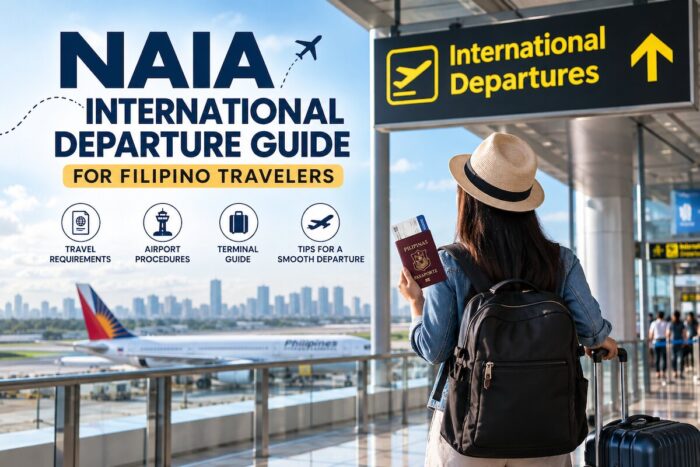
NAIA International Departure Guide for Filipino Travelers
This NAIA International Departure Guide for Filipino Travelers explains the process from leaving home to boarding your international flight. It also covers immigration interviews, terminal assignments, travel expenses, special assistance, family travel, connecting flights, and common problems that can disrupt your departure.
Rules and services can change. The information below reflects official guidance available for this 2026 guide. Confirm flight-specific instructions with your airline and check the relevant government agency before traveling.
1. How early should you arrive at NAIA for an international flight?
For most international flights, plan to arrive at the airport three hours before departure. Consider arriving three and a half to four hours early during busy travel periods, when traveling with children or elderly relatives, or when you need special assistance.
Your airline’s check-in deadline takes priority. Some airlines close check-in or baggage acceptance well before departure, and online check-in does not always remove the requirement for an airport document check.
| Situation | Practical arrival plan |
|---|---|
| Regular international flight | About 3 hours before departure |
| Peak travel periods and holidays | Allow 3.5 to 4 hours where practical |
| Family with young children or several bags | Allow additional time for check-in and assistance |
| Passenger needing wheelchair or mobility assistance | Arrange support in advance and allow extra time |
| Connecting from another flight | Add a buffer for delays, terminal transfers, baggage, and separate-ticket risks |
These are planning recommendations, not universal airline deadlines. Follow the specific check-in and boarding times printed on your booking or provided by your carrier.
Before leaving home, check Metro Manila traffic, roadworks, airport access advisories, and your estimated travel time. If someone is driving you, share the correct terminal and international departure entrance. Don’t assume all international airlines operate from the same building.
2. NAIA terminals and international airline assignments
Ninoy Aquino International Airport has four terminal buildings, but your flight’s assigned terminal depends on your airline and its current operations. An airline may also change its assigned terminal or check-in area, so confirm the details for your specific flight.
The airport’s official flight information service provides departure schedules, terminal information, check-in desks, and flight status. Start with the NAIA official departures page and the airline information page.
NAIA terminal comparison
| Terminal | What travelers should know |
|---|---|
| Terminal 1 | Handles international flights for several foreign carriers and other assigned airlines. Check the live departure listing for your flight. |
| Terminal 2 | Used for assigned Philippine Airlines operations and other flights as indicated by current airport information. Confirm the terminal for your exact route. |
| Terminal 3 | Handles many international and domestic flights, including assigned services from several major airlines. Do not assume every flight operated by a familiar airline uses T3. |
| Terminal 4 | Historically served domestic operations. Confirm its current operating status and your airline’s instructions before using it as a departure point. |
Terminal operations and airline assignments may change. The airport’s live departure listing and your airline’s current instructions take precedence over a general terminal guide.
How to confirm your terminal
- Open your airline booking confirmation or e-ticket.
- Check the airport terminal printed for your departure.
- Look up your flight number on the airport’s official departure page.
- Check your airline’s website, app, or latest travel advisory.
- Recheck on the day of travel before leaving home.
Use the flight number and destination. Two flights departing for the same city may use different check-in desks or terminals.
What facilities can you expect at each terminal?
NAIA terminals generally offer check-in counters, passenger screening, immigration facilities, toilets, food outlets, and other basic airport services. Lounges, currency exchange counters, ATMs, retail stores, Wi-Fi, and assistance facilities vary by terminal and operating hours.
Don’t assume a lounge accepts your airline ticket or bank card. Check access conditions, opening times, and whether a facility is located before or after immigration. If you need wheelchair assistance, a lift, accessible toilets, or help reaching a gate, contact your airline before the travel date and confirm the arrangements at check-in.
3. How to get to NAIA and find the correct drop-off point
Choose your transportation based on your terminal, departure time, luggage, and the traffic conditions on your route.
- Taxi: Use an authorized airport taxi service and confirm the destination terminal before the trip begins.
- Ride-hailing services: Enter the correct terminal and departure area in the app. Follow designated pick-up or drop-off instructions.
- Private car: Ask your driver to follow the terminal’s current access signs. Check parking availability and fees if someone plans to wait.
- Airport buses and shuttles: Verify the current route, stop, operating hours, and terminal connections before relying on them.
- Inter-terminal transfers: Allow extra time. Don’t assume you can walk easily between terminal buildings, especially with luggage.
Traffic can make a short distance take much longer than expected. During holidays, long weekends, severe weather, and major events, allow extra time.
If you arrive at the wrong terminal, ask authorized airport staff or airline personnel for directions immediately. Do not wait until the final boarding call to arrange a transfer.
4. Documents Filipino travelers should prepare
Keep your essential documents together in a small, secure travel pouch. Carry originals where required, with digital copies and backups stored securely.
Essential international travel documents
- Valid Philippine passport.
- Valid visa, eVisa, electronic travel authorization, or entry permit when required.
- Confirmed flight itinerary and return or onward ticket, if required by the destination.
- Accommodation address, hotel booking, or host information.
- Travel insurance policy and emergency contact details, if purchased or required.
- Supporting documents explaining the purpose of travel, if relevant.
- Proof of sufficient funds or a sponsor’s supporting documents, when relevant to your trip.
- Required vaccination records, medical documents, or destination-specific declarations.
- eTravel registration confirmation when applicable.
- DSWD travel clearance for a minor when required.
Passport validity
Check the passport validity rule of your destination and any transit country. Many destinations require at least six months of validity, but requirements differ. Some use a different validity period or apply specific rules based on nationality, residence, or visa status.
Check the destination country’s official immigration or embassy website rather than relying on a general rule. Also confirm that your passport is in acceptable physical condition and has sufficient blank pages if your destination requires them.
Visa and entry requirements
Visa-free access does not automatically guarantee entry. A destination may require a return ticket, proof of accommodation, sufficient funds, an electronic authorization, or evidence of the purpose and duration of your stay.
For example, Filipino travelers may face different requirements when visiting Japan, South Korea, Taiwan, Hong Kong, Singapore, Thailand, the United States, Australia, or Schengen countries. Requirements depend on the destination, travel purpose, passport, and current rules. Check official sources for the destination country before purchasing non-refundable arrangements.
Important distinction: Philippine immigration decides whether you may depart the Philippines under applicable rules. The destination country’s border officials decide whether you may enter. Passing Philippine immigration does not guarantee admission abroad.
5. eTravel registration: what to do before departure
The Philippine eTravel system collects information for border control and other government purposes. The official portal is etravel.gov.ph.
The official eTravel FAQ states that departing Filipino passengers must register or update their information, subject to the stated exceptions. Registration is free. Avoid websites that charge a fee to complete the official registration.
How to complete eTravel
- Visit the official eTravel website.
- Create or access your registration as the system instructs.
- Enter your personal and travel details carefully.
- Review the information before submitting.
- Save the resulting confirmation or QR code, if issued.
- Keep a screenshot or accessible copy on your phone and retain any reference details provided.
Complete registration within the applicable time window shown by the official system. Do not rely on an old screenshot or assume that a previous trip’s registration remains valid for a new journey.
What if eTravel does not work?
Check your internet connection, confirm the official website address, and retry if the system is temporarily unavailable. Review your entries for errors and save any reference number or confirmation already issued. If the issue persists, seek instructions through official eTravel or airport channels.
Do not pay an unofficial agent simply because the website is slow. Ask your airline or authorized airport personnel what to do if you cannot complete the required process before departure.
6. Philippine immigration: what happens at the departure counter?
After completing the airline’s check-in and applicable screening procedures, follow airport signs to Philippine immigration. Have your passport and any requested supporting documents ready.
Immigration officers may ask questions to verify your identity, travel purpose, itinerary, and compliance with applicable departure rules. Routine travelers should answer honestly and directly.
Common immigration questions
Questions may include:
- What is the purpose of your trip?
- How long will you stay?
- Where will you stay?
- What do you do for work or business?
- Who are you traveling with?
- Who is paying for your trip?
- When do you plan to return?
- Can you show your return ticket or accommodation details?
These are examples, not a fixed interview script. Officers may ask different questions depending on the circumstances.
How to prepare for immigration
- Know your itinerary, travel dates, and accommodation details.
- Be familiar with the information on your application, ticket, and supporting documents.
- Keep relevant documents organized and accessible.
- Answer questions truthfully. Do not memorize invented answers or provide misleading information.
- If you do not understand a question, politely ask the officer to clarify it.
- Do not present documents that you know are false or altered.
What is secondary inspection?
Secondary inspection means an officer needs to conduct additional checks before deciding whether to allow departure. It does not automatically mean that a traveler has committed an offense or will be prevented from traveling.
Additional questions may concern the purpose of travel, financial arrangements, sponsorship, employment, travel companions, or documentation. Stay calm, follow lawful instructions, and provide genuine supporting documents when requested.
If you are traveling on sponsorship, you may need evidence of the sponsor’s identity, your relationship to them, and their financial support. The appropriate documents depend on your circumstances. No single set of documents guarantees clearance.
Ask for an explanation of the process if you are unsure what is happening. The officer’s final decision must follow applicable rules. A traveler cannot guarantee departure clearance by carrying a thick folder or rehearsing answers.
7. Overseas Filipino Workers and sponsored trips
Filipino travelers departing for overseas employment must prepare the documents required for their employment category. The requirements differ from those for tourists visiting relatives or taking a holiday.
For OFWs
Depending on your circumstances, prepare your valid passport, employment visa or work authorization, employment contract, and the applicable Overseas Employment Certificate (OEC) or other required Department of Migrant Workers documentation. First-time overseas workers may have additional requirements.
Confirm your status and documents through the Department of Migrant Workers before going to NAIA. Do not assume that a tourist visa or a ticket alone is sufficient for a trip intended for overseas employment.
For sponsored travel
If someone else will pay for your trip, carry genuine documents explaining the arrangement when relevant. These may include your sponsor’s contact details, proof of your relationship, an invitation letter, accommodation information, or financial support documents.
A sponsorship arrangement does not automatically mean you will face secondary inspection, and no document guarantees clearance. Make sure your answers, itinerary, and supporting documents accurately describe your plans.
8. Travel tax: rates, exemptions, and payment
The Philippine travel tax is a government levy that may apply to people departing the Philippines. The amount depends on the applicable category and passage class. TIEZA publishes the current rates and exemption rules on its official travel tax page.
Published travel tax rates
| Category | First class | Economy class |
|---|---|---|
| Full travel tax | PHP 2,700 | PHP 1,620 |
| Standard reduced travel tax | PHP 1,350 | PHP 810 |
| Privileged reduced rate for qualifying OFW dependents | PHP 400 | PHP 300 |
These are published TIEZA rates. Eligibility for a reduced rate depends on the applicable rules and supporting documents.
Who may qualify for an exemption?
TIEZA lists categories that include overseas Filipino workers, qualifying Filipino permanent residents abroad whose stay in the Philippines is less than one year, and infants aged two years and below. Other categories may also qualify under specific rules. Check the official eligibility criteria rather than assuming that every OFW family member or overseas resident automatically qualifies.
How to pay
- Check your airline ticket or booking receipt to see whether travel tax is already included.
- If it is not included and you are liable to pay, use TIEZA’s authorized online payment service or an official payment counter.
- TIEZA reports that its 24-hour counters serve departure lobbies at NAIA Terminals 1, 2, and 3. Confirm the current counter location and service arrangements before relying on them.
- If you believe you qualify for an exemption or reduced rate, check the documentation requirements in advance.
- Keep your receipt or exemption confirmation until you have completed departure procedures.
Do not pay the travel tax twice without checking your ticket and payment records. Terminal 4 passengers should verify the applicable payment arrangements directly with TIEZA and their airline.
9. Airline check-in, baggage drop, and boarding passes
Once you reach the correct terminal, look for your airline’s check-in counters or use its approved self-service facilities where available.
Step-by-step check-in procedure
| Stage | What happens | Practical tip |
|---|---|---|
| Find your airline | Check the departure screens for your flight and counter | Use your flight number, not only the destination |
| Check in | Present your passport and other required documents | Online check-in may not replace an airport document check |
| Drop checked baggage | Staff weigh, tag, and accept your luggage | Check the baggage allowance before joining the queue |
| Receive boarding pass | Get a printed or approved digital boarding pass | Keep it accessible after check-in |
| Proceed to screening | Follow the airport’s security and immigration directions | Do not pack restricted items in cabin baggage |
| Reach the gate | Follow departure screens and gate announcements | Boarding can close before the scheduled departure time |
Some airlines offer kiosks, mobile boarding passes, or automated baggage-drop services. Availability depends on the airline, flight, terminal, and whether you’re eligible.
You may still need a printed boarding pass if the airline requires document verification or doesn’t accept a digital pass for your journey. Follow your carrier’s instructions.
What if the check-in counter is closed?
Contact airline staff immediately. If you arrive after the counter’s deadline, the airline may refuse check-in even if the aircraft has not departed. Ask about your available rebooking or ticket options, and retain receipts and booking records.
Don’t assume immigration or airport staff can reopen an airline’s closed check-in counter.
10. Baggage rules and items you should not pack
Baggage rules vary by airline, aircraft, fare, and destination. Check your airline’s current cabin and checked-baggage allowance before packing.
Cabin baggage
Review restrictions for liquids, aerosols, sharp objects, tools, flammable materials, and other prohibited items. International screening rules may limit the size of liquid containers in cabin baggage. Confirm the applicable rules for your airport and any connecting airports.
Power banks and lithium batteries
The Civil Aviation Authority of the Philippines advises passengers not to place power banks in checked baggage. Its published guidance permits power banks up to 100 watt-hours without prior approval, requires airline approval for units above 100 Wh and up to 160 Wh, and prohibits units exceeding 160 Wh. Airline policies and current safety rules may impose additional conditions.
Keep power banks in your cabin baggage, check the capacity marking, and follow airline instructions about use and storage during the flight.
Medicines and medical supplies
Carry prescription medicines in their original packaging where possible. Keep prescriptions or a doctor’s letter for medicines that may attract questions or face restrictions abroad. Check rules for controlled medicines and liquid medications in both your destination and transit countries.
If you require needles, mobility equipment, or medical devices, contact the airline in advance to confirm screening and carriage requirements.
Food, gifts, and pasalubong
Food permitted on the aircraft may still be restricted at your destination. Meat, dairy products, fresh fruit, plants, seeds, and agricultural products often face strict import rules. Check the destination country’s customs and biosecurity requirements before packing them.
Cash and valuables
Keep passports, essential documents, jewelry, medication, and other important items secure and accessible. Avoid placing irreplaceable valuables in checked baggage. Review cash declaration requirements in Section 13 before departure.
11. Families, minors, and solo parents traveling abroad
Families should prepare children’s documents separately and check the airline’s rules for infants, children, and unaccompanied minors.
A child may need a passport and destination visa, just like an adult. Additional consent or travel-clearance requirements may apply depending on who accompanies the child.
When is DSWD travel clearance required?
The Department of Social Welfare and Development states that Filipino minors traveling abroad alone or with someone other than a parent may need DSWD travel clearance. A legitimate minor traveling with either biological parent generally does not need this clearance, subject to applicable circumstances and rules. Other exceptions can apply, including certain legal-guardian and residency situations.
Before travel:
- Check the DSWD Minors Traveling Abroad guidance.
- Apply through the official Minors Traveling Abroad system when required.
- Prepare the child’s passport, visa if applicable, birth certificate copy, consent documents, and other supporting papers required for the specific case.
- Confirm the airline’s minimum age and unaccompanied-minor service rules.
- If the child is traveling with relatives or family friends, verify clearance requirements well in advance.
A solo parent should bring relevant documents establishing parental authority or legal custody when they apply for the trip. Do not rely on a generic checklist if custody, guardianship, or the child’s legal status is complicated.
12. Assistance for senior citizens, PWDs, and passengers with reduced mobility
Passengers who need assistance should contact their airline as early as possible, ideally when booking or well before departure. Explain whether you need wheelchair assistance, help navigating the terminal, support boarding the aircraft, or arrangements for a mobility aid.
Before leaving home
- Request wheelchair or other assistance through the airline.
- Ask whether assistance covers the terminal, security, immigration, and boarding.
- Confirm procedures for wheelchairs, walkers, medical devices, and battery-powered mobility aids.
- Bring relevant medical information and prescriptions.
- Allow extra time for check-in and document verification.
Travelers with disabilities may be eligible for accessible facilities or priority services where available. Services and arrangements vary by terminal and airline. Confirm the details rather than assuming every facility provides the same assistance.
Pregnant passengers and travelers with medical conditions should check airline requirements if their condition may affect fitness to fly. Some airlines require medical clearance under specific circumstances.
13. Money, foreign currency, and customs declarations
Plan your spending money before arriving at the airport. NAIA terminals may have currency exchange counters and ATMs, but availability, opening hours, and exchange rates vary. Compare fees and rates where possible, and do not rely on an airport ATM as your only source of cash.
Philippine currency and foreign currency limits
As of the Bureau of Customs advisory published on March 2, 2026, travelers carrying more than USD 10,000 or its equivalent in foreign currency must declare the full amount. Philippine currency above PHP 50,000 requires prior written authorization from the Bangko Sentral ng Pilipinas and proper declaration to Customs.
The foreign-currency declaration threshold is not a ban on carrying larger sums. It is a declaration requirement. For Philippine pesos above the limit, obtain the required authorization before departure.
Check the latest instructions from the Bureau of Customs and the Bangko Sentral ng Pilipinas. Keep cash secure and do not split funds among companions to evade declaration rules.
Protecting your money
- Keep payment cards and cash in secure, separate places.
- Notify your bank if required before international use.
- Check international transaction fees and withdrawal limits.
- Use authorized currency exchange counters.
- Keep receipts for large transactions and declarations.
- Never hand your passport, bank card, or money to an unsolicited person offering help.
14. Airport safety, scams, and finding legitimate assistance
NAIA has authorized airport personnel and designated service counters. If you need help, look for clearly identified airport staff, airline representatives, official information desks, or security personnel.
Be cautious of unsolicited offers for transportation, baggage handling, currency exchange, or immigration assistance. Confirm the service, price, and destination before accepting help.
Practical airport safety tips
- Keep your passport and boarding pass secure but accessible.
- Never leave your baggage unattended.
- Do not carry bags or packages for strangers.
- Do not share passport photographs or booking details with unknown people.
- Use authorized transportation services and designated pick-up areas.
- Report suspicious activity, missing property, or harassment to airport security or authorized staff.
- If you lose your passport, contact the nearest appropriate airport authority and your airline immediately.
If someone claims to be an immigration officer or airline representative, ask for official identification and verify their role through the airline or airport information desk. Never pay a person who promises guaranteed immigration clearance or special treatment.
15. Traveling with pets from NAIA
International pet travel requires advance preparation. Your airline’s rules, Philippine animal export requirements, and the destination country’s animal-import requirements may all apply.
Before booking, ask your airline whether your pet may travel in the cabin, as checked baggage, or through cargo. Restrictions can depend on the animal’s species, size, breed, carrier, route, and aircraft.
Contact the Bureau of Animal Industry for applicable veterinary and export documentation. Depending on the destination, your pet may need vaccination records, a veterinary health certificate, an export permit, a microchip, parasite treatment, or additional testing. Some countries also require quarantine or advance notification.
Don’t assume an ordinary veterinary certificate is sufficient for every destination. Confirm document validity periods and application deadlines before travel, and keep copies of the approved documents with you.
16. Connecting flights and arrival procedures abroad
If your itinerary includes a connection, check whether you need to change terminals, collect and recheck baggage, or pass through immigration during transit. These requirements depend on the airport, airline, ticket arrangement, destination, and nationality.
Before your first flight
- Check whether both flights are on one ticket or separate bookings.
- Confirm baggage transfer arrangements with the airline.
- Check whether you need a transit visa or electronic authorization.
- Review the connection time and terminal transfer arrangements.
- Keep your onward boarding pass and booking information accessible.
A short connection can become risky if your first flight is delayed. Separate tickets usually create additional risk because the second airline may treat a missed flight differently from a protected connection on a single booking.
At your destination
Follow signs for immigration, baggage claim, customs, or connecting flights as appropriate. Be ready to present your passport, visa or authorization, accommodation details, and onward or return ticket if requested.
Customs and biosecurity rules differ by country. Declare goods, food, cash, or restricted items when required. A visa or visa-free travel permission does not guarantee entry. The destination’s immigration officer makes the admission decision under that country’s rules.
17. What to do if your flight is delayed, cancelled, or missed
If your flight is disrupted, contact the airline’s official service counter or customer-service channel as soon as possible. Keep your booking reference, boarding pass, notifications, and receipts.
Flight delay or cancellation
Ask the airline to explain the disruption and your options. Depending on the circumstances and applicable rules, you may be eligible for rebooking, a refund, meals, accommodation, or other assistance. Entitlements vary by cause, delay length, route, and applicable regulations.
The Civil Aeronautics Board’s Air Passenger Bill of Rights provides information about passenger protections and complaint channels. CAB lists a 24/7 public assistance hotline at 165-66.
Missed flight or denied boarding
- Contact the airline immediately.
- Ask whether the ticket allows rebooking, and whether fees or fare differences apply.
- Request written confirmation of the disruption or denial when relevant.
- Keep receipts for expenses you may claim.
- Save messages, announcements, and other evidence related to the incident.
- If you believe your rights were not respected, review the applicable CAB guidance and complaint process.
If you miss a connecting flight, contact the operating airline or booking provider before purchasing another ticket. If both flights are on one protected itinerary, the airline’s obligations may differ from a journey booked on separate tickets.
18. Common NAIA departure problems and how to solve them
| Problem | What to do |
|---|---|
| You arrive at the wrong terminal | Ask airport personnel for the correct terminal and allow time for the transfer. Contact your airline if check-in is close to closing. |
| Your passport or visa is missing | Contact the airline and relevant authority immediately. Do not assume you can board without required documents. |
| Your baggage exceeds the allowance | Ask about repacking or purchasing additional baggage. Check the airline’s fee before paying. |
| eTravel registration fails | Verify that you are using the official portal, save any reference details, and seek official assistance. |
| Immigration requests more documents | Stay calm, answer truthfully, and provide genuine documents relevant to your trip. |
| You cannot pay travel tax online | Check whether it is already included in your ticket and contact TIEZA about authorized payment options. |
| Your flight is delayed | Monitor airline announcements and ask about rebooking, assistance, and applicable passenger rights. |
| You miss your flight | Contact the airline immediately and confirm the rebooking and refund conditions for your ticket. |
| You lose a passport or valuables | Notify airport security or the appropriate authority, then contact your airline and the relevant issuing authority. |
| Your connecting flight is missed | Contact the airline or booking provider before buying a replacement ticket. |
19. Step-by-step international departure checklist
Use this checklist before leaving home, inside NAIA, and before boarding.
Stage 1: Before leaving home
Stage 2: Upon arriving at NAIA
Stage 3: Before boarding
20. Frequently asked questions about international departures from NAIA
1. How many hours before an international flight should I arrive at NAIA?
Arrive at least three hours before your scheduled international departure as a practical starting point. Allow more time during peak seasons, holidays, heavy traffic, or when traveling with children, elderly relatives, or passengers who need assistance. Your airline’s check-in and boarding deadlines still apply. Check your terminal and counter information before leaving home, because arriving early at the wrong terminal can still cause you to miss your flight.
2. How do I know which NAIA terminal my international flight uses?
Check your airline’s booking confirmation, e-ticket, and latest travel instructions. You can also search your flight number on the official NAIA departures page, which provides terminal and check-in information when available. Confirm the assignment again on your travel date because airline operations can change. Do not choose a terminal based only on the destination or a previous trip with the same airline. Use your flight-specific instructions to guide your decision.
3. What documents do Filipino travelers need to leave the Philippines?
Most regular international tourists should prepare a valid passport, boarding pass, eTravel registration confirmation when applicable, and a visa or travel authorization if the destination requires one. Depending on the trip, you may also need a return or onward ticket, accommodation details, financial support documents, or other supporting records. OFWs, minors, and travelers with special circumstances may have additional requirements. Check the Bureau of Immigration and the relevant destination country’s official entry guidance before departure.
4. Is eTravel registration mandatory for Filipino travelers departing from NAIA?
The official Philippine eTravel FAQ lists departing Filipino passengers among those required to register or update their information, subject to specified exceptions. Registration is free through etravel.gov.ph. Complete the process within the applicable time window and save your confirmation or QR code when issued. Avoid unofficial websites that charge for registration. If the portal fails, verify the address, retry, and seek guidance through official channels rather than paying an unverified agent to complete the process.
5. What questions do Philippine immigration officers ask departing tourists?
Immigration officers may ask about your travel purpose, destination, length of stay, accommodation, employment, travel companions, funding, and return plans. These are examples, not a mandatory script. Prepare by knowing your itinerary and keeping genuine supporting documents accessible. Answer honestly and directly. If an officer requests additional information, remain calm and follow the instructions. No set of rehearsed answers or supporting documents guarantees departure clearance, because officers assess the circumstances under applicable rules.
6. Can Philippine immigration stop me from leaving the country?
Philippine immigration officers may defer or deny departure when you do not meet applicable legal or documentary requirements. An additional inspection does not automatically mean a traveler has done anything wrong. If referred for further questioning, answer truthfully and provide genuine documents relevant to your trip. Ask for clarification about the process if needed. If your departure is deferred, ask for the reason and any documents required for a future trip. The final decision depends on the applicable rules and circumstances.
7. How much is the Philippine travel tax in 2026?
TIEZA publishes a full travel tax of PHP 1,620 for economy-class passage and PHP 2,700 for first-class passage. Reduced rates may apply to qualifying travelers, including certain dependents of OFWs. Some categories may be exempt. Check the official TIEZA travel tax page for current rates and eligibility rules. Before paying, review your ticket to see whether the tax is already included. If you qualify for an exemption, prepare the required supporting documents and follow TIEZA’s official process.
8. Do I need to pay travel tax separately at NAIA?
Not always. Some airline tickets include Philippine travel tax, while others require passengers to settle it separately. Check your booking receipt and ask your airline if the tax status is unclear. If you need to pay, use an authorized TIEZA payment channel and keep your receipt. If you believe you qualify for an exemption or reduced rate, verify the applicable conditions before reaching the airport. Confirm current counter locations and payment arrangements, particularly if your flight uses a terminal with different operating arrangements.
9. Can I bring a power bank on an international flight from NAIA?
Power banks generally belong in cabin baggage, not checked baggage. CAAP guidance permits units up to 100 watt-hours without prior approval, requires airline approval for units above 100 Wh and up to 160 Wh, and prohibits units exceeding 160 Wh. Airline rules may add restrictions on quantity, storage, and use. Check the capacity printed on your device before packing it. If the rating is unclear or the unit is damaged, ask your airline for guidance rather than assuming it will pass screening.
10. What happens if I arrive at the wrong NAIA terminal?
Contact your airline or authorized airport staff immediately, provide your flight number and scheduled departure, and ask for directions to the correct terminal. Ask for directions to the correct terminal and allow time for traffic and terminal transfers. If the check-in deadline is approaching, tell airline staff before you try to transfer. Do not assume the terminals are within easy walking distance. To avoid this problem, confirm your terminal on your booking, the airline website, and the airport departure listing on the day of travel before leaving home.
11. Does a child traveling with a relative need DSWD travel clearance?
A Filipino minor traveling abroad alone or with someone other than a parent may need DSWD travel clearance. Requirements depend on the child’s circumstances, parental authority, legal guardianship, and other applicable exceptions. A legitimate minor traveling with either biological parent generally does not need this clearance, subject to the rules. Parents should check the official DSWD guidance and apply through the designated system when necessary. Confirm airline requirements for unaccompanied minors as well.
12. What should I do if I miss my international flight from NAIA?
Contact your airline immediately and ask whether your ticket allows rebooking, a refund, or another travel option. Charges may apply depending on your fare rules and why you missed the flight. Keep your booking reference, boarding pass, and any relevant receipts. If you missed the flight because of a delay on a separate ticket, the next airline may not be required to protect your connection. Avoid buying a replacement ticket before checking your existing booking and the airline’s available options.
13. Can I carry more than USD 10,000 in cash when departing the Philippines?
Travelers may carry foreign currency above USD 10,000 or its equivalent, but they must declare the full amount to the Bureau of Customs under the applicable rules. Philippine currency above PHP 50,000 requires prior written authorization from the Bangko Sentral ng Pilipinas and proper declaration. These are declaration and authorization requirements, not a simple prohibition on carrying larger amounts. Review the latest Bureau of Customs currency guidance and obtain required authorization before departure.
14. What assistance is available for senior citizens and PWDs at NAIA?
Passengers can request wheelchair assistance and other support through their airline before departure. Explain your mobility needs, whether you use a personal mobility aid, and whether you need help moving through the terminal or boarding the aircraft. Confirm how the service works at your assigned terminal and whether you need to make any arrangements for battery-powered mobility devices. Accessible facilities and priority services vary. Request assistance early, arrive early, and keep essential medical documents or prescriptions accessible throughout the journey.
15. Where can I check official NAIA departure rules and travel requirements?
Start with the airport’s official departure information and your airline’s current travel instructions. For Philippine departure requirements, consult the Bureau of Immigration. For eTravel, use etravel.gov.ph. For travel tax, check TIEZA. Families can review DSWD minor travel clearance guidance, while travelers with currency questions should consult the Bureau of Customs. Check these sources again shortly before departure because requirements and services may change.
Official sources to check before departure
Use these government and airport resources to verify current information before publishing or relying on the guide.
- New NAIA official website and departure information
- Bureau of Immigration
- Philippine eTravel System
- Tourism Infrastructure and Enterprise Zone Authority (TIEZA)
- Department of Social Welfare and Development (DSWD)
- Bureau of Customs
- Civil Aviation Authority of the Philippines (CAAP)
- Civil Aeronautics Board (CAB)
- Department of Migrant Workers (DMW)
- Bureau of Animal Industry (BAI)
Final reminder for Filipino travelers
A smooth international departure from NAIA starts before you reach the airport. Confirm your terminal, arrive early, prepare your passport and required documents, complete applicable eTravel registration, check your baggage allowance, and verify your travel tax status. Know your itinerary and answer immigration questions truthfully.
Before leaving home, check your airline’s latest instructions and the relevant government advisories. Airport procedures, airline assignments, fees, and destination entry rules can change. A few minutes spent verifying these details can help you avoid preventable delays and start your international trip with greater confidence.
Like, follow, and subscribe to OutofTownBlog.com on Facebook, Twitter, Instagram, and Pinterest, and Team Out of Town on YouTube for more DFA Appointment Tips.
Read:
- DFA Announces Birth Certificate Is No Longer Required To Renew Passport
- New Passport Application Process: Requirements + Guide to DFA Schedule Appointment
- DFA Courtesy Lane: Who are allowed to use the DFA passport express lane?
- The Quick Guide to Getting Your Passport in Cebu
- Philippine Passport Renewal Requirements + Guide to DFA Online Appointment
- What to Do When a Philippine Passport Is Lost or Stolen Abroad