Melo Villareal
NCAP Violation Guide 2026: How to Check, Protest, and Challenge a Traffic Notice
Receiving a No Contact Apprehension Policy (NCAP) notice can be confusing, especially if you believe you followed traffic rules, the vehicle details are incorrect, or someone else was driving. You may also wonder whether the notice is valid, how to review the camera evidence, where to file a protest, and whether you must pay before challenging the violation.
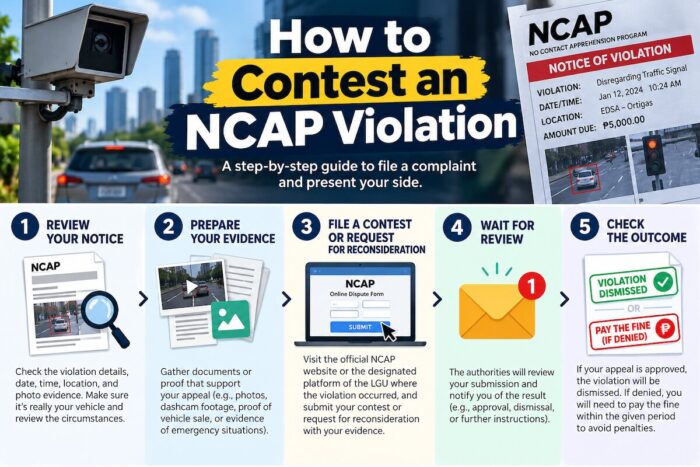
How to Contest an NCAP Violation
The right approach is to identify the issuing authority, verify the notice through official channels, gather supporting evidence, and follow the protest procedure for your specific city and violation. Deadlines, payment arrangements, online services, and administrative processes may differ.
The legal situation also changed in 2026. On June 3, 2026, the Supreme Court dismissed consolidated petitions challenging NCAP ordinances in several Metro Manila cities. The Court announced the dismissal on July 9, 2026, explaining that the petitions became moot after the adoption of the Metro Manila Traffic Code of 2023, among other procedural grounds. Quezon City subsequently announced that it would resume NCAP implementation on October 5, 2026. These developments make it important to check the current rules rather than rely on older articles about NCAP’s suspension.
This guide explains how Filipino motorists can verify and contest an NCAP notice, prepare an evidence package, handle ownership disputes, and follow up on a protest. It distinguishes national court rulings from city-specific procedures. Always confirm the latest requirements with the office that issued your notice before acting.
1. What Is an NCAP Violation?
The No Contact Apprehension Policy uses cameras and other traffic enforcement technology to record alleged traffic violations without requiring a traffic enforcer to stop the driver at the scene. Depending on the local program and applicable traffic rules, the system may record violations such as disregarding traffic signals, illegal turns, stopping in prohibited areas, or other regulated road behavior.
The system can generate a Notice of Violation (NOV) linked to the vehicle’s registration details. The registered owner may receive the notice even if another person was driving.
An NOV is a notice of an alleged violation. Review the specific allegation, date, time, location, vehicle details, evidence, and instructions before deciding whether to pay or protest.
NCAP is different from other traffic citations
Do not assume every traffic notice is an NCAP case. It may instead be an ordinary citation issued by a traffic enforcer, a local ordinance violation receipt, a citation issued under the Metro Manila Single Ticketing System, or a matter involving the Land Transportation Office (LTO).
Identify the issuing authority from the notice itself. That authority generally determines where you must verify the record, which rules apply, and how to challenge the citation. A procedure for contesting an ordinary citation may not be the same as the procedure for protesting an NCAP notice.
2. What Is the Legal Status of NCAP in October 2026?
The legal status must be read alongside the latest court decision and individual local governments’ actions.
Key developments and their practical meaning
| Date | Development | Practical meaning |
|---|---|---|
| 2022 | The Supreme Court issued a temporary restraining order affecting implementation of NCAP in Metro Manila. | Motorists should not rely on the historical suspension as proof that every city still has the same status. |
| June 3, 2026 | The Supreme Court decided the consolidated petitions in KAPIT and others v. City of Manila, Quezon City, Valenzuela City, Parañaque City, Muntinlupa City, and LTO, G.R. Nos. 261892, 262192, and 263752. | Read the actual decision to understand the Court’s disposition and the legal issues it addressed. |
| July 9, 2026 | The Supreme Court announced that it had dismissed the consolidated petitions. | The dismissal rested on mootness and additional procedural grounds, including standing, exhaustion of administrative remedies, the hierarchy of courts, and forum-shopping. It should not be described as a blanket ruling that every NCAP ordinance in the country is automatically valid in every respect. |
| September 30, 2026 | Quezon City announced it will resume NCAP implementation. | Motorists should check the city’s current system and guidance for violations within its jurisdiction. |
| October 5, 2026 | Quezon City’s announced reimplementation date. | The city has published instructions on how to check and protest NCAP violations. |
Sources: Supreme Court announcement and decision, plus the Quezon City Government’s reimplementation notice.
Does the Supreme Court decision mean you cannot challenge an NCAP notice?
No. The dismissal of the consolidated petitions does not mean that every individual notice is factually correct or immune from administrative review. A motorist may still have grounds to dispute a wrong plate number, incorrect vehicle identification, a duplicate notice, missing or unclear evidence, or an error in the recorded circumstances.
However, an individual protest is different from a broad legal challenge to a city’s ordinance or the legal authority for its enforcement program. The Supreme Court’s stated procedural grounds also underscore the importance of following available administrative procedures and obtaining a clear decision before considering further legal remedies.
If your argument concerns the constitutionality of an ordinance, a local government’s authority to impose a particular penalty, or another complex legal issue, consult a Philippine lawyer. Do not assume that a successful factual protest automatically resolves a broader legal question.
3. How to Verify an NCAP Notice Before Filing a Protest
Start with the notice itself. Do not pay or file a protest based only on an unfamiliar text message, an incomplete screenshot, or a third-party website. Use the official channel of the issuing city or agency.
Step 1: Identify the issuing authority
Look for the following details on your notice:
- City or agency that issued the notice.
- Notice of Violation number or ticket reference.
- Vehicle plate number and, if provided, motor vehicle file number.
- Alleged violation, location, date, and time.
- The fine amount, if stated.
- Instructions for verification, payment, and protest.
- Deadline and contact details for the office handling the case.
If the notice refers to a national road or a traffic enforcement system administered by another authority, confirm which office owns the record. For example, Quezon City’s published instructions distinguish its NCAP violations from violations on national roads.
Step 2: Open the official verification portal
Type the city government address or official portal into your browser, or access it through the city’s main website. Do not rely on a search advertisement or a link forwarded by an unknown sender.
For Quezon City, the government directs motorists to its official NCAP portal at nocontact.quezoncity.gov.ph. The city’s published instructions say motorists can search using the motor vehicle file number or NOV number together with the plate number.
For Valenzuela, use the official Valenzuela NCAP portal. Its published website identifies the Valenzuela Public Order and Safety Office as the program contact.
If your notice came from Manila or Makati, use that city’s official website to locate the office currently handling the specific notice. Do not assume another city’s portal can verify it.
Step 3: Compare the online record with the notice
Check each item carefully:
- Does the plate number match your vehicle?
- Do the vehicle make, model, color, and other identifying information match?
- Does the date and time match the allegation?
- Is the location specific enough to identify the road, intersection, or traffic control?
- Does the image appear to show your vehicle and the alleged act?
- Is the alleged violation consistent with the image and the circumstances?
- Is this a duplicate of another notice for the same event?
Save a copy of the notice and the online record. If the portal allows you to view or download photographs, video, or other evidence, preserve the available files. Record the date when you accessed the record.
Step 4: Contact the issuing office if the record is missing or inconsistent
A missing record does not automatically prove that the notice is invalid. The system may have a search issue, the notice may not yet be available online, or you may be using the wrong reference number.
Contact the office shown on the notice or on the official city website. Explain the discrepancy and ask for instructions on obtaining the full record. Ask for a reference number for your inquiry, if available.
Step 5: Verify the fine and deadline separately
Do not assume every city imposes the same fine or allows the same time to pay or protest. Compare the amount against the applicable city ordinance, official penalty schedule, and instructions for your particular notice.
Important: Keep the verification step separate from the decision to pay. If you intend to contest the violation, confirm the deadline and whether the city’s process requires a protest before payment. Ask the issuing office for written guidance when the notice does not clearly explain the procedure.
4. Where to Contest an NCAP Violation: City-by-City Comparison
The issuing city matters. The following comparison identifies official resources and the level of procedural detail that this guide can verify from the sources available. If a city has not published a clearly verifiable current process in the sources reviewed, confirm the details directly rather than relying on an assumed deadline or address.
| City or authority | Official resource | What motorists should do |
|---|---|---|
| Quezon City | NCAP portal and official verification and payment guide | Search using the required vehicle and notice identifiers. The city publishes online protest instructions and an in-person process through the Quezon City Traffic Adjudication Board. |
| Manila | Manila City Government | Verify which city office handles the notice, get the current protest instructions, and ask about accepted submission methods and the deadline. Do not apply another city’s deadline automatically. |
| Makati | Makati City Government | Confirm the issuing office and current status of the particular NCAP notice. Ask for the applicable protest form, evidence requirements, and rules for submitting from outside Makati. |
| Valenzuela | Valenzuela NCAP portal | Verify the notice through the official portal and use the contact details published there to confirm how to protest and submit supporting records. |
| Other Metro Manila LGUs | The relevant city or municipality’s official website | Identify the authority that issued the notice. Check its current NCAP status, ordinance, appeal procedure, and deadline. |
| MMDA or another issuing agency | MMDA official website | If the notice identifies MMDA or another agency rather than the city, contact that authority and follow the procedure for the actual citation. |
Sources for the Quezon City and Valenzuela resources: official city websites.
Quezon City: Online and in-person protests
Quezon City’s published guide explains how to check NCAP violations and file a protest online. For in-person protests, the guide directs motorists to the Quezon City Traffic Adjudication Board (QCTAB), 2nd Floor, DPOS Building, Quezon City Hall Compound, Diliman, Quezon City. It instructs motorists to present the NOV and the vehicle’s Certificate of Registration (CR), or another document supporting the claim. The guide lists the Traffic and Transport Management Department contact number as (02) 8295-8045. Confirm the current details before travelling.
Valenzuela: Verify directly with the official NCAP portal
Valenzuela’s official NCAP website identifies the Valenzuela Public Order and Safety Office, City External Services Office, MacArthur Highway, Dalandanan, Valenzuela City, as a program contact location. The website lists 02 8295 8043 as its hotline. Confirm whether that office handles your specific protest and whether you need an appointment or additional documents before visiting.
Manila and Makati: Do not assume a procedure that is not on your notice
For Manila and Makati, use the official city websites to identify the office responsible for the exact citation. Ask for the current NCAP protest procedure, filing deadline, required documents, and available online or in-person options. Request the current written instructions if they are not readily available.
This distinction matters because a city website or an earlier NCAP program does not, by itself, establish the current status of every camera enforcement operation or the exact process for contesting every notice. Verify the city-specific details when you act.
5. How to File an NCAP Protest Step by Step
A protest is a formal request for the issuing authority to review an alleged violation. Your objective is to explain precisely what is wrong, support your explanation with evidence, and ask for a specific remedy.
Step 1: Confirm the deadline
Read the notice and the issuing city’s current instructions. Note the date of the alleged violation, date of issuance, date of receipt, and any stated deadline.
Do not assume that every city gives the same number of days. A deadline in an older ordinance, a prior version of a city website, or a guide for ordinary traffic citations may not govern your notice.
If the notice arrived late or you did not receive it when expected, keep the envelope, delivery record, email, or other proof of receipt. Ask the office whether it accepts a late protest or considers delayed receipt. Explain the circumstances factually, and submit the request as soon as possible. Do not assume that delayed receipt automatically cancels the notice.
Step 2: Choose the correct protest channel
Check whether the city accepts:
- An online protest through an official portal.
- An in-person filing at a designated adjudication office.
- A written submission through an officially accepted channel.
Do not assume that sending an email to a general city inbox counts as a formal protest. Confirm the accepted method and keep evidence that you used it correctly.
Step 3: State the exact reason for your protest
Avoid a vague statement such as “I disagree with this fine.” Identify the notice number, the alleged violation, and the factual or procedural issue.
Examples include:
- The plate number in the image does not match your vehicle.
- The image does not clearly show the alleged violation.
- The notice identifies the wrong location or time.
- The record appears to duplicate another notice for the same event.
- The vehicle had already been sold or was reported stolen at the relevant time.
- Road signs or markings at the location appear inconsistent with the allegation.
State only what you can support. If you are unsure about a detail, say so and request the relevant record.
Step 4: Attach supporting evidence
Organize your documents so the reviewer can quickly see the connection between the evidence and your claim. Use clear filenames and label each attachment.
For example:
-
01_NCAP_Notice.pdf -
02_Vehicle_CR.pdf -
03_Camera_Image_Discrepancy.jpg -
04_Dated_Road_Sign_Photos.jpg -
05_Deed_of_Sale.pdf
Keep the original files. Do not crop, edit, or annotate your only copy of an image. If you need to highlight an area for clarity, preserve an untouched original and submit the annotated copy separately.
Step 5: Ask for a specific remedy
Your request should be clear. Depending on the facts and the city’s rules, you may request:
- Review of the alleged violation.
- Correction of inaccurate vehicle or notice details.
- Access to available supporting images or records.
- Cancellation of a notice that the authority determines was issued in error.
- Reconsideration of an earlier decision, if the rules permit it.
Do not demand a result as if it were automatic. The issuing authority must assess the evidence and applicable rules.
Step 6: Keep proof of submission
Save the online confirmation screen, reference number, acknowledgment email, date-stamped copy, or official receiving receipt. If you submit paper documents, keep a complete copy of everything filed.
A protest is harder to follow up if you cannot prove what you submitted and when. Record the name or office of the person who received the documents, where available, and the next stated step in the process.
Step 7: Follow up and ask for the result in writing
If you receive no response within the period stated by the city, contact the office using the protest reference number. Ask whether the filing is complete, whether you need to provide more evidence, and when you should expect a decision.
If the protest is rejected, ask for the written decision and the reasons for rejection. Check whether the city provides reconsideration or another administrative review. Do not assume you can automatically appeal a rejected protest to any office you choose.
6. What Evidence Can Help You Contest an NCAP Violation?
The strongest protest connects a specific factual claim to relevant evidence. A long explanation without supporting records may be less persuasive than a short, well-organized submission.
Essential documents
Prepare the following, as applicable:
- Copy of the NOV and any related notices.
- Vehicle Certificate of Registration (CR) and other vehicle records relevant to the dispute.
- Government-issued identification if the city requires it.
- Photographs, video, or other records supporting your explanation.
- Deed of sale or transfer documents if ownership changed.
- Police report or incident record if the vehicle was stolen.
- Authorization and company documents for a company-owned vehicle, where required.
- Proof of submission and correspondence relating to any earlier protest.
Check the issuing city’s requirements before filing. Do not submit sensitive or unrelated documents unless they are required or materially support your claim.
Requesting camera footage or other records
If the notice contains only a still image, ask whether additional images, video, timestamps, camera information, or other records are available for review. Describe the notice precisely so the office can locate the record.
Your request can include:
- NOV or ticket number.
- Plate number and vehicle details.
- Alleged violation, date, time, and location.
- A short explanation of why the record is needed.
- A request for the relevant image, video, or other available supporting record.
- Your preferred official method of receiving the response, if options are available.
Do not assume that every camera records continuous video or that every record can be released in the format you request. Ask the issuing authority what it retains and what it can provide under its procedures. Keep a copy of your request and any response.
If the office says a record is unavailable, ask for a written explanation and what other evidence is available for review. Explain how the missing record affects your ability to respond to the allegation. Whether this affects the outcome depends on the applicable rules and the facts of the case.
7. Common Grounds for Contesting an NCAP Notice
A protest should focus on a specific error, not simply that a camera issued the notice.
Incorrect plate number or vehicle identification
Compare the image with your vehicle’s actual plate number, make, model, body type, and distinguishing features. If the image shows a different vehicle, submit your CR and a clear photograph of your vehicle. Point out the precise mismatch.
A similar plate number or a poorly readable image may warrant review, but do not assume that a minor visual difference automatically proves an error. Ask the issuing office to check the original image and associated record.
Unclear or incomplete evidence
If the image does not clearly show the vehicle, location, traffic signal, road marking, or alleged act, identify what cannot be verified. Request the original or any additional available images, and explain why the evidence does not establish the event as described.
A blurry image does not automatically invalidate a notice. The question is whether the available evidence and applicable rules adequately support the allegation.
Wrong location, date, or timestamp
Compare the notice details with your records, such as parking receipts, work logs, trip records, dashcam footage, or other reliable evidence. If the location appears incorrect, explain the discrepancy and ask the authority to verify the original record.
Do not rely on memory alone when more precise records are available. Preserve original files and their metadata where possible.
Incorrect or missing road signs and markings
If your protest concerns signage or road markings, take clear photographs from the driver’s approach and from a wider angle showing the road layout. Record the date and location. Include images of relevant signs, lane markings, obstructions, or roadworks.
Explain how the condition relates to the alleged violation. For example, identify an obscured sign or a marking that was difficult to distinguish. A photograph taken after the event may not prove the exact conditions at the time of the violation, so explain any limits and provide other supporting records if available.
Duplicate notices
Compare the reference numbers, dates, times, locations, and evidence for both notices. If they appear to concern the same event, submit copies of both and ask the authority to determine whether one was issued in error.
Two notices that look similar are not necessarily duplicates. Different violations or separate events may produce separate records. State why you believe the notices refer to the same incident and request a review of the underlying records.
Traffic-enforcement or camera-record errors
If you believe the camera record misidentified the vehicle or captured the wrong event, state exactly what is inconsistent. Request any available supporting images and relevant records. Do not claim that a camera was defective simply because you disagree with the result. Technical problems, camera placement, and the legal adequacy of a record require evidence and may need specialist or legal advice.
8. When Someone Else Was Driving Your Vehicle
An NCAP notice may be sent to the registered owner even if someone else drove the vehicle. The procedure for disputing a notice depends on the applicable ordinance and the city’s rules.
Borrowed vehicle or family member driving
If you lent your vehicle to a family member, friend, or employee, determine who was using it at the recorded time. Check trip records, messages, work schedules, parking receipts, or other relevant documents.
Do not submit a statement that someone else was driving unless you have a reasonable factual basis for it. Ask the city whether it requires a driver declaration, an authorization, or other documents. A different driver does not necessarily mean that the registered owner has no responsibility under the applicable rules.
Company-owned vehicle
A company should designate an authorized representative to handle the protest. Gather the notice, CR, relevant company vehicle records, and documents showing the representative’s authority. A fleet log, dispatch record, trip sheet, or driver assignment may help establish who had the vehicle.
Keep the company’s records consistent and factual. Confirm whether the city requires corporate documents, a letter of authorization, or an affidavit.
Vehicle already sold
If you sold the vehicle before the alleged violation, gather:
- Deed of sale or other transfer document.
- Proof of the date you handed over the vehicle.
- Relevant LTO records or transfer documentation, if available.
- Copies of communications with the buyer that establish the transaction.
- The NOV and a concise written explanation.
Explain the date of sale and why it matters to the recorded violation. Ask the issuing office to review the ownership details and advise what additional proof it requires. Do not assume a deed of sale alone automatically removes all responsibility for registration or the notice.
Vehicle stolen or used without authorization
If the vehicle was stolen, use the police report and other records that establish the incident and relevant dates. If someone used the vehicle without authorization, provide reliable records that support the circumstances, if available.
A police report is useful evidence, but it does not guarantee cancellation. Explain how the incident relates to the recorded time and ask the issuing authority to assess the notice in light of the documents.
Registered owner deceased
A family member or authorized representative should contact the issuing office and ask who may submit the protest on behalf of the deceased owner or the estate. The city may require a death certificate, proof of relationship or authority, vehicle documents, and other records. Requirements may differ, so obtain the current list before filing.
9. What If You Already Paid the NCAP Fine?
Payment and a protest are different actions, and their relationship depends on the city’s rules and the case’s circumstances. Do not assume payment always prevents correction, or that it automatically preserves your right to challenge the notice.
If you paid and later discovered a clear error, gather the NOV, proof of payment, official receipt, evidence of the error, and any relevant correspondence. Ask the issuing authority whether it permits correction, reconsideration, cancellation, or a refund in that situation. Request written instructions about the process and any deadline.
Keep the payment confirmation and receipt even if you intend to contest the notice. If the office approves a correction or refund, retain its written decision and any transaction reference. Do not rely on an informal assurance that the amount will be returned without confirming the procedure.
10. What Happens If You Miss the Protest Deadline?
First, check the deadline printed on the notice and the issuing authority’s current rules. Some circumstances may allow a late protest, but do not assume every city permits an extension or that a delayed notice automatically invalidates the case.
If you missed the deadline because the notice arrived late, was sent to an outdated address, or you did not receive it, explain the circumstances and provide supporting records. Ask whether the city accepts a request for late filing or reconsideration and what documents it requires.
Submit your request promptly. Keep proof of when you received the notice and when you contacted the office. If the city rejects the request, ask for the decision in writing and confirm whether any further administrative remedy is available.
If a deadline is imminent or the consequences are significant, seek legal advice. Do not wait for an informal inquiry to be answered before checking the formal filing requirements.
11. What If the City Rejects Your Protest?
Read the decision carefully. Identify the reason for rejection and compare it with the evidence you submitted.
Take these steps:
- Request the written decision. If the office communicated only the outcome verbally or through a status update, ask for a copy of the decision and the reasons.
- Check the rules for reconsideration. Ask whether the issuing authority allows a motion for reconsideration, a second administrative review, or another prescribed remedy.
- Identify the remaining issue. Determine whether the rejection concerns missing documents, a factual disagreement, an expired deadline, or a legal question.
- Prepare a focused response. If the rules permit another submission, address the stated reason for rejection and attach relevant additional evidence.
- Consult a lawyer when necessary. If you want to challenge the legal authority for the penalty, raise a constitutional issue, or consider court action, obtain advice from a Philippine lawyer familiar with local traffic regulations and administrative remedies.
The proper next step depends on the city ordinance, the decision issued, the available remedies, and applicable procedural rules. Do not assume that the LTO, MMDA, or another city automatically acts as an appellate authority for every NCAP protest.
The Supreme Court’s 2026 decision specifically identified exhaustion of administrative remedies as a ground relevant to dismissing the consolidated petitions. That makes it especially important to document the steps you took and obtain the issuing authority’s response before considering broader legal action.
12. How to Check NCAP Fines and Payment Deadlines
NCAP fines are not automatically uniform across all cities and all types of violations. The amount may depend on the local ordinance, the specific offense, and the rules governing the notice.
Before paying, compare the stated amount with the official penalty schedule. If the amount is unclear, ask the issuing authority to identify the applicable ordinance provision and penalty. Save the response for your records.
Quezon City’s published ordinance materials contain provisions on NCAP penalties and payment periods. However, an older ordinance provision should not be treated as a universal deadline for every current notice or city. Verify the current rule that applies to your citation.
For a reliable check, use this sequence:
- Identify the exact violation cited.
- Locate the relevant ordinance or official penalty schedule.
- Confirm whether the notice refers to a city program or another enforcement authority.
- Ask whether any surcharge, additional charge, or separate procedure applies.
- Confirm the payment deadline and protest deadline independently.
- Keep the official receipt if you pay.
Do not rely on a fine amount copied from a social media post or an old news article. If you intend to contest the notice, ask the city whether payment is required before, during, or after the protest process and what effect payment has on any further review.
13. A Practical Timeline After Receiving an NCAP Notice
Use this timeline as a working plan, not as a replacement for the deadline in your notice or the issuing city’s official procedure.
Day 1
Verify the notice
Identify the issuing authority, record the notice number, confirm the vehicle details, and save a copy of the available evidence.
Days 2-3
Gather supporting records
Collect the CR, dated photographs, transaction records, ownership documents, or other evidence relevant to your claim. Request additional camera records if necessary.
Before deadline
File the protest correctly
Follow the accepted submission method, attach your evidence, state the remedy you seek, and keep proof of timely filing.
After filing
Monitor and follow up
Record the reference number, check for requests for additional documents, and ask for the decision in writing. If rejected, verify the next available remedy.
If you receive a notice late, contact the issuing authority immediately and ask whether it accepts a late protest. If the office requires an in-person appearance, confirm the location, office hours, documents, and whether someone may appear on your behalf.
14. Worked Example: Challenging a Notice With the Wrong Vehicle Details
Suppose a motorist receives an NCAP notice alleging an illegal turn. The image shows a dark sedan, but the motorist’s registered vehicle is a white hatchback. The plate number in the image is partly obscured, and the notice does not clearly show the alleged turn.
The motorist should avoid assuming the notice is invalid simply because the vehicle looks different. Instead, they can prepare a focused evidence package.
Sample evidence package
- A copy of the notice showing the NOV number and alleged violation.
- A copy of the vehicle’s CR.
- Clear photographs of the registered vehicle, including its plate and distinguishing features.
- A copy of the camera image supplied with the notice.
- A short written comparison identifying the visible differences.
- A request for the original or additional available camera images.
- Proof of submission and any correspondence with the issuing office.
Sample protest outline
The protest should identify the notice, explain the mismatch, refer to each attachment, and request review of the original record. It should avoid accusations or unsupported claims about camera malfunction.
The motorist submits the protest using the city’s official procedure and saves the acknowledgment. If the city requests more information, the motorist responds within the period the office sets. If the protest is denied, the motorist requests the written reasons and checks whether reconsideration is available.
This example illustrates a practical process, not a guaranteed result. The issuing authority must assess the complete record and the applicable rules.
15. Short Sample NCAP Protest Letter
Use this as a starting point. Replace the placeholders with accurate details and check whether the city requires its own form.
Subject: Protest of NCAP Notice of Violation No. [NOV Number]
To the Appropriate Traffic Adjudication Office:
I am writing to formally contest Notice of Violation No. [NOV Number], issued for the alleged [type of violation] on [date] at [location], involving vehicle plate number [plate number].
I respectfully request a review because [briefly state the specific factual error or reason for contesting the notice]. The supporting documents attached to this protest include [list the relevant documents, photographs, or other records].
I also request access to any additional available camera images or records relevant to the alleged violation, if these are not already included in the notice.
Based on the information submitted, I respectfully request that your office review the record and determine whether the notice should be corrected or cancelled under the applicable rules. Please acknowledge receipt of this protest and advise me of any additional requirements or the next step in the process.
Thank you.
Respectfully,
[Full Name]
[Contact Information]
[Date]
16. Common Mistakes to Avoid When Contesting an NCAP Violation
| Common mistake | How to avoid it |
|---|---|
| Ignoring the notice because of older reports about NCAP suspension | Verify the current status and instructions with the issuing authority. |
| Using an unofficial website to check a notice | Reach the portal through the official city or agency website. |
| Missing the deadline while gathering evidence | Check the deadline first and ask about the accepted procedure for requesting additional records. |
| Filing with the wrong office | Confirm the authority named on the notice and the office responsible for protests. |
| Submitting only a general denial | Identify the exact error and connect it to specific evidence. |
| Sending unclear or incomplete documents | Use legible copies, label attachments, and keep the original files. |
| Assuming someone else’s use of the vehicle automatically cancels the notice | Gather relevant driver, ownership, and trip records, then follow the city’s requirements. |
| Relying on a deed of sale without explaining the timeline | Include the transfer date, proof of turnover, relevant registration records, and a clear explanation. |
| Treating two similar notices as automatic duplicates | Compare dates, times, locations, and records, then request a review of both references. |
| Assuming all cities have identical fines and procedures | Verify the ordinance, penalty schedule, protest method, and deadlines for the issuing authority. |
| Paying without retaining proof | Save the official receipt, payment reference, notice, and correspondence. |
| Failing to preserve submission records | Keep confirmation screens, emails, receiving stamps, and protest reference numbers. |
| Assuming a rejected protest ends every possible remedy | Request written reasons and check the applicable reconsideration or legal options. |
| Making unsupported claims about defective cameras or unlawful enforcement | Focus on verifiable discrepancies and seek legal advice for complex legal challenges. |
| Waiting indefinitely for a response | Follow up using your reference number and ask for the status and next step in writing. |
17. Concise Glossary of NCAP Terms
- NCAP: No Contact Apprehension Policy, a system that uses traffic enforcement technology to record alleged violations without stopping the driver at the scene.
- NOV: Notice of Violation, the notice identifying an alleged traffic offense.
- CR: Certificate of Registration, a vehicle registration document.
- LTO: Land Transportation Office, the national agency responsible for vehicle registration and driver licensing functions.
- LGU: Local government unit, such as a city or municipality.
- MMDA: Metropolitan Manila Development Authority, which performs regional functions in Metro Manila, including traffic-related responsibilities.
- Traffic adjudication: The administrative process for reviewing and deciding a contested traffic citation.
- Reconsideration: A request asking the same authority or decision-maker to review a decision again, if the rules permit it.
- Exhaustion of administrative remedies: The general principle that a party should use applicable administrative procedures before pursuing certain court remedies, subject to recognized exceptions.
- Temporary restraining order (TRO): A court order that provides temporary relief under applicable legal rules. Its scope and effect depend on the specific order.
18. Frequently Asked Questions About Contesting an NCAP Violation
1. Can I contest an NCAP violation in the Philippines?
Yes. If you believe a notice contains an error or the evidence does not support the alleged violation, check the issuing authority’s protest procedure. Gather the NOV, vehicle records, and supporting evidence, then submit your protest through the accepted channel. The availability of a protest does not guarantee cancellation. You must identify a specific issue and follow the applicable deadline and requirements. Keep proof of filing and request a written decision.
2. Is NCAP still suspended in the Philippines in October 2026?
You should not assume that NCAP remains suspended nationwide. The Supreme Court dismissed consolidated petitions challenging NCAP ordinances in Metro Manila in a decision dated June 3, 2026, announced on July 9, 2026. Quezon City later announced that implementation would resume on October 5, 2026. These developments do not establish the current status of every city’s program. Check the latest official notice from the city or agency named on your citation before taking action.
3. What is the deadline for filing an NCAP protest?
There is no single deadline that automatically applies to every NCAP notice in the Philippines. The relevant period depends on the applicable rules and the issuing authority’s current procedure. Read the notice, check the official city instructions, and contact the responsible office if the deadline is unclear. If the notice arrived late or you received it after the stated period, keep proof of receipt and ask whether they will consider a late protest.
4. Can I contest an NCAP violation online?
Some cities offer online services to check notices and submit protests. For example, Quezon City offers an online process to verify and protest NCAP violations. Other cities may have different platforms or may require additional steps. Start from the official city website, confirm that the portal handles your specific notice, and follow its instructions. Save the confirmation screen or reference number. Do not assume that an email or online inquiry counts as a formal protest.
5. What documents do I need to contest an NCAP notice?
Start with a copy of the notice and your vehicle’s CR. Add evidence that supports your specific claim, such as clear vehicle photographs, dated road-sign images, relevant trip records, a deed of sale, or a police report. The exact documents depend on the issue and the city’s requirements. Ask the issuing office whether it requires a particular form, identification, authorization, or additional supporting records. Keep complete copies of every document you submit and proof of submission.
6. What if the NCAP camera captured the wrong plate number?
Compare the plate in the notice image with your vehicle’s plate and registration details. If the image shows a different vehicle or an unreadable plate, identify the discrepancy in writing and attach your CR and clear photographs of your vehicle. Request a review of the original image and any additional records you have. A visual mismatch may justify further review, but it does not automatically cancel the notice. The issuing authority must assess the evidence and apply the rules governing the notice.
7. Can I contest an NCAP violation if someone else was driving?
You may raise the circumstances if someone else was driving your vehicle, but do not assume this automatically removes the registered owner’s responsibility. Gather reliable records showing who used the vehicle, such as trip logs, dispatch documents, or relevant communications. Explain the facts and ask the issuing authority what declaration or supporting documents it requires. The result depends on the applicable ordinance and procedure. Avoid submitting an unsupported statement about who was driving.
8. What if I sold the vehicle before the violation occurred?
Gather your deed of sale, proof of the turnover date, relevant LTO records, and any other documents establishing the transaction. Compare the sale and turnover dates with the alleged violation date. File a protest explaining the timeline and ask the issuing office to review the ownership information. A deed of sale may support your claim, but it does not automatically resolve every registration or liability issue. Confirm the city’s requirements and retain proof of your submission.
9. Can I request the camera footage used for an NCAP notice?
You can ask the issuing authority whether additional images, video, timestamps, or other records relating to the notice are available. Include the NOV number, plate number, date, time, and location so the office can identify the event. Ask how to access the records and whether you need a specific request form. Do not assume continuous video exists or that every record can be released. Keep the request and the authority’s response in your evidence file.
10. What if the road signs or markings were unclear?
Photograph the relevant road signs, lane markings, intersection, and surrounding layout. Include the location and date of your photographs, and explain how the condition relates to the alleged violation. If possible, provide other records that help establish the conditions when the incident occurred. Later photographs may not prove what the road looked like at the time of the alleged offense. Ask the issuing authority to review the available record and avoid claiming that unclear signage automatically cancels the notice.
11. Can I contest a duplicate NCAP notice?
If two notices appear to concern the same incident, compare their reference numbers, dates, times, locations, and images. Submit copies of both notices and explain why you believe they refer to the same event. Ask the issuing office to review the underlying records and determine whether it issued a duplicate. Similar-looking notices are not necessarily duplicates because they may involve separate events or different violations. Keep the acknowledgment and any written decision so you can follow up if the records are not corrected.
12. What happens if I miss the deadline because the notice arrived late?
Contact the issuing authority promptly and ask whether it accepts a late protest or request for reconsideration. Keep the envelope, delivery information, or other evidence showing when you actually received the notice. Explain why you could not file earlier and submit the request using the city’s accepted procedure. Delayed receipt does not automatically invalidate a notice or guarantee an extension. If the office rejects your request, ask for the written reason and check whether any further remedy is available.
13. Can I contest an NCAP violation after paying the fine?
That depends on the issuing authority’s rules and how you paid. If you discover a factual error after paying, retain the notice, official receipt, payment reference, and supporting evidence. Ask the city whether it offers correction, reconsideration, cancellation, or a refund, and whether a deadline applies. Do not assume that payment always prevents review, but do not assume it preserves every remedy either. Request written instructions and keep any decision about a correction or refund.
14. What should I do if the city rejects my NCAP protest?
Ask for the written decision and the reasons for rejection. Review whether the authority identified missing evidence, an expired deadline, or another reason that you can address. Then check whether the city’s rules permit reconsideration or another administrative review. If your concern involves a legal challenge to an ordinance or you are considering court action, consult a Philippine lawyer. The correct next step depends on the governing rules, the decision, and the remedies available for your case.
15. Do I need a lawyer to contest an NCAP violation?
Many straightforward factual disputes can begin with a clear written protest and relevant documents, provided the motorist follows the city’s procedure. A lawyer may be useful if the case involves a complex ownership dispute, significant procedural questions, a rejected protest with limited further remedies, or a challenge to the legal authority for the penalty. The Supreme Court’s 2026 decision makes it especially important to understand administrative remedies and procedural requirements. Seek legal advice when you are unsure which remedy applies or when a deadline could affect your rights.
19. Official Sources and References
Use these official sources to verify the current legal position, city procedures, and contact details. Online instructions can change, so check the relevant page again before submitting a protest.
- Supreme Court of the Philippines: SC Dismisses Petitions Against NCAP. The Court’s July 9, 2026 announcement explains the dismissal of the consolidated petitions and its stated grounds.
- Supreme Court decision: KAPIT and others v. City of Manila, Quezon City, Valenzuela City, Parañaque City, Muntinlupa City, and LTO. Read the decision for the full legal reasoning and procedural context.
- Supreme Court E-Library: Full decision and NCAP-related legal materials. Useful for reviewing the decision’s discussion of the relevant city ordinances and enforcement provisions.
- Quezon City Government: How to Verify and Pay for QC NCAP Violations. Provides official verification, payment, and protest instructions.
- Quezon City Government: NCAP Reimplementation, October 5, 2026. Provides the city’s announcement concerning the resumption of NCAP.
- Valenzuela City: Official NCAP portal. Use this portal to check the city’s current program information and contact details.
- Manila City Government: Official website
- Makati City Government: Official website
- Metropolitan Manila Development Authority: Official website
- Land Transportation Office: Official website
For Manila, Makati, and other cities, verify the program’s current status and the specific protest procedure directly with the authority named in the notice. The availability of a general government website does not, by itself, establish a particular NCAP deadline or appeal process.
Legal note: This guide provides general information, not individualized legal advice. It reflects official sources reviewed as of October 12, 2026. City procedures, deadlines, fines, and enforcement arrangements may change. Confirm the applicable ordinance and current instructions with the issuing authority. For a constitutional challenge, a disputed legal interpretation, or a court case, consult a qualified Philippine lawyer.
Follow #TeamOutofTown on Facebook, Twitter, Instagram, Bloglovin, and Pinterest for more travel ideas.
Also read:
- How to Apply for RFID Sticker for SLEX, NLEX, CAVITEX, Etc. (EasyTrip & Autosweep)
- How to Renew Your Motorcycle Registration in the Philippines
- Updated LTO Student Permit Requirements and Procedure 2023
- A Complete Guide to Driver’s License Renewal in the Philippines
- NCAP Cameras in Metro Manila Cities: What Motorists Need to Know
- 10 Things Metro Manila Drivers Should Know About NCAP
- How to Spot NCAP Scams and Fake Text Messages
- 10 Traffic Violations That Can Get You an NCAP Ticket