Melo Villareal
Manaslu Circuit Trekking in Nepal Himalayas
Good News Adventure Seekers! Manaslu Circuit is finally open! Considered a great alternative to the Annapurna Circuit because it is less crowded but with epic scenery and equally spectacular trails. Discover Hindu and Buddhist culture, Nepal’s protected wildlife, rhododendrons and wild flowers, raging rivers, precarious bridges, and stunning mountain scenery by joining this trek.

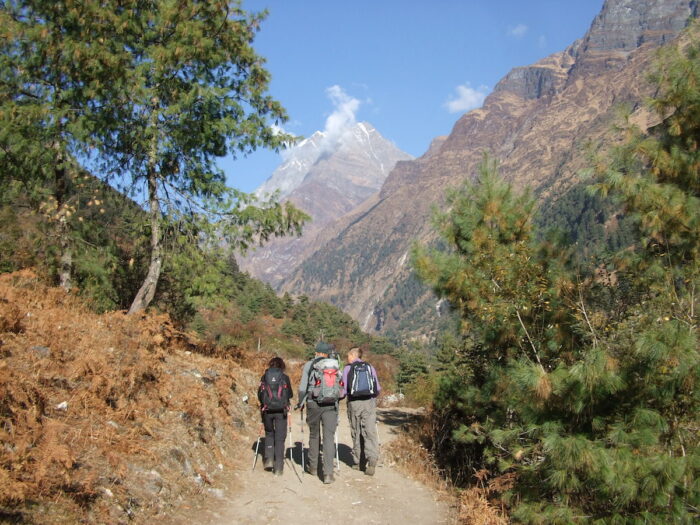
Hiker on the trek in the Himalayas, Manaslu region, Nepal
Trip Profile:
- Trek route: Gorkha to Larkya la pass to Khudi
- Duration: 16 nights / 17 days in total
- Grade: Moderate to Adventurous
- Max. Elevation: (5,135m/1,843ft) at Larkya-La pass
- Trek style: Teahouse basis
- Meal: Full board on trek, breakfast in the city
- Accommodation: Teahouse on trek, hotel in Kathmandu
- Transportation: Private vehicle (Car/4WD)
- Best Months: Sep – Oct & Mar – May
- Group size: Min. 2 pax required for the Manaslu trek
Trip Price:
- US$1,950.00 per person based on 5-star hotels in the city
- US$1,700.00 per person based on tourist standard hotels in the city
Single Supplement: $300.00 and $100.00, respectively.
Manaslu Circuit Trek Introduction:
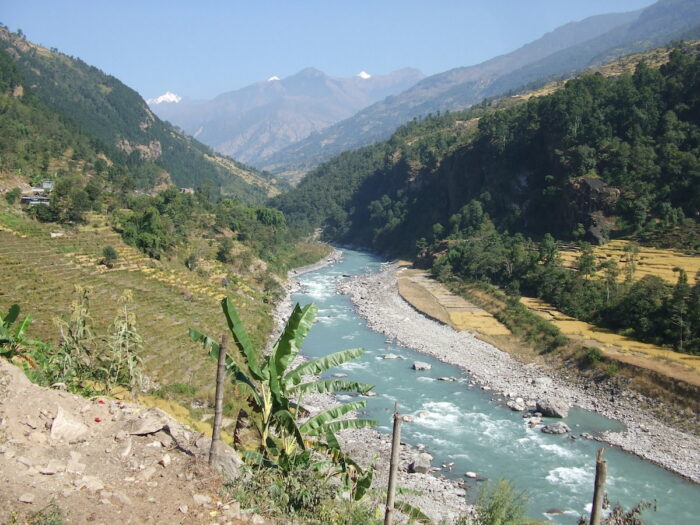
Manaslu circuit trek – the land of secret trail is one of the adventurous treks in the western part of Nepal Himalaya, which is located in Gorkha District with the adjoining plateau of Tibet. This adventure trek begins in the famed ancient Gorkha Kingdom in western Nepal. The trek follows the Budi-Gandaki River upstream from the subtropical forest to the dry Tibetan zone, offering outstanding views of Mt. Manaslu (8,156m), the 8th-highest peak in the world, along with a panoramic view of the surrounding magnificent peaks, including the border with Tibet.
This off-the-beaten-track trek on the Manaslu Circuit continues with encounters with rugged people of Tibetan stock. Visit traditional villages with their flat-roofed timber houses and workshops, and secluded Buddhist monasteries. Enjoy inspiring views of Manaslu. Larkya La Pass marks the divide between Manaslu’s less-traveled western flanks and the Marshyangdi River valley.
From the top of the pass, it is almost downhill through the serene alpine forests and meadows till we come to the main trail of the Annapurna circuit. After being on the main track for a few days, our journey continues towards Besishahar and drives back to Kathmandu. This Manaslu trek with the Larke Pass requires a special permit with a minimum of 2 pax in the trekking group.
Manaslu Circuit Trek Itinerary:
- Day 01: Arrival in Kathmandu
- Day 02: Kathmandu sightseeing & trek preparation
- Day 03: Drive to Arughat
- Day 04: Trek to Lapu Besi
- Day 05: Trek to Dovan
- Day 06: Trek to Philim
- Day 07: Trek to Deng
- Day 08: Trek to Namrung
- Day 09: Trek to Sama Gompa
- Day 10: Acclimatization day at Sama Gompa
- Day 11: Trek to Samdo
- Day 12: Trek to Larkya Guest House
- Day 13: Trek to Larkya La pass to Bimthang
- Day 14: Trek to Dharapani
- Day 15: Drive back to Beshishahar
- Day 16: Drive to Kathmandu
- Day 17: Departure from Kathmandu
Trip Dossier:
Day 01: Arrival day in Kathmandu (1,300m/4,264 ft)
Namaste & welcome to the Himalayan Planet of Nepal. While you landed at the Tribhuvan International Airport. A representative from Himalayan Planet Adventures will welcome you by name and assist with your transfer to your hotel in Kathmandu.
After time to get refreshed, we’ll bring you to the head office and give a briefing about the program, and in the evening we’ll pick you up for a welcome dinner in one of the typical Nepalese restaurants with a cultural program in the heart of Kathmandu, and overnight at the Hotel.
(Welcome dinner & hotel accommodation included)
Day 02: Sightseeing in Kathmandu Valley
After your breakfast, head on for our guided day trip to world heritage sites in Kathmandu valley and visit the highlights of Kathmandu and the surrounding areas. We take you to see the pilgrimage sites of the Hindu temple Pashupatinath, one of the most important shrines of Shiva temples on the subcontinent, which is a place of thousands of devotees, Saddhus (holy men/Baba), and where the cremation of bodies can be seen most of the time on the holy riverbank of Bagmati.
Hundreds of monkeys are giggling with you and taking time to explore the surrounding area and visit the Bouddhanath stupa, another pilgrimage center, the most popular and important place for Buddhists. You can explore with a round prayer wheel and a colorful flag, accompanied by melodious chanting.
After visiting the Bouddhanath stupa, we’ll drive to the City of Devotees (Bhaktapur). This traditional and traffic-free town is the third biggest town in the Valley. We’ll explore the medieval-like squares, courtyards, and temples of this vibrant town.
After a stop for lunch at a restaurant in Bhaktapur, it’s time to drive back to Kathmandu and meet up with your travel consultant & fellows to prepare for the next day and overnight at the hotel. Alternatively, the same group may choose the same 3 sightseeing places within the Kathmandu Valley instead of the designated ones.
(Breakfast, Kathmandu city tour & hotel accommodation included).
Day 03: Kathmandu to Arughat (550m/1,804ft)
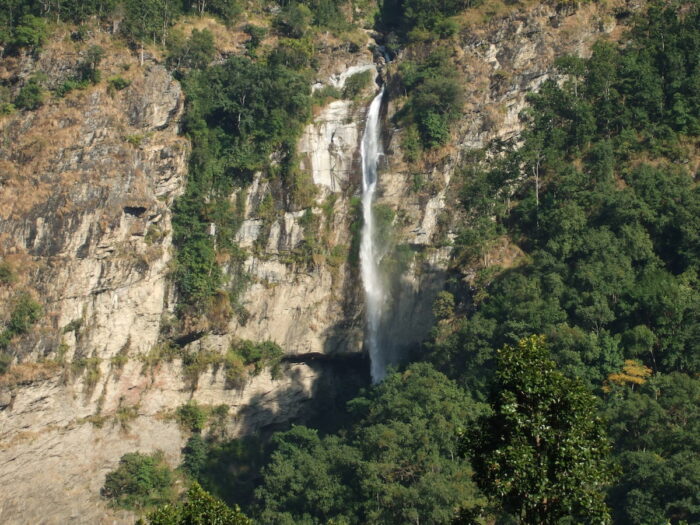
This morning, after breakfast, we’ll begin our journey with a drive through the beautiful river views and Nepalese countryside to reach Arughat, on the footsteps of Manasalu. Arughat Bazzar is clustered on both sides of the River Budi-Gandaki linked by a suspension bridge, this is the largest settlement in the valley and it is also a junction to various important places.
The path from here across the River leads to Dhading & Trisuli Bazaar, and our route from here leads north. We will have time for a visit to the village, a cool splash in the Budi Gandaki River, and overnight at camp.
(Breakfast, lunch, dinner & teahouse accommodation included).
Day 04: Arughat to Lapu Besi (750m/2,461ft)
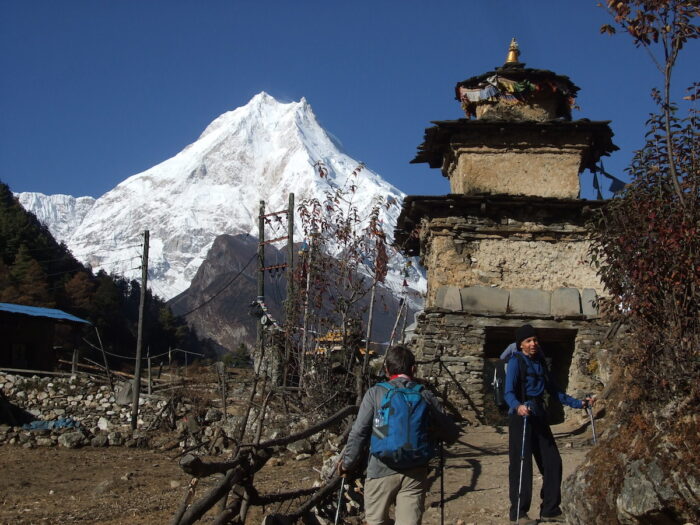
Today, as we continue our journey, we will follow the Budi-Gandaki River upstream. The trail from Arughat is much narrower and passes through more rural farm villages and terraced fields, with numerous streams to cross along the way. The path follows the right bank of Budi Gandaki, passing through cultivated land with many scattered farmhouses and hamlets, eventually reaching the villages of Mordar, Simre, and then Arket.
This lower trail, which sometimes leads to the riverbed, is impassable during the monsoon season. We will climb to Kyoropani, then descend to the river to reach Soti Khola, continuing our walk to Lapu Besi for an overnight stay.
(Breakfast, lunch, dinner & teahouse accommodation included).
Day 05: Lapu Besi to Dovan (890m/2,920ft)
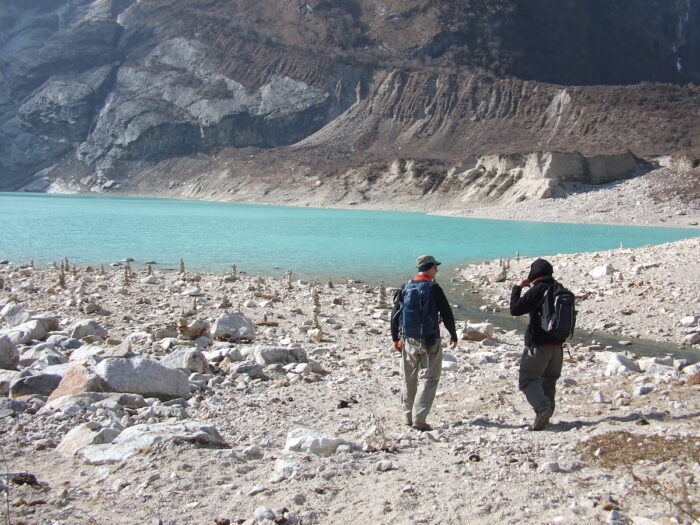
Today, the path from here at times cuts into the steep, densely forested valley, passing through several small villages tucked into the hillside, until we reach a widening of the valley opposite the point where a large tributary stream enters the Burhi Gandaki River. The terraced cultivated fields are located in the upper village of Lapubesi.
From here, our path descends to the vast, sandy riverbed, following a trail that winds along the steep, craggy valley side. We have the last climb to bring you to the nearby villages where there are some teashops, and nearby we’ll stay overnight after a long day, a 7-8 hour walk.
(Breakfast, lunch, dinner & teahouse accommodation included).
Day 06: Dovan to Philim (1,350m/4,429ft)
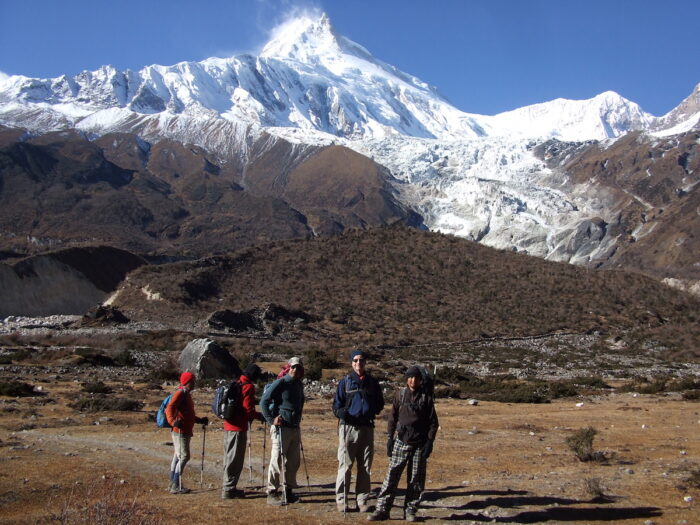
The trail leads to more interesting farm villages and fields as the vegetation changes slowly, after crossing a bridge and heading upstream to the tiny town of Kholabesi and the hot springs at Tatopani. From here, the valley sides become steeper until the path becomes impassable. The route then switches to the left bank of the river by way of a suspension bridge. We have a short section of forest path coming to some teahouses at Doban.
Above Dobhan, the Burigandaki River flows down in an impressive torrent of rapids. Beyond this steep section, the river becomes calmer, meandering across a broad gravel bed. On reaching Lauri, we cross the Vana River on a suspension bridge, from here leading to a climb on a high path, and then descending into an open valley at a place known as Yara Khola.
Here, there are many good camping spots depending upon the length of the walk and the condition of the trail. Our journey continues for another hour (if not camping here) to the village of Philim for overnight, after 6-7 hrs of walking. It is a large village after Arughat with a mixed community.
(Breakfast, lunch, dinner & teahouse accommodation included).
Day 07: Philim to Deng (1,960m/6,430ft)
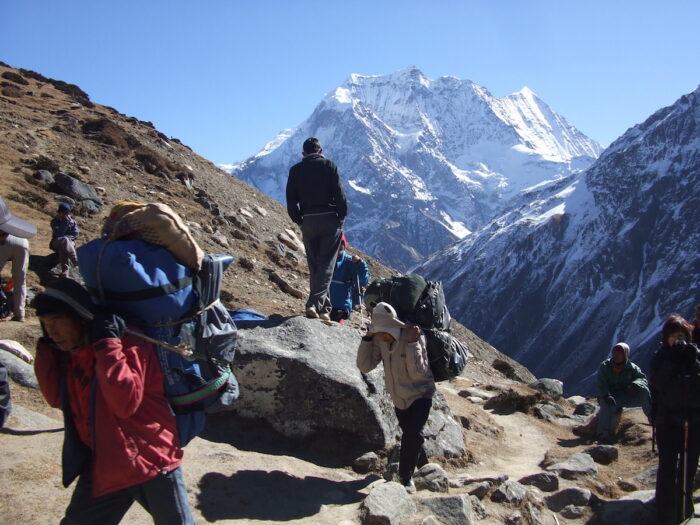
Firstly, the path climbs a terraced hillside to Salleri, overlooking distance view of Sringi Himal 7,187m from this spot, the walk follows ups and down trail as we reach to the bridge over Budi-Gandaki, after crossing the bridge from Ghata-khola, the path winds up towards Philim village.
From here, the trail climbs slowly along the hillside, passing through small settlements of Aga and Lokwa.
After Lokwa, it’s a downhill to camp at a small place, Eklaibhati, near Shiar Khola with great views looking over the valley towards Pangsing. An hour walk after Eklai-bhatti, we cross to the east side of the river.
The path follows up and down in some section the trail is cut into the sheer cliff walls, after this dramatic portion the track finally improves as the walk leads to Deng village for the overnight. This takes a 6-7 hrs walk.
(Breakfast, lunch, dinner & teahouse accommodation included).
Day 08: Deng to Namrung (2,700m/8,858ft)
From Deng onward, the houses and terrain were transformed entirely into more Tibetan-style ones. The people here are of Tibetan origin, along with their ancient culture. Villagers in these areas cultivate buckwheat, wheat, barley, and potatoes as staple crops. Additionally, as trekking has become popular in this area, spinach, carrots, and cabbage are also grown.
After 3-4 hours of walking, we arrive in Bih. Our journey continues for another two hours in this steep-sided and impressive valley, coming across the Mani prayer stone and finally arriving at Ghap village, which straddles the river on a short wooden bridge, for lunch. There is a strong Tibetan influence in this village.
The trekking is pleasantly cool as we begin to gain height and enter the alpine forest. The walk continues steeply up as the valley opens out with quite extensive pastures with a more steady climb, then crossing a large stream flowing down from the Lidana Glacier, with a magnificent view of the snow peaks on the north Kutang Himal range, with Pang Phuchin 6,335m, and Saula Himal 6,235m, and other unnamed peaks of over 6000m.
To the south lie the Manaslu Himal and Simang Himal ranges, with their array of over 7,000 m peaks. The walk is pleasant, with a gradual uphill grade; altitude gains slowly as you reach the farm villages of Namrung, passing through fir and rhododendron forests, and overnight at the camp.
(Breakfast, lunch, dinner & teahouse accommodation included).
Day 09: Namrung to Sama Gompa (3,360m/11,024ft)
Today, we pass through a few small villages and arrive at Lho, a large town with a lovely little monastery and numerous chortens and Mani walls. We continue trekking, with many snow-capped mountain views, passing small villages. A couple of hours further, we reached Sama Gaun village, with a superb view of Mt. Manaslu. Samagaun, one of the largest villages in this region, is home to mostly farmers who grow what they can in this harsh terrain and cold climate.
Buckwheat and barley are the main crops, and potatoes and a few varieties of vegetables are grown in this soil. The people, like their ancestors, migrated from Tibet as early as 300 years ago; their culture and lifestyle are very much like those of their predecessors. The people in this area still trade with Tibet, traveling there 2 or 3 days a week.
The border to Tibet is a day’s walk for the locals. It is one of the old salt trade routes from Nepal to Tibet. We’ll stay and explore the surrounding area and visit the Monastery, which is the biggest one in the area.
(Breakfast, lunch, dinner & teahouse accommodation included).
Day 10: Acclimatization day at Sama Gompa
Today is a full day of rest and relaxation at the camp for acclimatization, or you can spend the day hiking up to the lake, monastery, or relaxing and exploring Sama Gompa village. This is a big Tibetan community. You will see a fabulous view of Manasalu and stroll back to camp for an overnight stay.
(Breakfast, lunch, dinner & teahouse accommodation included).
Day 11: Sama Gompa to Samdo (3,780m/12,402ft)
After acclimatization at Sama Gompa, today’s trek climbs slowly towards Samdo and beyond. Actually, the walk to Samdo is not too far. It can be done within 3-4 hours, but the increase in altitude and dry air make the walk slightly slower than on previous days. We need to ascend slowly, taking our time and enjoying the views along the way, as we approach the village of Samdo.
From the campsite we cross a high plateau and skirt around the ridge of lateral moraine heading towards Karmo Kharka and Kermo Mamam, as the trek advance near to Samdo village we then climb a terraced hillside on the opposite bank of Budi Gandaki reaching one of the most remote permanent settlements in Nepal, at Samdo.
It is a sizable village of about 40 houses, with 200 villagers living in the most severe conditions. This is the last village before Larkya-la. Basic teahouse is available.
(Breakfast, lunch, dinner & teahouse accommodation included).
Day 12: Samdo – Larkya Guest House (4,200m/13,780ft)
From Samdu, the track leads to more barren areas. The walk begins on the wild mountain path, crossing the Gyala Khola, then ascending to the ridge where the ruins of a village known as Larkya Bazaar lie. Presumably, this village once thrived on trade with Tibet over the nearby Gya La, a trade that has since diminished.
Our walk nearing the Larkya Glacier reaching Duwang, where there is a lodge, built to serve travellers crossing the Larkya -La which lies now just ahead. Overnight at the teahouse is just around this place in the clearing.
(Breakfast, lunch, dinner & teahouse accommodation included).
Day 13: Larkya Guest House to Larkya La (5,135m/1,843ft) to Bimthang (3,700m/12,136ft)
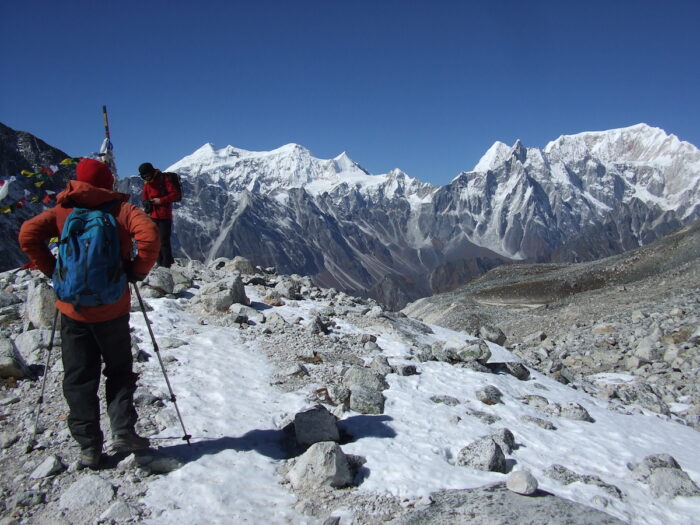
The walk from Larkya phedi (bottom) towards the top of Larkya-la at 5,135m is a gradual, winding climb. We make an early morning start to prepare for the crossing of the highest pass on this trek, a short climb above the lodge. We reach the ablation valley on the north side of the Larkya Glacier with magnificent views of Cho Danda and then of Larkya Peak. Finally, we cross the glacier moraines, making a gradual ascent that becomes steeper in the final section to the top of the pass.
From the pass, outstanding views of Himlung, Cheo Himal, Kang Guru, and Annapurna II are visible. After a wonderful moment on the highest spot, a long descent follows over snow and scree to reach the valley trail to Larcia. A further hour on a moraine ridge path leads to Tambuche at 3,900m and with a short distance walk from here to camp at Bhimthang a lovely place on a broad and level valley with a number of mani walls and deserted house. We will surely arrive tired in camp after a long, hard, satisfying day.
(Breakfast, lunch, dinner & teahouse accommodation included).
Day 14: Bimthang to Dharapani (1,960m/6,430ft)
After the long day’s walk to Bhimthang, the walk from here to Dharapani will be pleasant through the forest of pines, rhododendron, and summer pastures with occasional views of the nearby snow peaks. From Bhimthang, after crossing this high pasture, we descend the valley of the Burdin Khola to the area of the base camp of the west side of Manasalu.
From a ridge, we have excellent views of Manasalu to the southeast and Annapurna II to the southwest. Beyond a bridge over the headwaters of the Dudh Khola, we descend and follow a trail through a narrow valley and into a serene forest, where we camp in the meadows, surrounded by the forest, in perfect tranquility after 4 hours of easy walking to near or after Karche 2,785m for lunch.
From here, the track leads downhill through the forest, passing through a small summer settlement at Goh, and then, after an hour or more of gradual walking, we climb through terraced fields to the Karche La.
We can see ahead a green and heavily forested valley, dropping down to the distant Marsyangdi River, after a few hours of walking, coming to the village of Tilje, following the Dudh (milky) river downstream.
We pass several villages, including Thonje, which has a checkpoint. From Tilje, an hour climb to cross the bridge, and then comes to where the main trail of the Annapurna circuit joins at Dharapani village for the overnight.
(Breakfast, lunch, dinner & teahouse accommodation included).
Day 15: Drive from Dharapani to Beshishahar (790m02, 591ft)
Today, we can have a jeep drive up to Beshishahar and stay overnight. It takes approximately 5 hours to reach Beshishahar. (This Jeep drive may not be available during the summer season.
(Breakfast, lunch, dinner & teahouse accommodation included).
Day 16: Drive back to Kathmandu
Today, we drive back to Kathmandu, passing through Lamjung’s headquarters, Besishahar, the starting point of the Annapurna Circuit trek. We went back to Kathmandu and checked into the hotel. In the evening, we will have a farewell dinner, and the reminder is to rest and relax at the hotel overnight.
(Breakfast, farewell dinner & hotel accommodation included).
Day 17: Departure from Kathmandu
Today is a good day to do last-minute shopping for souvenirs or gifts for your family, friends, or relatives, or to purchase items for your departure flight/drive, or to begin any extra trips or activities you may have booked with us. If departing, you’ll be transferred to the International Airport for your departure flight to your onward destination.
(Breakfast included).
Service Includes:
- 3 nights’ standard twin sharing accommodation in Kathmandu as per your requested hotel categories
- All local transportation by suitable vehicle (car, van, bus) in Kathmandu
- Complementary welcome and farewell dinner in Kathmandu
- A day in Kathmandu sightseeing as per the itinerary with a tour guide & entry fees
- Kathmandu to Arughat & Beshishahar to Kathmandu both ways by Land Cruiser (4WD) or similar
- Dharapani to Beshishar by sharing a local Jeep
- Meal on a full board (breakfast, lunch, dinner, tea & coffee) basis during the trek as per the itinerary
- Twin sharing accommodation at the teahouse during the trek
- Trek leader (English speaking, First Aid and eco trained), one Sherpa porter for 2 pax, one asst. guide based on 4 pax basis, all necessary payments with insurance
- Manaslu conservation & Annapurna conservation entry fee
- Special Manasalu permit (Restricted zone requires a special license)
- Complementary Himalayan Planet company T-shirt and duffel bag for trekking
- Safe drinking water purified by Steripen/Iodine tablets
- Exclusive medical kit bag & all government and local taxes
Service Excludes:
- Visa fees, international airfare
- Lunch and dinner in the city, except as mentioned
- Travel and rescue insurance
- Personal expenses, e.g., phone calls, laundry, bar bills & extra porters
- Tips for drivers, guides, and porters
- Any extended trips
- Services are not included in the service-inclusive column
Useful Information:
Meals and Accommodation
During the Manaslu trek, we will provide all meals on a full-board basis. This trek is based on camping, and we will provide meals three times a day (Breakfast, lunch, dinner) and tea & coffee during meals from the teahouse kitchen.
The meals feature a variety of American and traditional Nepali & Chinese dishes. During the stay in Kathmandu, meals are on a breakfast basis with a welcome & farewell dinner included in the price. Snacks, bottled drinks, including mineral water, and alcohol are not included in the price.
We provide 3 nights’ twin-share accommodation in the requested hotel category in Kathmandu and 13 nights’ twin-share accommodation in the teahouse (Single occupancy available on request with a single supplement).
Trekking Group
The Manaslu trek in the Nepal Himalaya is based on a group-joining trip in Kathmandu. The minimum group size is 2 pax, and the maximum is 12 pax, based on group bookings. This region most requires minimum 2 persons to visit. Please make sure that you have a group joining before you book the trip, and we do organize the trip in large groups on request, but small groups, which means we can provide our best services during the journey.
Physical Requirements
The Manaslu Circuit trek is strenuous, but it does not require prior trekking or mountaineering experience. It does not require any technical experience; only that you are in good physical & mental condition and can hike for 4-6 hours over mountain terrain with a light daypack. Before booking the trip with us, please consult with your Medical Doctor once, and in case of Doctor References, go ahead with your trip booking process with us.
Trek Leaders and Staff
With a decade of experience in adventure tourism, our incredible guides and staff are the backbone of the company. They are selected as highly skilled professionals with technical proficiency, proven safety records, careful judgment, patient, supportive teaching styles, and great personalities.
Most of our field staff are from the local area and cover the eastern to western Himalayan ranges, directly supporting local communities. They have good health and fitness, as well as experience and strong knowledge of team leadership in the Himalayan region.
Acclimatization
This Manaslu round trek itinerary is specifically tailored to minimize AMS (Acute Mountain Sickness). Typically, altitude sickness begins at 3,600 meters (11,808 feet), and there are no issues below this threshold. During your trip, the best approach is to acclimate gradually.
Consider that at higher altitudes, there is less oxygen in the air. Suppose crossing high passes above 5,000 meters (16,400 feet) results in 50% less oxygen than at sea level. Your body needs several days to acclimate during travel in the high Himalayas.
Travel Insurance
We strongly recommend purchasing trip cancellation and travel insurance. This comprehensive travel insurance provides coverage for trip cancellation and interruption, travel delays, loss of baggage and travel documents, baggage delay, medical expenses, and emergency assistance.
Climate and Weather
Nepal has diverse topography, ranging from 60 meters to the summit of Mt. Everest at 8,848 meters. We have a dry season from October to May and the wet season (monsoon) from June to September.
For the Manaslu trek, mid-August to October is one of the best times, and March to May is also good. During the autumn, the vegetation is lush after the rains of the monsoon, and the air is clean and fresh, and spring can be a little dusty but with pleasant & warm weather. The rainy season from June to August is cloudy and bad for visibility.
Passport and Visa Requirements
Before you travel for the Manaslu trek, please check your passport and ensure it is valid. Passports must be valid for at least 6 months beyond the end date of your trip. We require a copy of your full passport details, sent by fax or as a scanned copy.
In Nepal, you will need a visa, which can be obtained in advance from the Nepalese Embassy in your country or upon arrival at Kathmandu Airport (in peak season, you may need to wait long at the airport while obtaining a visa). Here is a general list of Nepalese visa fees as below, and a web link (http://nepalimmigration.gov.np/)
Nepal visa fees to be levied while issuing a tourist visa by the Mission or entry point:
- US Dollars 25, or an equivalent convertible foreign currency, for a 15-day multiple-entry visa.
- US Dollars 40, or an equivalent convertible foreign currency, for a 30-day multiple-entry visa.
- US Dollars 100, or an equivalent convertible foreign currency, for a 90-day multiple-entry visa.
- Notwithstanding anything written in clause (a) and (b), no visa fee shall apply to the passport holder of member states of the South Asian Association for Regional Cooperation (SAARC) for 30 days.
Manaslu Trek Permits and Fees
During this trip, you will need to obtain the Manaslu & Annapurna Conservation Area entry permits, a special Manaslu permit with a TIMS card, and World Heritage Site entry permits. All relevant permits and entry fees are included in the quoted cost, except for personal donations & contributions. If any such conditions apply, we will inform you of any additional permit fees required before you make a booking with us.
Health and Medical Information
During the Manaslu trek with us, our crews are highly experienced travelers who have long shared their expertise to help travelers achieve their ambitions. In fact, we specialize in Himalayan travel, and we are all from the Himalayan region with plenty of local knowledge, having guided for a decade, which is a key factor in providing the standard service to our clients.
All our services are based on the client’s safety and satisfaction. We offer a wide range of high-quality services and provide personal care throughout the trip. Each of our guides carries a medical kit bag for any incidents that may occur during travel, and they are first-aid trained.
Environmental Concerns
We are highly sensitive to protecting our natural environment and participate in many environmental cleanup campaigns. Our responsible tourism sends a positive message to locals, and we consistently train them on dos and don’ts and how to maintain a clean environment. Additionally, the tourism industry has an obligation to protect and preserve the natural environment for future generations. Kathmandu Environmental Education Project (KEEP) (http://www.keepnepal.org/) helps to cooperate with many trekking companies, and this organization provides many practical trainings to our crews and environmental awareness programs in the mountains.
Manaslu Circuit Trek Experience
Himalayan Planet Adventures P. Ltd. is a government-registered company based in Kathmandu, Nepal, and we are working in adventure travel in the Himalaya of Nepal, Tibet, Bhutan, and India. The operator has gained a decade of experience in adventure tourism, working as a guide, adventure travel consultant, and stabilizing their own company.
With our extensive experience in adventure travel, we are even more dedicated to meeting our clients’ requirements and are committed to client satisfaction. We are also delighted to say that many of our past clients who organized their trips in the Himalayas wouldn’t hesitate to recommend our organization and professional organizing skills.
How to Book
While you have chosen your trip, contact our head office by mail or phone to check the availability dates (you may visit the updated departure date page), groups, or any remaining questions you may have. We are happy to help and will respond promptly. We’ll hold your booking until your final decision.
Please read our trip booking terms & conditions before your booking and fill out the booking form (download from our website) along with the appropriate deposit of 20 % per person in advance, and payment made through bank transfer, or submit your credit card (Visa/master card) details with the booking form.
When you choose the advance payment method, a signed and completed booking form will still be required to confirm the booking. Bookings will be confirmed only upon receipt of a completed and signed booking form and the required payment.
The final balance for your booking will be on arrival in Kathmandu. We will invoice you before your arrival for the final balance, along with other final pre-departure details as appropriate. Your final invoice will reflect the price from the previous quote at the time of invoicing.
For complete details on the Manaslu Trek, please visit this page from Himalayan Planet Adventures (P) Ltd.
For reservations and inquiries, you can contact them by phone at 00977 1 4701040 or mobile at 00977 9851104438, or email them at info@himalayanplanet.com or himalayanplanet@gmail.com. Visit their website http://www.himalayanplanet.com, http://www.everestbasecamp.travel, and like them on Facebook. You can also follow them on Twitter and Instagram.
Follow and subscribe to OutofTownBlog.com on Facebook, Twitter, Instagram, and Team Out of Town on YouTube for more travel and tourism news.
Read:
- Your Whirlwind Travel Tale of 10 Days in Nepal should be like this!
- Hiking Trails: Trekking In Nepal
- Top 15 Best Things to Do in Kathmandu, Nepal
- Culinary And Cultural Delights Of Jiufen Old Street