

 Melo Villareal
AI Video Generators: The Future of Faster, Smarter Video Creation
Video creation used to require expensive equipment, editing software, technical skills, and hours of post-production work. Today, artificial intelligence is changing that process.
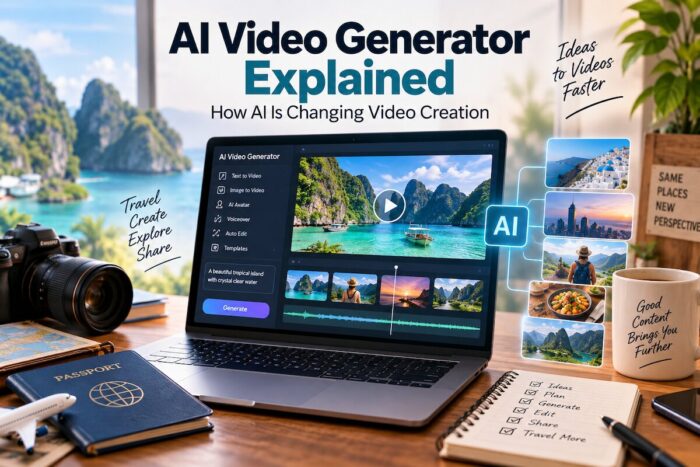
AI Video Generator Explained: How AI Is Changing Video Creation
An AI video generator can turn text prompts, images, scripts, or existing footage into videos with significantly less manual work. Depending on the platform, creators can generate scenes, animate images, create digital presenters, add voiceovers, write scripts, edit footage, and produce different versions of the same video.
For travel bloggers, influencers, marketers, small businesses, and lifestyle publishers, these tools are opening up new ways to produce content faster.
What Is an AI Video Generator?
An AI video generator is software that uses artificial intelligence to create or modify video content based on user-provided instructions.
You might type a simple prompt describing a scene, upload an image, provide a script, or select a visual style. The AI then processes the information and generates video content based on those instructions.
Some platforms focus on text-to-video generation. Others specialize in AI avatars, image animation, video editing, voice generation, or the conversion of long-form content into short videos.
The technology varies between platforms, so the quality, available features, video length, resolution, and level of creative control can differ considerably.
How Does AI Video Generation Work?
AI video generation combines several technologies to understand instructions and produce visual content.
A typical workflow can include:
- Writing a prompt or script
You describe the video you want to create. - AI interpretation
The system analyzes your text, images, or other inputs. - Scene generation
The platform creates or assembles visual elements based on the instructions. - Motion and animation
AI can add movement to generated scenes or still images. - Voice and audio generation
Some tools can create narration, dialogue, sound effects, or background music. - Editing and refinement
Users can adjust scenes, timing, transitions, text, characters, and other elements. - Export
The finished video can be exported for platforms such as YouTube, TikTok, and Instagram, as well as for websites and presentations.
The process can reduce the amount of manual editing required, especially for straightforward social media content.
From Text to Video
One of the most talked-about applications is text-to-video generation.
Instead of filming every scene, creators can describe what they want. For example, a travel creator could request a cinematic video showing a tropical beach at sunset, a bustling night market, or an aerial-style view of a city.
The AI generates visuals based on the prompt.
This can help creators visualize concepts before investing in production. It can also provide supplementary footage when original footage is unavailable.
However, AI-generated scenes can contain inaccuracies. Architecture, people, objects, signs, landscapes, and cultural details may appear incorrectly. Travel publishers should therefore review generated footage carefully before publishing it.
AI Video Generators for Travel Creators
Travel content is highly visual, making AI video tools particularly useful for bloggers and content creators.
A travel creator can use AI to develop:
- Destination teaser videos
- Instagram Reels
- TikTok videos
- YouTube Shorts
- Hotel promotional videos
- Travel itinerary videos
- Destination explainers
- Animated maps
- Social media advertisements
- Video introductions
- Storyboard concepts
- Photo-to-video content
For example, a collection of hotel photographs could be turned into a short promotional video with animated transitions, narration, captions, and background music.
AI can also help turn a written travel article into a video concept. A long destination guide could be broken into a series of short videos covering attractions, food, transportation, hotel recommendations, and travel tips.
AI Can Animate Photos
One useful feature for travel photographers is image-to-video generation.
Instead of leaving a photograph as a static image, AI can introduce movement. A landscape photograph could receive subtle camera movement. A food photograph could be animated into a short social media clip. A photograph of a hotel room could be part of a video walkthrough.
This gives existing content a longer lifespan.
For photographers and bloggers with extensive archives, AI can provide another way to repurpose photographs without creating an entirely new production.
AI Avatars and Virtual Presenters
AI video platforms can also create virtual presenters.
An AI avatar can deliver a script without requiring the creator to record themselves. This can be useful for tutorials, product explainers, corporate presentations, travel information, and social media content.
Creators can select an avatar, enter a script, choose a voice, and generate a presenter-led video.
This approach can save recording time, particularly when producing multiple versions of a video.
However, creators should disclose the use of synthetic presenters when transparency matters to their audience.
AI Voiceovers Are Changing Video Production
Voice generation is another important part of the AI video ecosystem.
Traditional voiceovers require recording equipment, a suitable environment, and often multiple takes. AI voice tools can generate narration from written scripts.
Creators can use voiceovers for:
- Destination guides
- Hotel reviews
- Travel tips
- Product demonstrations
- Tutorials
- Explainer videos
- Social media clips
AI-generated voices can sound increasingly natural, but creators should still check pronunciation, pacing, tone, and accuracy.
Proper pronunciation is especially important for destination names, local languages, people’s names, restaurant names, and cultural terms.
AI Video Editing Saves Time
AI is also changing the editing stage.
Modern AI-powered editing tools can automate tasks such as removing silences, generating captions, identifying highlights, resizing videos for different platforms, improving audio, and creating short clips from longer recordings.
A creator who records a 20-minute travel experience could potentially turn that footage into several shorter social media videos.
This changes the economics of content production. One recording session can generate multiple pieces of content for different platforms.
What Are the Advantages of AI Video Generators?
The biggest advantage is efficiency.
AI can reduce the time required for certain repetitive production tasks. This allows creators to spend more time on storytelling, research, photography, destination experiences, and audience engagement.
Other advantages include:
Lower Production Costs
Creators may need fewer resources for certain types of videos. AI can help with scripting, voiceovers, editing, animation, and visual development.
Faster Content Production
A video that once required several stages of manual work can potentially move from concept to draft much faster.
Easier Experimentation
Creators can test different visual concepts without committing to a full production.
Content Repurposing
Existing photographs, articles, podcasts, and videos can be repurposed into new formats.
Accessibility
People without advanced video editing skills can experiment with video production using simpler interfaces.
What Are the Limitations?
AI video generation still has limitations.
Generated footage may contain visual inconsistencies, unnatural movements, incorrect details, or problems with hands, faces, text, and objects. Characters may also change appearance between scenes.
AI-generated text inside images and videos can be particularly unreliable.
There are also questions surrounding copyright, ownership, consent, privacy, and the use of training data. Rules and industry practices continue to evolve, so creators should understand the terms of the AI platform they use.
For travel content, another issue is authenticity.
A beautifully generated image of a destination does not prove that the destination actually looks that way. Publishers should avoid presenting synthetic footage as real travel photography or documentary footage.
AI Video Generation vs Traditional Video Production
AI does not eliminate the need for traditional video production.
Professional filming remains important for documentaries, interviews, destination coverage, hotel reviews, events, commercials, and other content where authenticity matters.
AI works particularly well as a supporting tool.
A travel creator could film an actual hotel stay, then use AI to create an introductory animation, generate captions, remove unwanted pauses, produce alternative versions, or create additional promotional assets.
This hybrid approach combines real experiences with AI-assisted production.
How AI Is Changing the Role of the Creator
AI is changing the skills required for video creation.
Creators increasingly need to understand prompts, storytelling, editing, visual consistency, fact-checking, copyright considerations, and platform-specific formats.
The ability to communicate an idea clearly is becoming increasingly important.
A detailed prompt can produce a more controlled result than a vague instruction. Creators who understand pacing, composition, lighting, storytelling, and audience behavior can also make better use of AI tools.
The technology may automate parts of production, but creative direction remains important.
The Future of AI Video Creation
AI video technology will continue to develop as models become more capable and video generation becomes easier to control.
Future tools are likely to offer greater consistency across scenes, more natural character movement, improved audio quality, more precise editing, and stronger integration with existing creative workflows.
For travel and lifestyle publishers, this could mean faster production of destination videos, social media campaigns, hotel content, travel explainers, and promotional material.
The most useful approach is to treat AI as part of the creative toolkit rather than a complete replacement for human storytelling.
Real experiences, original photography, research, cultural knowledge, and editorial judgment remain valuable. AI can help creators turn those ideas into more formats and publish them more efficiently.
Final Thoughts
AI video generators are changing how people approach video creation. Tasks that once required specialized software and extensive production time can now be completed with simpler workflows.
For travel and lifestyle creators, the technology offers practical opportunities to transform articles, photographs, footage, and ideas into engaging video content.
The challenge is learning where AI adds value and where human creativity and real-world experience remain essential.
As the technology develops, successful creators will likely be those who combine AI-assisted production with strong storytelling, accurate information, original experiences, and a clear understanding of their audience.
Want more Updates? Please follow #TeamOutofTown on Facebook, Twitter, Instagram, and Pinterest for more travel ideas.
Read:
- SMAC Prestige Card Philippines: How to Qualify, Benefits, Perks, and Requirements
- List of Bank Transfer Fees in the Philippines: PESONet and InstaPay


