

 Melo Villareal
25 Filipino Words That Entered Spanish: The History Behind Their Meanings
Spanish borrowed words from the Philippines over centuries of contact through trade, colonial administration, missionary activity, and everyday cultural exchange. These words reflect the plants, animals, boats, food products, social structures, and traditions that Spanish speakers encountered in the archipelago.
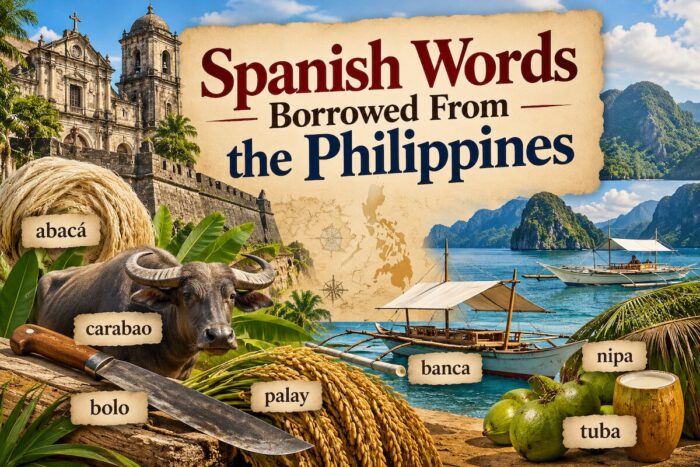
Spanish Words Borrowed From the Philippines
However, an important distinction matters: a word used in Philippine Spanish is not automatically a word adopted into Spanish worldwide. Some Philippine-origin terms appear in the Diccionario de la lengua española, published by the Real Academia de la Lengua Española and the Asociación de Academias de la Lengua Española. Others are documented in historical accounts, specialized dictionaries, and linguistic studies of Spanish as spoken in the Philippines. Researchers also disagree about the origins of certain terms.
This guide distinguishes established Philippine-language origins from uncertain etymologies and explains when a word belongs mainly to the historical or regional vocabulary of the Philippines. The goal is to explore 25 documented terms without suggesting that every Spanish speaker today knows or uses them.
How Philippine Words Entered the Spanish Language
Spanish colonial rule began in the Philippines in the sixteenth century. Manila later became a major trade center connecting Asia with the Spanish Americas through the Manila-Acapulco galleon trade. Spanish administrators, missionaries, merchants, soldiers, and settlers encountered numerous Philippine languages, including Tagalog, Cebuano, and other Visayan languages.
They needed local words for unfamiliar plants, materials, boats, tools, customs, and political structures. Some terms entered Spanish-language reports and dictionaries. Others remained characteristic of Philippine Spanish, a regional variety shaped by the country’s multilingual environment.
The movement of words was not always direct. A term might have circulated through several languages before appearing in Spanish records. Historical spelling also varied, making it difficult to connect older written forms with modern Philippine words.
A 2024 scholarly study of the eighteenth-century writings of Jesuit historian José Joaquín Delgado identifies numerous filipinismos, or words associated with Philippine Spanish. It also distinguishes Philippine-origin terms from words brought to the Philippines from Spanish America. This distinction is essential when evaluating linguistic origins.
Quick Reference: 25 Philippine-Origin Words Recorded in Spanish
The following table summarizes the terms discussed below. It includes words documented in Spanish dictionaries or historical Philippine Spanish sources. Their geographic reach and the strength of their etymological evidence vary.
| Spanish form | Meaning or referent | Philippine connection |
|---|---|---|
| Abacá | Manila hemp | Indigenous fiber plant |
| Aeta | An Indigenous people | Philippine ethnonym |
| Anito | Spirit or ancestral being | Indigenous belief |
| Asuán | Supernatural being | Philippine folklore |
| Babailán | Traditional ritual specialist | Visayan cultural history |
| Baguio | Typhoon or storm-related term in historical usage | Related to bagyo |
| Bahague | Traditional loincloth | Indigenous clothing |
| Balangay / barangay | Traditional boat; later, a community or administrative unit | Maritime and social history |
| Banca | Outrigger boat | Philippine maritime life |
| Baroto | Small boat | Visayan maritime vocabulary |
| Bilimbín | Regional plant or fruit name | Philippine botanical vocabulary; origin needs caution |
| Bolo | Heavy, single-edged cutting tool | Agricultural tool |
| Bonote | Coconut fiber | Coconut-processing vocabulary; origin uncertain |
| Buri | Palm associated with useful fibers and materials | Philippine plant life |
| Buyo | Betel leaf or betel-related preparation | Traditional plant use |
| Carabao | Water buffalo | Philippine agricultural life |
| Caracoa | Traditional warship | Visayan maritime history |
| Cogón | Cogon grass | Philippine vegetation |
| Dalaga | Young unmarried woman | Tagalog social vocabulary |
| Ganta | Traditional measure | Historical trade and commerce |
| Igorrote | Historical term for certain Indigenous peoples of northern Luzon | Ethnographic vocabulary |
| Molave | Philippine hardwood tree | Timber and forestry |
| Nipa | Nipa palm | Coastal ecosystems and building materials |
| Palay | Unhusked rice | Philippine agriculture |
| Tuba | Palm wine | Fermentation and food culture |
Important note on the table: These entries do not all have identical dictionary status. Some are established Spanish dictionary headwords; others are documented as historical Philippine Spanish vocabulary. Some forms have disputed or incompletely established origins. In particular, balangay and barangay are related historically but should not be treated as interchangeable in every context. The discussion below identifies these limitations rather than presenting all 25 as equally certain or equally widespread.
25 Spanish Words With Philippine Connections
1. Abacá

Meaning: A tropical plant whose strong fibers make rope, cordage, and other products.
Linguistic origin: The Spanish abacá comes from the Philippine word abaká, used in Tagalog and other Philippine languages.
Historical background: Abacá became commercially important because its fibers were valuable for maritime and industrial uses. Spanish-language descriptions of the Philippines recorded the plant and its products, helping the local name circulate beyond the archipelago.
Cultural connection: Known internationally as Manila hemp, abacá remains associated with Philippine agriculture and traditional fiber production. It shows how a locally significant plant’s name can enter a colonial language through commerce.
2. Aeta
Meaning: A name used for Indigenous peoples of the Philippines, particularly communities associated with Luzon.
Linguistic origin: The term is documented in Spanish descriptions of Philippine peoples. Its spelling and usage have varied across historical sources, and the word should not be assumed to represent every Indigenous community.
Historical background: Spanish missionaries, officials, and chroniclers recorded names for communities they encountered. These descriptions often reflected colonial observers’ categories and assumptions rather than the full range of Indigenous identities.
Cultural connection: Aeta communities have distinct histories, languages, and cultural traditions. The term is relevant to Philippine ethnography, but contemporary writing should respect the names and identities preferred by the communities concerned.
3. Anito
Meaning: A spirit or supernatural being in Indigenous Philippine belief systems, sometimes associated with ancestors.
Linguistic origin: The word is associated with Philippine languages, including Tagalog, and entered historical Spanish descriptions of local religious practices.
Historical background: Spanish missionaries documented Indigenous beliefs while attempting to explain them through European religious concepts. Their records preserved some local terminology, though colonial religious attitudes sometimes shaped their interpretations.
Cultural connection: Anito offers a glimpse into the spiritual traditions that existed before and during Spanish colonization. Its meaning varies with historical and cultural context, so it should not be reduced to a single universal definition.
4. Asuán
Meaning: A supernatural being in Philippine folklore, often associated with the broader family of aswang traditions.
Linguistic origin: The form asuán appears in historical descriptions of Philippine folklore. Its relationship to modern forms such as aswang requires care because spelling, pronunciation, and regional usage differ.
Historical background: Colonial writers recorded stories about supernatural beings as part of their accounts of local customs and beliefs. These descriptions were filtered through Spanish-language interpretations and did not always accurately capture local distinctions.
Cultural connection: Aswang traditions remain part of Philippine folklore and popular culture. The historical form is interesting as evidence of cultural contact, but it should not be presented as a universally accepted modern Spanish word.
5. Babailán
Meaning: A traditional ritual specialist, healer, or spiritual leader in certain Visayan societies.
Linguistic origin: The term is associated with Visayan languages and is related to forms commonly written as babaylan in contemporary Philippine usage.
Historical background: Spanish religious and administrative records described local ritual specialists, often interpreting their roles through the lens of European religious institutions. Spellings in Spanish texts may differ from modern Philippine forms.
Cultural connection: Babaylan traditions are important to discussions of Indigenous knowledge, healing, ritual, and community leadership. Their roles varied across places and periods, making this term especially useful for understanding how language records intersect with cultural history.
6. Baguio
Meaning: In historical Spanish vocabulary, a storm- or typhoon-related term associated with the Philippine word bagyo.
Linguistic origin: Discussions of Philippine-origin vocabulary in Spanish document its relationship to Philippine bagyo. The word should not be confused with Baguio City, the mountain city in northern Luzon.
Historical background: Storms were an unavoidable part of life in the archipelago. Spanish observers recorded local weather-event terminology as they documented navigation, agriculture, settlements, and maritime conditions.
Cultural connection: The Philippine word bagyo remains widely used for a tropical cyclone or severe storm. This example shows how environmental conditions can introduce local vocabulary into historical records in another language.
7. Bahague
Meaning: A traditional loincloth or similar garment.
Linguistic origin: Historical Spanish accounts use forms such as bahague for traditional clothing associated with Philippine communities. The precise source language and spelling may vary between records.
Historical background: Clothing descriptions appeared in colonial-era accounts of Indigenous societies. Spanish writers often used local terms when European vocabulary could not adequately describe unfamiliar garments or their cultural significance.
Cultural connection: Traditional clothing differs among Philippine communities, climates, and historical periods. The word offers a glimpse into older descriptions of dress, but it should not be treated as a complete or universal name for Indigenous Philippine clothing.
8. Balangay and Barangay
Meaning: Balangay refers to a traditional boat, while barangay today commonly refers to the smallest local government unit in the Philippines.
Linguistic origin: The forms are historically related in discussions of Philippine maritime and social vocabulary, although their meanings and development must be distinguished.
Historical background: Spanish sources recorded local political and maritime terms. The modern administrative meaning of barangay developed through a complex history and should not be assumed to match every earlier use of balangay.
Cultural connection: The balangay is an important symbol of Philippine maritime history, while the barangay remains central to everyday civic life. Together, the words show how a language can preserve traces of both traditional transport and social organization.
9. Banca
Meaning: A small boat, often associated with the outrigger boats used in the Philippines and other parts of Southeast Asia.
Linguistic origin: The word is well established in Spanish vocabulary, but its deeper etymology is complex. Its presence in Philippine Spanish does not, by itself, prove that the term originated in a Philippine language.
Historical background: Boats were essential for transport between islands, fishing grounds, and coastal settlements. Spanish writers encountered numerous local vessel types and sometimes applied familiar terms inconsistently to different boats.
Cultural connection: The Philippine bangka remains an important part of coastal transport and fishing. Because the historical relationship between banca and bangka requires careful etymological treatment, this is an example where regional usage should not be confused with proof of borrowing direction.
10. Baroto
Meaning: A small boat, especially in Visayan maritime contexts.
Linguistic origin: Baroto is associated with Philippine maritime vocabulary and appears in historical accounts of the Philippines. Its precise linguistic history should be assessed against individual dictionary entries.
Historical background: Spanish-language descriptions of the archipelago included names for boats used for fishing, trade, travel, and coastal communication. Local vessel terminology was valuable to observers documenting movement between islands.
Cultural connection: Small boats remain essential to many coastal and island communities. Baroto connects language history with practical knowledge of the sea, while showing how regional terms may be recorded in Spanish without becoming common vocabulary across the Spanish-speaking world.
11. Bilimbín
Meaning: A regional plant or fruit name recorded in historical Philippine vocabulary.
Linguistic origin: The form appears in scholarship on filipinismos, but its precise origin and relationship to other regional plant names require additional etymological confirmation.
Historical background: Botanical terminology was a major source of vocabulary in colonial descriptions. Writers needed names for unfamiliar plants used for food, medicine, construction, and trade. Local names were often transcribed according to Spanish spelling conventions.
Cultural connection: Philippine plant names can vary substantially between languages and regions. This term illustrates why historical botanical vocabulary is valuable but also why an entry in an old Spanish text should not automatically be treated as a fully established modern Spanish word.
12. Bolo
Meaning: A heavy, single-edged cutting tool used for agricultural work, clearing vegetation, and other practical tasks.
Linguistic origin: Spanish bolo is documented as a borrowing associated with the Philippine word bolo.
Historical background: The tool was common in Philippine agricultural and rural life. Spanish observers recorded its name because the implement had important practical uses and did not correspond perfectly to every European cutting tool.
Cultural connection: The bolo remains recognizable in Philippine farming, gardening, and rural work. It is one of the clearer examples of a Philippine term entering Spanish-language vocabulary through direct contact with a locally significant object.
13. Bonote
Meaning: Coconut fiber, particularly the fibrous material associated with the husk.
Linguistic origin: Bonote appears in historical Spanish vocabulary connected with Philippine materials. Its exact etymology is less secure than that of some better-established Philippine-origin words.
Historical background: Coconut products were useful for ropes, mats, packing materials, and other goods. Spanish-language accounts recorded names for local materials as they became relevant to commerce and production.
Cultural connection: Coconut processing remains important in many Philippine communities. The term shows how raw-material names can travel through trade and technical descriptions, even when the precise borrowing pathway is not fully established.
14. Buri
Meaning: A palm known for its useful leaves and fibers.
Linguistic origin: The term is documented in Philippine-related Spanish vocabulary. Its exact classification and source language depend on the historical record being consulted.
Historical background: Palms supplied materials for weaving, thatching, and household products. Spanish writers recorded local plant names when describing natural resources, manufacturing, and everyday life in the archipelago.
Cultural connection: Buri is associated with traditional crafts and plant-based materials in the Philippines. It belongs to a broader pattern in which local botanical terms became part of Spanish descriptions of the region’s natural resources.
15. Buyo
Meaning: A term associated with betel leaf and betel-chewing preparations.
Linguistic origin: Buyo is documented in Philippine-related vocabulary, although related words and practices extend across parts of South and Southeast Asia. Its deeper linguistic history should therefore be treated carefully.
Historical background: Betel chewing had cultural and social importance in several Asian societies. Spanish observers described the practice and the plants involved, sometimes adopting local names for the leaves and preparations.
Cultural connection: The term links Philippine history to a broader regional tradition of plant use and social customs. It also shows that a word’s presence in Philippine Spanish does not always mean its origin can be traced exclusively to the Philippines.
16. Carabao
Meaning: A water buffalo, especially the domesticated animal important to Philippine agriculture.
Linguistic origin: Spanish carabao is documented as a Philippine-related borrowing, with historical forms associated with Visayan languages.
Historical background: Water buffaloes were essential for plowing rice fields, transporting goods, and supporting rural livelihoods. Spanish accounts of agriculture and trade naturally included the animal and its local name.
Cultural connection: The carabao is widely recognized as a symbol of Philippine farming life. Its place in the vocabulary reflects the importance of local animals to colonial agriculture and to the everyday experiences of people living in the archipelago.
17. Caracoa
Meaning: A traditional Philippine warship or large seagoing vessel.
Linguistic origin: The Spanish caracoa is associated with the Visayan word karakoa, a vessel documented in historical accounts.
Historical background: Spanish chroniclers described Philippine boats used for warfare, transport, and maritime expeditions. These vessels demonstrated local shipbuilding expertise and the importance of seafaring in regional political and economic life.
Cultural connection: The karakoa is part of the Philippines’ maritime heritage. The word provides evidence that Spanish-language descriptions incorporated local terminology when European observers encountered technologies and vessel types unfamiliar to them.
18. Cogón
Meaning: A tropical grass that grows in open areas and is used in some traditional thatching and other applications.
Linguistic origin: Spanish cogón is linked to the Philippine word kugón.
Historical background: Colonial descriptions of landscapes, agriculture, and settlements included names for common vegetation. Cogon grass was significant because it grows readily in disturbed land and has practical uses, including as roofing material in some settings.
Cultural connection: Cogon grass remains familiar in the Philippines, where it can be both a useful plant and a challenge for land management. The word illustrates how local ecological knowledge contributed to Spanish vocabulary about the natural environment.
19. Dalaga
Meaning: A young, unmarried woman in Tagalog.
Linguistic origin: Dalaga is a Philippine-language term recorded in historical Spanish vocabulary associated with the Philippines.
Historical background: Spanish accounts of Philippine society sometimes included local words for social roles, age categories, and relationships. Such terms could carry cultural meanings that did not align exactly with Spanish social categories.
Cultural connection: Dalaga remains familiar in Filipino, although its use and connotations depend on context. Its historical appearance in Spanish-language records reminds us that cultural concepts do not always translate neatly between languages.
20. Ganta
Meaning: A traditional measure of capacity used in the Philippines, particularly for agricultural products.
Linguistic origin: Ganta appears in historical records of Philippine Spanish. Its deeper origin and the history of related measures need to be considered separately from its use in the Philippines.
Historical background: Measures were essential to markets, taxation, farming, and the exchange of rice and other commodities. Spanish administrators and merchants needed to understand local units, even when these did not correspond exactly to measurements used elsewhere in the Spanish Empire.
Cultural connection: The ganta belongs to the history of Philippine trade and food production. It shows how measurement terms entered administrative writing out of practical necessity, although their precise values may have varied by place and period.
21. Igorrote
Meaning: A historical Spanish term used for certain Indigenous peoples of the Cordillera region in northern Luzon.
Linguistic origin: The term is recorded in Spanish descriptions of the Philippines. Its historical usage is associated with Philippine ethnonyms, but the name’s development and application should not be simplified into a single uniform Indigenous identity.
Historical background: Colonial ethnographic writing grouped communities according to Spanish observers’ classifications. These categories sometimes obscured distinctions among languages, settlements, and cultural traditions.
Cultural connection: The peoples of the Cordillera have diverse identities and histories. The historical term is useful when reading older Spanish documents, but contemporary writing should use more specific, community-appropriate names wherever possible.
22. Molave
Meaning: A hardwood tree native to the Philippines, valued for its durable timber.
Linguistic origin: The Spanish term molave is associated with Philippine botanical vocabulary and is documented in historical descriptions of local timber.
Historical background: Wood was essential to buildings, boats, furniture, and infrastructure. Spanish-language accounts of the archipelago recorded local tree names because timber quality and availability mattered to construction and trade.
Cultural connection: Molave is part of the Philippines’ forest and timber heritage. Its inclusion in Spanish-language vocabulary shows how names for commercially useful native trees spread through colonial economic and botanical writing.
23. Nipa
Meaning: A palm that grows in coastal and brackish-water environments.
Linguistic origin: The Spanish term nipa is associated with Philippine plant vocabulary and appears in historical Spanish accounts of the archipelago.
Historical background: Nipa palms provided leaves used in traditional roofing and other materials. Their role in settlement and construction made them relevant to descriptions of Philippine houses, landscapes, and local resources.
Cultural connection: Nipa remains a recognizable part of coastal Philippine environments. The word links Spanish-language botanical and ethnographic records to traditional building practices and communities’ adaptation to tropical coastal conditions.
24. Palay
Meaning: Rice in its unhusked form, before milling.
Linguistic origin: Palay is associated with Tagalog and other Philippine agricultural vocabulary. It appears in historical accounts of the Philippines, though its use should be distinguished from the broader Spanish word arroz for rice.
Historical background: Rice was a major crop and a staple food. Colonial administrators and observers needed to distinguish between rice in the field, harvested grain, and processed rice when describing farming and commerce.
Cultural connection: Palay remains an everyday agricultural term in the Philippines. It reflects the importance of rice cultivation and the way specialized local vocabulary can persist in descriptions of farming and food production.
25. Tuba
Meaning: A fermented drink commonly made from the sap of certain palm trees.
Linguistic origin: Tuba is associated with Philippine languages, including Visayan usage, and appears in historical Spanish vocabulary related to the Philippines. Related terms and palm-wine traditions exist elsewhere in Southeast Asia, so the ultimate linguistic history should not be overstated.
Historical background: People collected and fermented palm sap for local consumption and social occasions. Spanish observers recorded local drinks as part of their descriptions of food, trade, and customary practices.
Cultural connection: Tuba remains associated with traditional fermentation and regional food culture in the Philippines. Its vocabulary shows how local drinks and foodways could enter historical Spanish accounts through everyday contact.
What These Words Reveal About Philippine and Spanish History
The terms above reveal several patterns in how vocabulary moved between Philippine languages and Spanish.
First, plants, animals, and natural materials were important sources of borrowing. Words such as abacá, cogón, molave, nipa, and carabao helped Spanish writers describe the archipelago’s environment and resources.
Second, maritime life contributed terms such as caracoa, baroto, and balangay. These words reflect the importance of boats, trade, travel, and inter-island connections in Philippine history.
Third, Spanish-language descriptions of communities and customs included local cultural and social terms. Words such as anito, babailán, and dalaga reveal the challenges of representing Indigenous beliefs and social concepts through a colonial language.
Finally, the historical record is uneven. Some words entered dictionaries and became recognized Spanish vocabulary. Others remained regional or historical Philippine Spanish terms. Still others have uncertain etymologies or were borrowed through a longer chain of language contact.
The presence of a Philippine word in a Spanish source therefore indicates contact, but it does not automatically mean the word became common across the Spanish-speaking world. Understanding this distinction makes the history more accurate and more interesting.
Frequently Asked Questions
1. Did Spanish borrow words directly from Philippine languages?
Yes. Historical records and linguistic studies document Philippine-origin words that entered Spanish, particularly in descriptions of plants, animals, boats, tools, and local customs. However, not every term Spanish speakers used in the Philippines was borrowed directly from a Philippine language. Some words passed through other languages, while others developed within Philippine Spanish. Etymologists examine historical spellings, early written records, and comparisons with regional languages to determine a word’s likely source and borrowing pathway.
2. Which Philippine-origin words are recognized in Spanish dictionaries?
Words such as abacá, barangay, bolo, and cogón are among the Philippine-related terms discussed in connection with Spanish dictionary records. The Diccionario de la lengua española is an important reference for checking the spelling, definition, and etymology of individual entries. Historical Philippine Spanish studies also document words that may not have the same status in general Spanish dictionaries. A careful article should distinguish official dictionary entries from terms found mainly in historical or regional sources.
3. Are these words commonly used in Spain today?
Not necessarily. A word’s inclusion in a Spanish dictionary does not mean that most Spanish speakers encounter it in everyday conversation. Terms connected with Philippine plants, traditional boats, local customs, and agricultural tools may be unfamiliar to people outside the Philippines or specialist fields. Their recognition can depend on geography, education, profession, and subject matter. Dictionary status establishes that a word has been recorded and defined, not that it is widely used throughout Spain or Latin America.
4. Why did Spanish adopt Philippine words during the colonial period?
Spanish speakers encountered objects, plants, animals, technologies, and social practices for which they needed local names. Trade, administration, missionary work, and travel created repeated contact between Spanish speakers and multilingual Philippine communities. Local terminology entered reports, chronicles, commercial descriptions, and other written materials. Some words subsequently appeared in dictionaries. This process was not unique to the Philippines: languages commonly borrow terms when speakers encounter unfamiliar things or need to communicate across cultural and linguistic boundaries.
5. Did Philippine languages borrow more words from Spanish than Spanish borrowed from the Philippines?
The historical influence was much greater from Spanish into Philippine languages. Filipino, Tagalog, Cebuano, and other Philippine languages adopted many Spanish words, particularly for religion, government, education, food, and everyday objects. The reverse borrowing also occurred, but the documented Philippine-origin vocabulary in Spanish is considerably smaller. Don’t confuse the two directions: kutsara, for example, comes from Spanish cuchara, while abacá is a Philippine-origin word recorded in Spanish.
6. Is barangay originally a Spanish word?
No. Barangay has Philippine-language origins and appears in Spanish-language sources as a term for local social organization. Today, it is widely used in the Philippines to refer to the country’s smallest local government unit. The related word balangay refers to a traditional boat, but the two forms have distinct histories and meanings. Philippine history often discusses their relationship, and neither should be described simply as a Spanish invention.
7. Why do historical Spanish records spell Philippine words differently?
Spanish writers used the spelling conventions available to them, often adapting unfamiliar sounds to Spanish orthography. They also transcribed words they heard from speakers of different Philippine languages, sometimes without a standardized spelling system. As a result, one term may appear in several forms across documents. Modern spelling may differ from older versions, and historical variants can complicate etymological research. Comparing multiple sources helps researchers identify likely relationships without assuming that every similar-looking word has the same origin.
8. Are all 25 words in this article confirmed Philippine borrowings?
No. The list combines words documented in Spanish dictionaries or historical Philippine Spanish sources, but the evidence varies in strength. Some have relatively clear Philippine-language connections, while others have uncertain origins, regional meanings, or complicated histories involving neighboring languages. A term’s presence in a historical Spanish text is not enough to prove its ultimate origin or widespread adoption. Readers researching a particular word should check its individual dictionary entry and scholarly etymological treatment.
9. What is a filipinismo?
In linguistic studies of Spanish, filipinismo refers to a word, expression, meaning, or usage associated with Spanish as used in the Philippines. Not every filipinismo is a direct borrowing from a Philippine language. Some terms have local meanings, some reflect regional usage, and others were adopted from indigenous languages. Researchers classify these terms according to their form, meaning, and history. This distinction helps explain why Philippine Spanish vocabulary cannot be treated as identical to the general vocabulary used in Spain.
10. Did trade introduce Philippine words into Spanish?
Trade was an important route, but not the only one. The Manila-Acapulco galleon trade connected the Philippines with Spanish America, while regional Asian trading networks also brought different language communities into contact. Spanish officials, missionaries, and chroniclers recorded local names for plants, boats, products, and customs. These records helped some terms circulate in Spanish. Nevertheless, you must investigate the history of each word separately because a shared trading environment does not prove that a particular word followed a specific route.
11. How can readers verify whether a word came from the Philippines?
Start with the Diccionario de la lengua española and examine the entry’s etymology, regional labels, and definition. Then compare the result with historical Philippine Spanish studies, early dictionaries, and linguistic research on the relevant Philippine language. Look for older spellings and evidence showing when the word first appeared in Spanish-language records. If sources disagree, treat the origin as uncertain rather than choosing the most appealing explanation. This approach separates documented linguistic evidence from popular claims that may oversimplify a word’s history.
12. Why is it important to distinguish Spanish words from Filipino words?
The distinction helps readers understand how languages influence each other without reversing their histories. Many Filipino words originated in Spanish, while a smaller set of Philippine-origin terms entered Spanish, particularly through colonial-era contact. Other words belong to Philippine Spanish as a regional variety and do not necessarily become common in the wider Spanish-speaking world. Identifying the direction of borrowing prevents misleading claims and reveals a more accurate picture of Philippine multilingualism, colonial history, trade, and cultural exchange.
Conclusion
Philippine-origin vocabulary in Spanish records encounters between languages, environments, and communities. Words connected with abacá, boats, rice, palm products, and Indigenous traditions show how local knowledge entered Spanish-language descriptions of the archipelago.
The most important lesson is to examine each word individually. Some have well-documented Philippine connections, while others remain regional, historical, or etymologically uncertain. By distinguishing dictionary evidence from broader claims about everyday usage, readers can explore this shared linguistic history without confusing Philippine-origin terms with the many Spanish words adopted into Filipino languages.
Follow and subscribe to OutofTownBlog.com on Facebook, Twitter, Instagram, Pinterest, and YouTube for more Travel-related updates.
Read:
- A Place Called Hiraya Manawari
- Whispers Beneath the Surface of Yesterday: Rediscovering Bustos
- Thrift Garments of Meycauayan’s Yesterdays
- A Day Along the River: Adventure, Laughter, and Memories
- Beyond the 330 Steps: Finding Stillness at Mount Brigino
- Splashes, Slides and Smiles: Discovering Rayloong Waterfun Park Resort
- Pulong Kabyawan: Where the Field Holds Memories