

 Melo Villareal
NCAP Violation Online: How Many Days Before You Can Check Your Traffic Ticket?
Did you recently drive along EDSA, C-5, Quezon Avenue, or another road monitored by traffic cameras? You might be wondering whether you violated a traffic rule and how long it takes for an NCAP violation to appear online.
How Long Before an NCAP Violation Appears Online?
The No Contact Apprehension Policy (NCAP) lets authorities record certain traffic violations using CCTV cameras and other traffic-monitoring technologies. Instead of stopping motorists immediately, authorities review the recorded footage and process the violation through their traffic enforcement system.
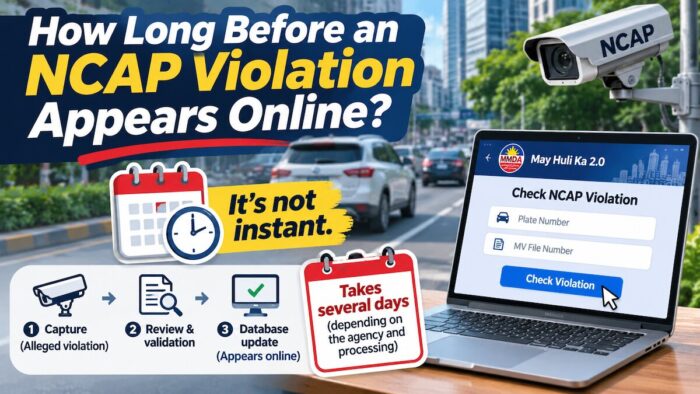
However, an NCAP violation does not necessarily appear online immediately after it is recorded. The process involves several steps, including reviewing the footage, validating the violation, registering it, and notifying the registered vehicle owner.
The waiting period can vary depending on the traffic enforcement agency, location, and processing requirements. Motorists should also understand that checking an online portal is different from receiving an official Notice of Violation (NOV).
This guide explains how long NCAP violations may take to appear online, where to check them, what to do if no record is found, and how to contest a traffic violation.
How Long Does It Take for an NCAP Violation to Appear Online?
No single guaranteed posting timeframe applies to every NCAP violation nationwide.
The time it takes for an NCAP violation to appear online depends on the issuing authority and its processing system.
For MMDA-recorded violations, the process generally involves reviewing camera footage, manually validating the alleged violation, and updating the traffic enforcement database.
The Metropolitan Manila Development Authority (MMDA) has previously explained that recorded footage undergoes manual validation before a motorist receives an NCAP notification.
This means a violation captured by a traffic camera may not appear in the online system immediately.
Expected NCAP violation posting timeline
The following table explains the stages motorists should expect. These are process descriptions, not guaranteed deadlines.
| Stage | What happens |
|---|---|
| Day of the alleged violation | A camera records the vehicle and a possible traffic violation. |
| Initial processing | The footage and vehicle information enter the enforcement system. |
| Validation | Authorized personnel review the footage to determine whether a violation occurred. |
| Database update | The validated violation is processed and may become available through the online portal. |
| Notification | The registered vehicle owner may receive an official notice. |
| Payment or contesting | The motorist follows the instructions provided by the issuing authority. |
A violation may become searchable before the physical notice arrives. Conversely, a notice may take longer to reach the registered owner because of mailing and delivery delays.
Important: Do not assume that a violation is automatically dismissed because it has not appeared online after a few days.
The absence of an online record does not necessarily mean that no violation was recorded.
Why does an NCAP violation take time to appear online?
Several factors can affect how quickly an NCAP violation is processed and posted.
1. Manual validation of traffic camera footage
NCAP systems may use cameras and automated technology to identify possible traffic violations. However, personnel must validate the recorded footage before confirming a violation.
The reviewing personnel must determine whether the vehicle committed the alleged offense and whether the footage contains sufficient evidence.
For example, the system might initially flag a vehicle entering a prohibited lane. The reviewing personnel must verify the footage and confirm whether the vehicle actually violated the traffic regulation.
2. Volume of recorded violations
Traffic cameras along busy roads can record numerous incidents throughout the day.
A large volume of footage may affect how quickly authorities process and validate violations.
During heavy traffic, enforcement agencies may have more recordings to review, which could delay posting.
3. Database synchronization
After validation, the violation must be processed and reflected in the relevant traffic enforcement database.
Technical issues, system maintenance, and delays in updating records may affect when motorists can see their violations online.
4. Different enforcement agencies
NCAP implementation is not necessarily identical across all cities.
The MMDA and participating local government units may use different portals, processing procedures, and notification systems.
A violation recorded by one authority may not appear on another authority’s website.
5. Mailing and notification delays
The online posting date and the date a Notice of Violation reaches the registered vehicle owner may not match.
Physical notices may take additional time to print, process, and deliver.
Motorists should check the official online system rather than relying exclusively on postal delivery.
Is NCAP currently implemented in the Philippines?
Yes. NCAP implementation resumed following developments in the Supreme Court proceedings.
The Supreme Court issued a temporary restraining order in August 2022 against NCAP implementation. In May 2025, the Court partially lifted the TRO, allowing the MMDA to resume NCAP enforcement on major roads under its jurisdiction.
On July 9, 2026, the Supreme Court dismissed consolidated petitions challenging the Metro Manila NCAP ordinances. The Court explained that the issues became moot after the adoption of a new, uniform traffic enforcement framework under the Metro Manila Traffic Code of 2023.
The Court’s dismissal should not be interpreted as a blanket declaration that every NCAP implementation nationwide is constitutional. The decision addressed the specific petitions before it.
In October 2026, six Metro Manila local governments announced they would resume NCAP implementation: Manila, Quezon City, Valenzuela, Parañaque, Muntinlupa, and San Juan.
Motorists should check the current enforcement status and procedures of the specific city or agency involved.
Where can you check NCAP violations online?
The correct website depends on the authority that recorded the alleged violation.
1. MMDA May Huli Ka website
The MMDA launched the May Huli Ka 2.0 website so motorists can check NCAP violations online.
The official website is:
mayhulika.mmda.gov.ph
Motorists are generally required to provide:
- Vehicle plate number or conduction sticker number
- Motor Vehicle (MV) file number
The MV file number is included as an additional security measure to help protect vehicle owners’ information.
You can find the MV file number in your vehicle’s Official Receipt and Certificate of Registration (OR/CR).
How to check an NCAP violation through May Huli Ka
-
Open the official MMDA May Huli Ka website.
-
Enter your vehicle’s plate number or conduction sticker number.
-
Enter the correct MV file number.
-
Submit the information to check for recorded violations.
-
Review any violation records displayed.
-
Follow the official instructions to pay or contest the violation.
Make sure you enter the correct vehicle information. A single incorrect character may result in a “No Record Found” message.
The May Huli Ka portal covers MMDA NCAP records. Do not treat it as a universal database for all traffic violations nationwide.
2. eGovPH application
The MMDA and Department of Information and Communications Technology integrated NCAP services into the eGovPH application in July 2026.
The integration allows motorists to access relevant NCAP records, track payment status, and use available traffic services through the government application.
Vehicle owners should register their vehicles using the platform’s required information and check whether their records are available.
The eGovPH application provides another convenient channel for accessing MMDA NCAP information, but it does not necessarily replace participating LGUs’ individual portals.
3. Local government NCAP portals
Some local government units maintain their own online traffic enforcement systems.
Motorists should check the official website or traffic management office of the city where the alleged violation occurred.
For example, a violation recorded in Quezon City may need to be checked through the appropriate Quezon City traffic enforcement system rather than the MMDA portal alone.
The same principle applies to other participating cities.
| Enforcement authority | Where to check |
|---|---|
| MMDA | May Huli Ka website or available eGovPH services |
| Quezon City | Official QC traffic enforcement portal or designated office |
| Manila | Official Manila traffic enforcement channels |
| Valenzuela City | Official Valenzuela traffic enforcement channels |
| Parañaque City | Official Parañaque traffic enforcement channels |
| Muntinlupa City | Official Muntinlupa traffic enforcement channels |
| San Juan City | Official San Juan traffic enforcement channels |
Portal availability, features, and procedures can change. Confirm the current official channel before submitting personal information or making payments.
What does “No Record Found” mean on the NCAP website?
If the NCAP website displays “No Record Found,” it means the search didn’t return a matching violation record based on the information you entered.
However, this does not automatically prove that you have no traffic violations.
There are several possible reasons.
Incorrect vehicle information
You may have entered an incorrect plate number, conduction sticker number, or MV file number.
Double-check your OR/CR and try again.
The violation has not been validated
The alleged violation may still be undergoing review.
If the camera footage has not been validated or the record has not been processed, it may not appear in the portal yet.
The violation is recorded by another authority
A traffic violation recorded by an LGU may not appear on the MMDA website.
Likewise, an MMDA violation may not appear in a local government portal.
The violation is not covered by NCAP
A traffic ticket issued directly by a traffic enforcer may not appear in an NCAP database.
Manual apprehensions, parking violations, and other traffic enforcement records may require a separate checking process.
The online portal is experiencing technical issues
System maintenance, connectivity problems, or temporary database issues may prevent motorists from retrieving their records.
Try again later or contact the relevant traffic enforcement office.
Practical tip: If you recently passed through a camera-monitored road, check the appropriate portal periodically rather than repeatedly searching every few minutes.
How often should you check for an NCAP violation?
No official universal schedule requires motorists to check NCAP websites at a specific frequency.
However, if you suspect you committed a traffic violation, check the appropriate official portal a few days later and periodically thereafter.
A practical approach is to:
- Check the relevant portal a few days after the alleged violation.
- Recheck after several days if no record appears.
- Verify the official notification channels associated with your vehicle registration.
- Keep your vehicle registration and contact information up to date.
- Check the relevant authority if you have a specific concern or received a notice.
This is a practical recommendation, not a formal NCAP deadline.
Do not delay responding to an official Notice of Violation simply because you are waiting for the record to appear on another website.
How long does it take to receive an NCAP Notice of Violation?
The time required to receive an NCAP Notice of Violation may vary depending on the enforcement agency and delivery method.
For MMDA violations, motorists may receive notifications through available official channels, including physical notices and electronic notifications.
The MMDA has previously stated that its delivery personnel deliver physical notices to registered vehicle owners in Metro Manila.
For registered owners outside Metro Manila, the MMDA may send notices through postal or express mail services.
A physical notice may therefore arrive later than the online record.
The MMDA also introduced SMS and email notification features. However, motorists should verify the current notification procedures because these may change.
Keep your contact information updated in the Land Transportation Office’s records whenever necessary.
Can you receive an NCAP violation even if you did not receive a text message?
Yes, motorists should not rely exclusively on text messages or email notifications.
An SMS notification is a convenient way to alert vehicle owners, but a missing message does not automatically prove no violation exists.
Possible reasons for missing notifications include:
- Outdated mobile numbers
- Incorrect contact information
- Network or delivery problems
- Spam filtering
- Notification system delays
- Records that have not yet been processed
The safest approach is to verify violations directly through the issuing authority’s official portal.
Beware of fake NCAP text messages
The MMDA has warned motorists about fraudulent text messages and websites impersonating NCAP systems.
According to the Philippine Information Agency’s report on the MMDA advisory, the agency identified MMDA_NCAP as its official SMS sender ID.
The MMDA also warned motorists against suspicious payment links and fake websites.
If you receive a message claiming that you have an NCAP violation:
-
Do not click unfamiliar payment links.
-
Do not provide banking information or passwords.
-
Do not immediately pay through an unfamiliar website.
-
Manually type the official portal address into your browser.
-
Verify the violation using the required vehicle information.
Report suspected scams through official MMDA channels.
What should you do if an NCAP violation appears online?
Once a violation appears in the official portal, review the record carefully before making a payment.
Step 1: Verify the violation details
Check the following information:
- Vehicle plate number
- Date and time of the alleged violation
- Location
- Type of traffic violation
- Corresponding fine
- Available photographic or video evidence
- Instructions for payment or contesting the violation
If the details are incomplete, contact the issuing authority for clarification.
Step 2: Review the evidence
If photographic or video evidence is available, examine it carefully.
Check whether:
- The vehicle shown is yours.
- The plate number is correct.
- The location and timestamp are accurate.
- The alleged traffic violation is clearly identifiable.
- Road signs or traffic markings support the alleged violation.
If the evidence seems incorrect or unclear, consider filing a formal contest instead of paying immediately.
Step 3: Check the payment deadline
Base the payment deadline on the applicable notice and the issuing authority’s official rules.
Do not assume that every NCAP violation has the same payment deadline.
Check the official Notice of Violation and follow the instructions provided.
Step 4: Pay through authorized channels
If you decide to settle the violation, use only payment channels officially recognized by the issuing authority.
Keep your payment receipt, transaction number, and confirmation.
These documents may help if your payment isn’t immediately reflected in the online system.
Step 5: Confirm that the payment was recorded
After paying, check the portal again to verify that the payment status has been updated.
If the violation remains unpaid or outstanding despite a successful transaction, contact the issuing authority and provide your payment reference.
How long does it take for an NCAP payment to appear online?
Payment posting times vary depending on the payment method and the issuing authority’s processing system.
Electronic payments may appear relatively quickly, but motorists should not assume every payment will appear immediately.
If your payment does not appear:
-
Check your payment confirmation.
-
Verify the transaction reference number.
-
Allow the payment provider’s stated processing period.
-
Contact the issuing authority if the record remains outstanding.
-
Keep all supporting documents.
Avoid paying the same violation twice just because the online system hasn’t updated.
Can you contest an NCAP violation?
Yes. Motorists generally have the right to contest an alleged traffic violation through the appropriate traffic adjudication process.
The procedure depends on the issuing authority and the applicable traffic enforcement rules.
Under the Metro Manila Traffic Code framework, motorists may contest traffic violations through the designated traffic adjudication mechanism.
The MMDA has also provided procedures for contesting NCAP apprehensions.
Common reasons to contest an NCAP violation
You may consider filing a contest if:
- Your vehicle was incorrectly identified.
- The plate number does not match your vehicle.
- The recorded vehicle was not yours.
- The alleged violation did not occur.
- The traffic sign or road marking was unclear or missing.
- The camera footage does not support the alleged violation.
- The violation was recorded on the wrong date, at the wrong time, or at the wrong location.
- The vehicle was being driven under circumstances that require further review.
How to contest an NCAP violation
-
Read the Notice of Violation carefully.
-
Identify the issuing authority.
-
Check the official deadline for filing a contest.
-
Gather supporting evidence.
-
Submit your contest through the designated online portal or adjudication office.
-
Keep a copy of your submission and acknowledgment.
-
Attend any required hearing or follow-up procedure.
Supporting evidence may include photographs, dashcam footage, vehicle documents, or other relevant records.
Important: Do not ignore the contest deadline
The MMDA’s previously published procedures indicated that motorists could contest an NCAP violation within 10 working days from receipt of the Notice of Violation.
However, motorists should verify the applicable deadline under the current rules and notice they received.
Do not automatically assume that the same deadline applies to every city or enforcement authority.
Can NCAP violations affect your vehicle registration?
An NCAP violation may affect traffic enforcement records and vehicle-related transactions, depending on the applicable rules.
The Metro Manila Traffic Code framework includes procedures for recording traffic violations and coordinating relevant information with the Land Transportation Office’s Land Transportation Management System.
However, motorists should not assume that every NCAP violation automatically results in an LTO registration restriction.
Consequences depend on the violation, issuing authority, applicable regulations, and the status of the record.
If you are concerned about vehicle registration, check directly with the LTO and the traffic enforcement agency responsible for the violation.
What motorists should remember about NCAP violations
The most important thing to remember is that NCAP violations do not necessarily appear online immediately after they are recorded.
The process involves footage review, validation, database processing, and notification.
Motorists should:
- Check the correct official portal.
- Enter vehicle information accurately.
- Avoid assuming that “No Record Found” means no violation exists.
- Keep vehicle registration and contact information up to date.
- Review violation evidence before paying.
- Observe the official payment or contest deadline.
- Avoid suspicious SMS messages and payment links.
- Keep receipts and confirmation documents.
NCAP systems and procedures may change as government agencies update their enforcement policies and digital services.
For the most accurate information, motorists should verify the current requirements with the MMDA, relevant LGU, or LTO.
Frequently Asked Questions About NCAP Violations
1. How many days before an NCAP violation appears online?
There is no guaranteed nationwide timeframe for when an NCAP violation appears online. The posting timeline depends on the enforcement agency, footage validation, database processing, and notification procedures. Some violations may become searchable sooner than others. If you suspect that you committed a violation, check the appropriate official portal periodically. Do not assume that a violation has been dismissed simply because it has not appeared online after several days.
2. Can an NCAP violation appear online after one week?
Yes. An NCAP violation may appear online several days after the alleged traffic offense, depending on how quickly the footage is validated and processed. However, one week is not a guaranteed posting deadline. A record may take longer to appear, particularly when processing or technical issues occur. If you are concerned about a particular incident, check the appropriate official portal and contact the issuing authority if you need clarification.
3. Does “No Record Found” mean I have no NCAP violation?
Not necessarily. A “No Record Found” message means that the system did not return a matching record based on your submitted information. The violation may still be undergoing validation, or you may have entered an incorrect plate number, conduction sticker number, or MV file number. The alleged violation could also belong to another enforcement agency. Check your information carefully and consult the appropriate authority if you remain concerned.
4. How do I check NCAP violations online in the Philippines?
For MMDA NCAP violations, motorists can use the May Huli Ka website and provide the required vehicle information, including the plate number or conduction sticker number and MV file number. The eGovPH application also provides access to MMDA NCAP services. For violations recorded by participating local governments, check the official portal of the city concerned. Remember that one website may not display every traffic violation recorded nationwide.
5. Can I check my NCAP violation using only my plate number?
The MMDA May Huli Ka 2.0 website requires additional vehicle information for verification, including the MV file number. This requirement helps protect motorists’ personal information and prevents unauthorized access to traffic records. Have your vehicle’s Official Receipt and Certificate of Registration ready when checking your violation. Other LGU portals may have different verification requirements, so follow the instructions provided by the official website.
6. Will I receive an NCAP violation through text message?
Motorists may receive SMS notifications from the relevant enforcement authority when an NCAP violation has been processed. However, text notifications depend on the agency’s system and the contact information associated with the vehicle. A missing text message does not automatically mean that no violation exists. Check the official portal directly, and avoid clicking unfamiliar links in messages claiming that you have an outstanding traffic fine.
7. How long does it take to receive an NCAP Notice of Violation by mail?
The delivery period depends on the issuing authority, the registered address, and the postal or delivery service used. MMDA notices may be delivered through its designated personnel or postal services, depending on the vehicle owner’s location. A physical notice may arrive after the violation becomes available online. Motorists should not rely exclusively on postal delivery and should verify their records through official channels when necessary.
8. Can I pay an NCAP violation online?
Yes, online payment may be available through authorized platforms provided by the MMDA or participating local government units. The available payment methods depend on the issuing authority and its current digital services. Before paying, verify the violation details and the amount due. Use only official payment channels, retain the transaction receipt, and check whether the payment status has been updated. Never pay through suspicious links sent by unknown numbers.
9. What should I do if I paid my NCAP violation but it still appears online?
If your NCAP violation remains outstanding after payment, first verify your transaction confirmation and payment reference number. Online systems may require time to process and update payment records. Avoid paying the same violation again without checking with the issuing authority. Contact the appropriate traffic enforcement office and provide your receipt or transaction details. Keep copies of all communications until the system officially reflects the payment.
10. Can I contest an NCAP violation if I believe it was incorrect?
Yes. Motorists may contest an alleged NCAP violation through the designated traffic adjudication process. Review the Notice of Violation, check the filing deadline, and gather supporting evidence. This may include photographs, dashcam footage, vehicle documents, or other relevant records. Submit your contest through the official portal or designated office and retain proof of submission. Follow the applicable rules of the issuing authority.
11. How many days do I have to contest an NCAP violation?
The deadline depends on the applicable rules and the Notice of Violation issued by the enforcement authority. The MMDA has previously published procedures allowing motorists to contest NCAP apprehensions within 10 working days from receipt of the notice. However, verify the current deadline rather than assuming every LGU follows identical procedures. Filing within the prescribed period is important because missing the deadline may affect your ability to contest the violation.
12. Can I check NCAP violations through the eGovPH app?
Yes. MMDA NCAP services became available through the eGovPH application in July 2026. The integration allows motorists to access violation records, check payment status, and use relevant traffic services. Users need to register their vehicles and provide the required information. However, the application may not include every local government traffic violation. If you cannot find a record, check the issuing authority’s official portal or contact its traffic management office.
13. Can an NCAP violation affect my LTO vehicle registration?
An NCAP violation may be recorded within the relevant traffic enforcement system and may have implications under applicable traffic rules. However, motorists should not assume that every violation automatically prevents vehicle registration renewal. The actual consequences depend on the issuing authority, applicable regulations, and the violation’s status. If you have concerns about registration restrictions or outstanding traffic records, verify the details with the LTO and the agency that issued the citation.
14. Are NCAP violations from different cities available on one website?
Not necessarily. The MMDA May Huli Ka website primarily covers MMDA NCAP records, while local government units may maintain their own enforcement portals. Some services may be integrated into broader government platforms, but motorists should not assume that one website contains every traffic violation nationwide. If you traveled through multiple cities, check the relevant official portals and verify which authority recorded the alleged violation.
15. How can I avoid fake NCAP violation text messages?
Always verify traffic violations through official government websites or recognized applications. Avoid clicking unfamiliar payment links, sharing banking details, or providing passwords through text messages. The MMDA has warned motorists about fake NCAP messages and impersonation websites. Manually enter the official May Huli Ka website address into your browser instead of following links from unknown senders. If you suspect a scam, report it through official MMDA channels and do not make payments until the violation is verified.
Final reminder for Filipino motorists
If you recently passed through an NCAP camera, remember that a violation may take time to appear online because authorities must review and validate the recorded footage.
There is no universal posting deadline that guarantees when every NCAP violation will become searchable.
Use the correct official portal, verify your vehicle information, and carefully review the Notice of Violation if one is issued. If you believe the apprehension is incorrect, follow the official contest procedure and observe the applicable deadline.
Do not rely on unofficial websites or suspicious text messages to check or pay traffic violations.
Follow #TeamOutofTown on Facebook, Twitter, Instagram, and Pinterest for more travel ideas.
Also read:
- How to Apply for RFID Sticker for SLEX, NLEX, CAVITEX, Etc. (EasyTrip & Autosweep)
- How to Renew Your Motorcycle Registration in the Philippines
- Updated LTO Student Permit Requirements and Procedure 2023
- A Complete Guide to Driver’s License Renewal in the Philippines
- NCAP Cameras in Metro Manila Cities: What Motorists Need to Know
- 10 Things Metro Manila Drivers Should Know About NCAP
- How to Spot NCAP Scams and Fake Text Messages
- 10 Traffic Violations That Can Get You an NCAP Ticket
- How to Contest an NCAP Traffic Violation: Appeals, Deadlines, Fines, and Legal Rights
- How to Pay NCAP Fines Online in the Philippines
- How to Check NCAP Violations Online: Official MMDA and City Government Portals