

 Melo Villareal
Asin Tibuok: Traditional Sea Salt Making in Alburquerque, Bohol, Philippines
Bohol is known for many extraordinary things, such as the iconic Chocolate Hills, Panglao Island, and the world’s smallest primate, the Tarsiers. But did you know that there’s one interesting product that is truly unique to Bohol? Yes, and this time, it’s mainly for culinary use. I’m talking about the ever-famous Dinosaur Egg.

Asin Tibuok photo via Kabilin Albur FB Page
Oh, did the name catch you off-guard too? But it’s true. The Bohol-native Asin Tibuok or Asin Tibook really does have a lot of similarities with a dinosaur egg. First off, the appearance of this artisanal sea salt really resembles that of a dinosaur egg. Moreover, the method of preservation used to create Tibuok sea salt has existed way before the Spanish colonization, about 500 years ago! Filipino farmers used this type of salt preservation to trade with hacienderos for their rice. Both parties receive the kind of staple they need at the end of the day.
Today, the legendary Asin Tibuok way of salt preservation is on the brink of extinction as the saltmakers are slowly retiring with no one to inherit the tradition.

What Makes Tibuok Sea Salt Rare and Unique?
Asin Tibuok is very rare and unique because of the traditional meticulous process of making it. Basically, it’s made from filtering seawater through ashes. But how is this legendary artisanal salt really made?

We visited a remote village in the town of Alburquerque to see how this artisanal salt is made. First, coconut husks are left to soak in seawater for several months so they can absorb natural sea minerals along the coastline during high tide.


This process alone gives us an idea of how long it takes just to acquire the natural minerals required for Asin Tibuok’s unique taste. The coconut husks are then chopped into small pieces and sun-dried for at least 2 to 3 days. After that, these husks are slowly burned over several days strictly using native hardwoods like Ipil-Ipil, Mahogany, and Duhat. This coconut charcoal combination provides the unique aroma of Asin Tibuok.

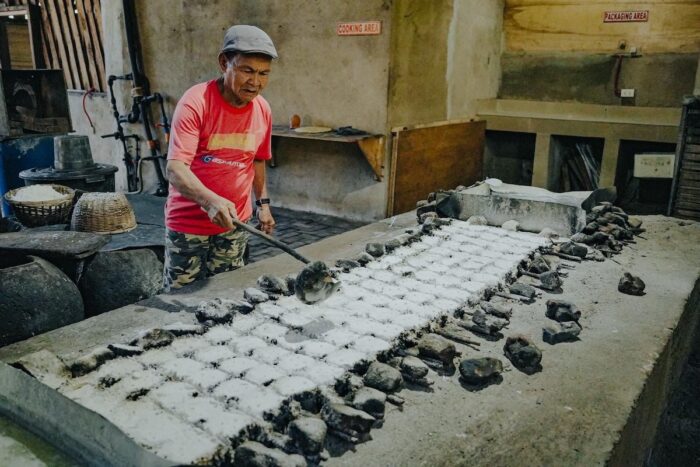
Next, lots of seawater are then filtered using activated charcoal called gasang. The filtered seawater is then transferred to the dinosaur egg-shaped clay pots and hung on walls in a special furnace. The brine (known as tasik) is collected into a hollowed-out coconut trunk beneath the funnels. These are boiled for a few hours in the furnace, continually replenishing the pots with more tasik once some evaporate. As more water evaporates, the sea salt gets harder, and the process continues until the clay pot gets filled with hard rock salt.
Eventually, the pots will crack, revealing the solidified pinkish mass of salt. The salt mass will be initially very hot, and it usually takes a few hours before it is cool enough to be handled. They are sold along with the broken domed pots, which have given them the nickname “the dinosaur egg” in international markets due to their appearance.

This final process requires focus and dedication as both the heat and salt must not be left alone. After following this heating process all day, it then requires a whole evening before the Asin Tibuok becomes cool enough to handle.
Asin Tibuok’s Culinary Uses
As expected from the unique and meticulous process to make Asin Tibook, it also offers an equally special flavor that undoubtedly makes it one of the rarest kinds of salt in the world. Asin Tibuok gives off a smoky and salty flavor with a hint of both umami and sweetness. Well, these are reasons why Asin Tibuok has a never-ending list of culinary uses!
To harvest the legendary salt and incorporate it into your cooking, you have to use a Microplane grater and scrape away from the dinosaur egg or solid salt dome. For starters, it can be used as a regular table salt and season lots and lots of dishes like stews and fried meat and fish. If you want to use the salt in chunks or ground bits, it’s up to you because it works both ways just fine. Some even use Asin Tibuok to season their desserts or make a simple pasta out of it together with tomatoes and oil. Asin Tibuok brings a unique and smoky flavor to the table, and it’s definitely worth a try.
Traditionally, Asin Tibuok is casually dusted over plain hot rice with a few drops of oil, and it’s already consumed as is! You’ll be surprised how flavorful this simple meal truly is, and it can already take you throughout the day.
Where Can You Buy Asin Tibuok?
Despite the ultimate rarity of Asin Tibuok, it’s good to see that several Filipinos and even foreigners are now appreciating this legendary artisanal salt from Bohol. Back then, the only way to buy Asin Tibuok was to fly directly to Tagbilaran and visit the town of Albuquerque, Bohol, to get some from the local markets there.
Now, it’s nice to know that they are also available online! There are already some online stores that sell authentic Asin Tibuok that are 100% made from the province of Bohol.
You can buy Asin Tibook at Kabilin sa Albur website or via Ritual Dumaguete – it is an organic grocery store and they have an online store on Shopee where you can buy authentic Tibuok sea salt at reasonable and affordable prices. Their shop is also trustworthy, having received several positive reviews since they started selling the iconic salt. If you’re interested in buying one, I suggest that you do it quickly because it sells out really fast!
Follow Out of Town Travel Blog on Facebook, Twitter, Instagram, and Pinterest if you want more travel and tech-related updates.
Read:
- Adobong Manok: Easy Chicken Adobo Recipe
- Alburquerque Church: The Santa Monica Parish Church in Bohol