Team Out of Town
Bucket List: Best Activities and Amazing Places to Visit in Ronda, Spain
Ronda is a beautiful city filled with rich culture, tradition, and historical monuments that make it a must-visit destination!
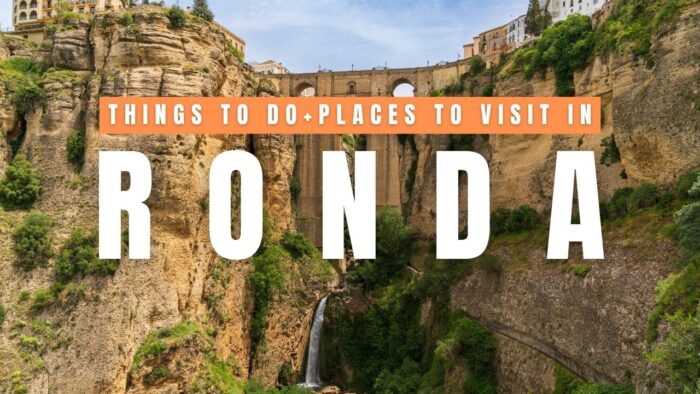
Best Things to do in Ronda, Spain
The city of Ronda is considered to be one of the most majestic places to visit in Spain! You can find tons of historical and traditional things in Ronda, even dating back to the early 1700s! In this article, we’re going to show you 15 of the best things to do in the city of Ronda!
1. See the majestic Puente Nuevo!

The Puente Nuevo, also known as the “New Bridge,” is one of the most famous attractions to visit in Ronda! The 227-year-old arched stone bridge (built in 1793) offers an incredible view of the surrounding valleys for locals and tourists. One might even say that the view is “mesmerizing”!
The bridge was designed by the architect José Martin de Aldehuela and built by Juan Antonio Díaz Machuca. In fact, the one present today is a replacement for the first one, which lasted for only six years before collapsing, causing the deaths of 50 individuals. Construction began around 1759 and took nearly 40 years to complete the bridge.
The stone bridge also had a small stone chamber located in the middle, used as a prison throughout the 19th century and Spain’s Civil War. The prison has been turned into a museum where it exhibits the stone bridge’s history, the prison, and how it all came to be. The entrance fee to the chamber last checked was €2.
The Puente Nuevo is one historical monument you should definitely see in the city!
2. See the Plaza del Toros (The Bullring)

Now, after the Puente Nuevo, it is a short walk to Ronda’s neoclassical Plaza del Toros. The Plaza del Toros, or “The Bullring,” is considered to be one of the largest and oldest bullrings in Spain. The bullring was also built by the same architect as the Puente Nuevo; it was built by architect José Martin de Aldehuela in 1785.
The Plaza de Toros is also considered the birthplace and home of modern bullfighting. It is said that Spain’s first-ever corrida de Toros (bullfight) took place here. Francis Romero, a significant Spanish matador born in Ronda in 1695, is credited as the founding father of the bullfighting dynasty and for giving bullfighting its modern-day rules, including the introduction of the cape and the muleta. Pedro Romero (1754-1839) became one of Spain’s greatest bullfighters and is considered a key figure in bullfighting history. Pedro founded the Ronda School for Bullfighting; it is still known today for its classicism and strict adherence to the rules.
The ring can hold up to 5,000 spectators, and underneath the seats lies the story of the Real Maestranza de Ronda, the Museo Taurino (Bullfighting Museum), and the Royal Harness Collection of the House of Orleans. The Museo Taurino holds two centuries of bullfighting history, bullfighting regalia, and important outfits.
The collection also includes a large number of weapons used by the Real Maestranza in the Spanish war. The museum is open year-round except during the week of the Feria in September; entry costs 7.00 € per person, or 8.50 € with an audio guide.
3. Go inside the Baños Arabes (Arab Baths)

Even dating back to the end of the 13th century, the Baños Arabes still remain in tremendous condition. Back then, the baths were used by the Moorish empire. The cold, warm, and hot rooms are all still intact but no longer in use, though locals and visitors can still visit the domed rooms, which offer a gorgeous view of their star-shaped vents in the ceiling.
The baths are located near the old city walls, near the Puente Arabe, located in the old Arab quarter of the city, known as the San Miguel Quarter. It plays a huge part in the city’s Moorish heritage.
It is said to be one of the most important tourist attractions in Ronda, and some even argue it is more important than the unquestionably beautiful Puente Nuevo or Ronda’s other claim to fame, the Plaza de Toros. It is also one of the best-preserved baths in Spain. The entrance costs 3.75 € per person.
4. The Mondragón Palace

The elegant Palacio de Mondragón was originally built in 1314 by the Moorish King Abomelik. The Moorish palace served as the home of King Abomelik, was then handed over to Seville’s distinguished family, and was later renovated in the 15th century. Today, it is home to the Municipal Museum in Ronda, where one can learn more about its history.
The palace has a grand view of the El Tojo gorge, and although some medieval elements are gone, the cliff-top setting and garden complex still give it a sense of it. Inside the palace, you can see the coffered ceilings, and the original geometric tiling stands out. The municipal museum exhibits can fill you in on this building’s exciting history and the town around it.
It is considered the most important Ronda monument for its historical and archaeological significance, featuring genuine Moorish elements and decorations. The palace now showcases the history of the palace and the city to locals and tourists. The entrance fee is around 3.75€ per person, and entry is free for EU citizens from 3 PM on Tuesdays.
5. Take a stroll at the Alameda del Tajo

Take a stroll out to the Alameda del Tajo, a public park that has been around since the 19th century. The park looks somewhat like a front garden for the town which has tree-lined promenades and various other mature trees typical in ornamental gardening in the Málaga province, notably the Himalayan cedar and acacia pine, as well as more commonplace pines and, around its fountains, pergolas twined with roses hymned by James Joyce in Finnegans Wake.
The park also offers a panoramic view of the Tajo gorge. Many local families head there for the paseo (evening stroll).
6. Visit the La Casa del Rey Moro

The La Casa del Rey Moro, or Home of the Moorish King, was never actually the home of any Moorish kings, as it was built in 1709. The monument now serves as a heritage museum in Ronda and features 3 key figures.
The 14th-century water mine, which served as a water supply for the city of Ronda; the neo-Mudejar house, which is now being restored; and Jean Claude Nicolas Forestier’s serene hanging gardens surrounding the house, created in 1912.
The place offers beautiful scenery that goes way back in time, and even the El Tajo gorge view. The place is located in La Ciudad, or “the old town,” part of the city.
7. The Iglesia de Santa María la Mayor

Right after a 10-minute walk from the Puente Nuevo is the magnificent Catholic church, the Iglesia de Santa María la Mayor. This church was built in the 14th century as one of the city’s original Muslim mosques.
The church is also a national monument of the city and one of Ronda’s largest and most attractive churches. As it was built in the 14th century, the church shows different architectural styles, such as Renaissance, Baroque, Gothic, and Mannerist.
It is located on the main square in the old town (La Ciudad) of Ronda and has an entry fee of 4.50 € (audio guide included). The entrance is free for devotees and residents of Ronda. All in all, the church is one place you should definitely see!
8. Visit the spooky Museo Lara

Just located across the Puente Nuevo is the spooky Museo Lara or locally known as the “The Palace of the Count of the Conquest of the Batanes Islands.” It lives up to its name as well, being one of the city’s best museums.
This museum is very much different from your ordinary museum. It has tons of collections dedicated to antique scientific instruments, weaponry, cinema and photography, torture, and witchcraft-related items that you can’t see anywhere else!
This private collection is owned by none other than Juan Lara Jurado, who has been a collector since the age of 10. He bought the building in 1993 and opened the museum six years later. It is said that he still lives above the museum in his 80s. The entry fee is 4 € and 2 € for seniors.
9. Stand in the Coño Balconies

Overlooking the majestic El Tajo gorge is the Coño Balcony, better known as El Balcón del Coño. This balcony is just over the cliffside and offers a straight-down view that will make even the brave shudder.
People usually stand on the balcony and scream the word “coño” in the English sense, saying “sh*t!” but the literal meaning is the female genitalia. Yes, it is considered acceptable to scream the word, but only when you’re standing on the balcony. It is one of the reasons for its name.
The balcony is close to Alameda Park and is known as one of the best places to take in the surrounding landscape.
10. The magnificent Jardines de Cuenca

The Jardines De Cuenca, or Cuenca Gardens, is a park where people can spend hours enjoying the beautiful view of the El Tajo gorge and the Puente Nuevo. It also has a winding staircase from the Puente Viejo to the top of El Mercadillo (New Town).
Built in 1975, the garden has since been surrounded by ever-growing flowers, succulents, trees, palms, and cypresses. Many locals and tourists come here for picnics, and it is said that the view is even better in the early morning or early evening.
11. Go wine tasting!

The city of Ronda has been known to produce wine since Roman times. To this day, the city is known as one of Spain’s winemaking cities. Ronda has also been added to the official list of the Andalusian Wine Route. You can find many small bodegas in the city that produce wine increasingly appreciated both nationally and internationally.
The wine-producing area known as the Serranía de Ronda produces the well-known “Ronda Wines.” There are many wineries in the city, and most offer tours of their facilities and wine production, and, of course, wine tasting. You can find a list of the bodegas here.
12. Take a dip at the Cueva del Gato

Locally known as the “cat’s cave” due to the cave’s mouth being shaped like a cat’s face. This is the best place to relax and take a dip in the very clean, extremely cold water after a long day of sightseeing in the city. The river pool is often found deep in the Andalusian countryside.
Going to the place is very straightforward; you can just drive up there and park alongside the river. You can take two entrances: the northern one in Hundidero or the usual one to the south in the Cueva del Gato. The entrance fee is 2 € per person, and car parking is 1 €.
13. The Ruins of Acinipo

Sometimes referred to as Ronda La Vieja, or “Old Ronda,” this historical landmark is said to date back to the 1st century of the Roman Empire. The ruins of Acinipo were once an ancient city said to have been founded by retired Roman soldiers more than 2,000 years ago.
Over 5,000 people in the 1st century built their homes here. The city also includes a Roman theater with its original architectural designs dating back to the 1st century.
The city has many historical features, and entry is free!
14. Visit the Casa Don Bosco

Also, one of the city’s main attractions is the old house called Casa Don Bosco. Built at the beginning of the 20th century, the Casa Don Bosco has been around for more than 100 years. The house was built in a modernist style, has some of the finest antique furniture in the city, and has a garden facing the majestic El Tajo gorge.
It belonged to one of Ronda’s rich families and was given to the Salestian Priest to serve as a refuge for the sick and elderly. In 1931, it was announced as a historical monument. The entry fee is 2 € per person.
15. The El Tajo gorge

Last but not least is the El Tajo Gorge. This is probably the main highlight of the city! It’s also considered one of the main reasons people worldwide come to see the gorge’s majestic view. It is 120 meters high, and it’s quite narrow, approximately 68 meters wide. The gorge was formed by the constant erosion of the Guadalevín River.
The gorge also divides the city into La Ciudad (Old Town) and El Mercadillo (New Town). The Puente Nuevo bridge provides a great vantage point to take in the chasm’s vast view.
It was recently declared a natural monument of Andalusia in 2019. Now, people from all around still see the monument, and some even take the challenge to hike down the chasm! It is also possible to hike down the El Tajo for a better view, and you can even walk along the banks of the Guadaíra River!
These are some of the best things you can do in Ronda! There are still many things to do in the beautiful city, and it’s just waiting for you! Book your trip and enjoy the city of Ronda!
Ronda Travel and Tour Packages
To help you plan out your vacation to Ronda, we listed places to visit and other amazing activities in Ronda, Spain. We also listed some of the best travel deals and tour packages, as well as excellent flight and accommodation deals.
Searching for the best hotels, resorts, and affordable flights in the nearby Cities? Check out our list of affordable Ronda hotels and resorts on Agoda or Booking, or you may also find available Airbnb properties in the city.
Want more updates about new package tours and tourist spots in Ronda, Spain? Follow #TeamOutofTown on Facebook, Twitter, Instagram, and Pinterest for more travel ideas.
Also read:
- Hotel Del Mar In Barcelona
- EL NIDO TRAVEL GUIDE
- Best Things To Do In Crete
- 15 Of The Best Places To Visit In North Carolina, USA
- Malagonlong Bridge In Tayabas City: The Longest Spanish Bridge In The Philippines