

 Nizrhane Abdallah
A Visit to Historic Aachen
Aachen, Germany — When choosing a city to visit, one criterion I consider is its historical significance. Aachen surely fits the bill in terms of its historical significance. As a kid, I always wanted to visit Aachen because of the man who made it famous, Charlemagne. And Charlemagne, with Aachen under his feet, gave rise to Europe.

A Visit to Historic Aachen, Germany
Anyway, it’s a very long story. On to our visit to Aachen, the birthplace of the Holy Roman Empire.
How Aachen Was Born
The story of the city goes way back, even further before Charlemagne and his predecessors. Sources point to Roman times when the place began as a spa town. Aachen was then Aquae Granni, or “Granni’s/Grenus’ Water”, and was under Roman rule until around the year 470. It soon came under Frankish rule. According to some sources, Charlemagne’s father, Pepin the Short, once had a castle in the area because of its close proximity to the hot springs.
When Charlemagne took the reins of the Frankish kingdom, he built an octagonal building called the Palatine Chapel (now part of Aachen Cathedral). The chapel was allegedly part of his palace, where he lived from 768 until his death in 814. The construction of the chapel was one reason Charlemagne himself made Aachen the center of the Empire. He may have been an itinerant Emperor, but the soul of his governance was synonymous with the city he called home.
Today, Aachen is known for its Cathedral, its Aachener Printen, Charlemagne, and its status as the westernmost city in Germany.
How We Got to Aachen
Aachen is located in the state of North Rhine-Westphalia, one of the 16 states of the Federal Republic of Germany. The city itself is surrounded by the Netherlands to the northwest and by Belgium to the southwest. Aachen can easily be reached by train from anywhere in Germany. In our case, we traveled by regional trains from Osnabrück to Aachen for almost five hours (including stops and wait times) for only 46€. We got off in Cologne to take a train to Aachen, which took about 40 minutes.

The Accommodation

We chose A&O Hotel and Hostel (hotel info) because it is close to the central station. We got our twin room for 85€, and it was just right for our three-day stay in Aachen.
Walking Around Aachen
Walking is the best way to get around a new town or city. My husband and I walked to the old part of Aachen from our hotel despite the winter weather — cold and wet. It wasn’t snowing but raining.
The Aachener Altstadt
The old town is always, personally, the main focus of my travels. The Altstadt is where the magic began; it is the nucleus of the present city. German old towns have their own kind of charm. Aachen boasts historical charm spanning more than a thousand years. In it, you will see cobblestone streets leading you to the world-famous Aachen Cathedral.
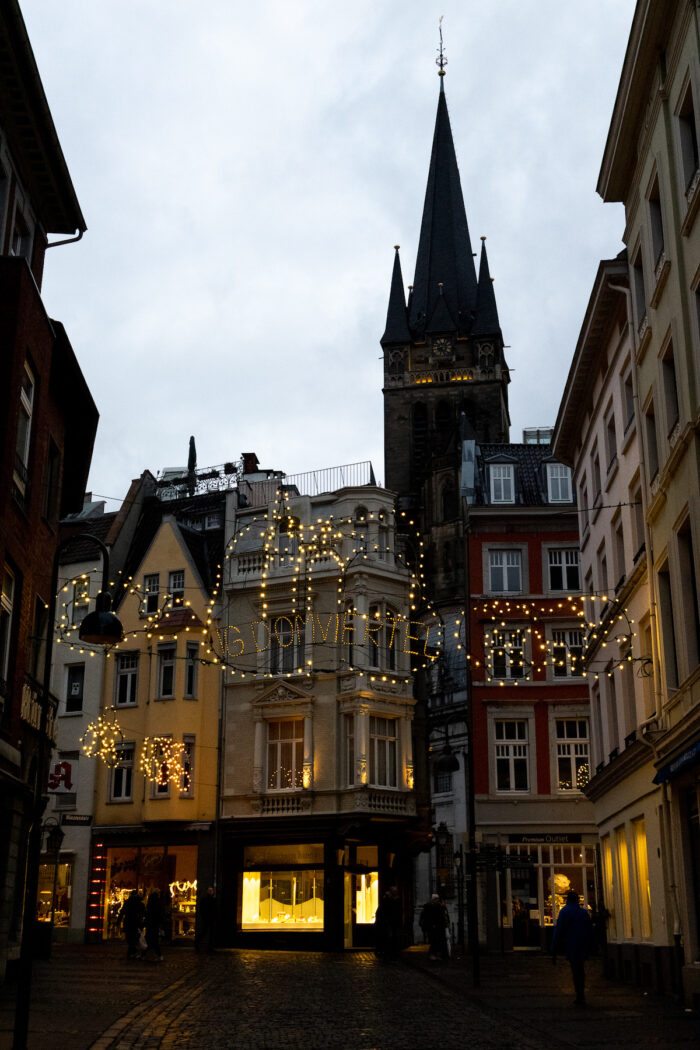
In the picture above, you can see quaint shops, and on top is a portion of the Aachen Cathedral. When we were walking to the Cathedral and saw this view, I couldn’t resist taking a shot of it. The quaintness is just fascinating.
Aachen Cathedral
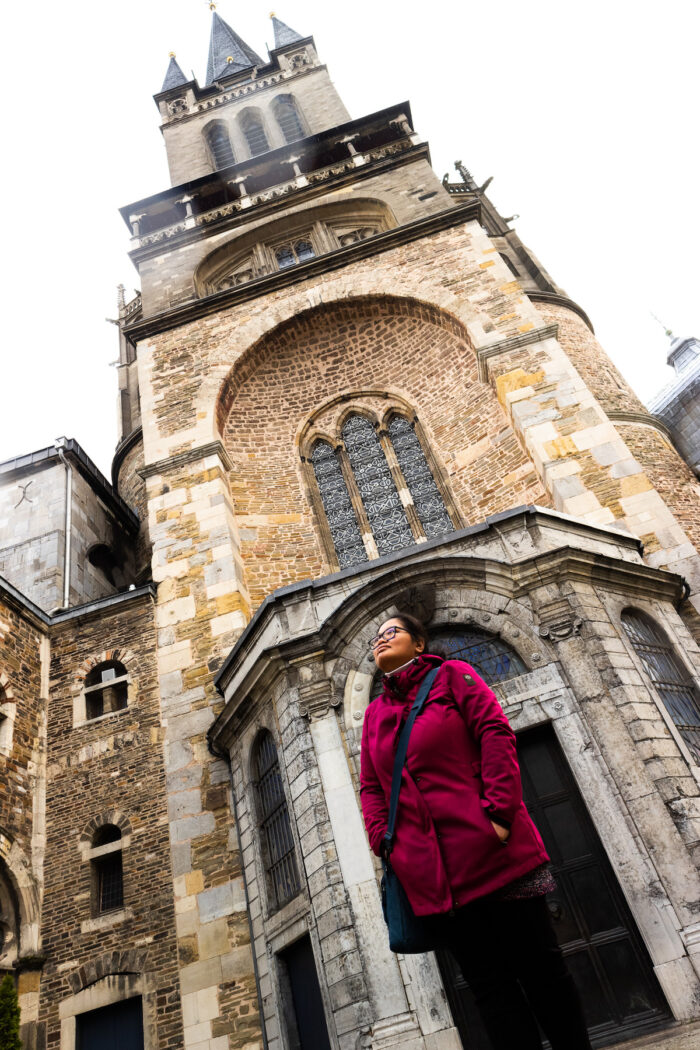
Ah, yes. This 1223-year-old cathedral is right in the heart of the old town. It’s not difficult to miss, because the spire peeks out to greet everyone. The cathedral bells rang in a symphony as we walked towards it. It was magical.
Aachener Rathaus
The present iteration of the Rathaus or Town Hall was built around the fourteenth century. The townspeople who helped build it incorporated the old parts of the building that had been there since Charlemagne’s time. The Town Hall served as the venue for coronation feasts during kings’ coronations.

Centre Charlemagne
The city museum of Aachen offers a time travel worthy of Doc Brown’s approval. As you start your museum tour, you will be greeted by a statue of Charlemagne that suspiciously reminded me of Poseidon in Disney’s “The Little Mermaid”. Also featured in the museum is an illuminated display, “Je suis Charlemagne” (“I am Charlemagne” in French), in the familiar Coca-Cola font.

The Cathedral Treasury
The 1223-year history of the Aachen Cathedral has provided a wealth of religious and historical art enjoyed by visitors yearly. I was able to see the renowned bust of Charlemagne for the first time ever. I used to see photos of this particular artifact in books many years ago, and seeing it made me really happy.

Marschiertor and Ponttor
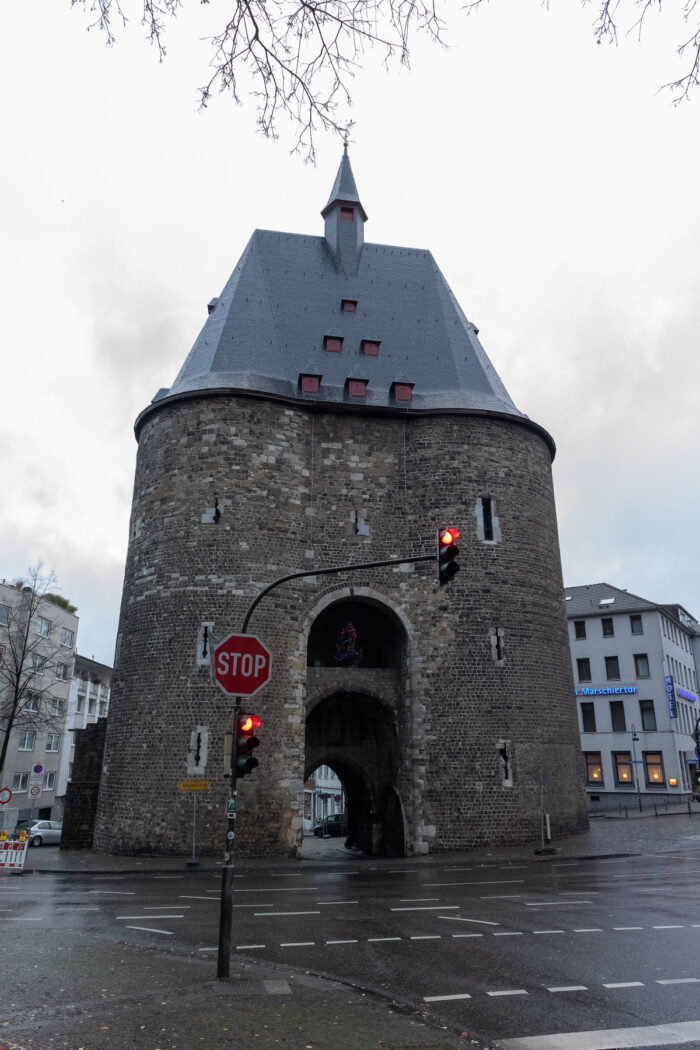
These city gates are two of the oldest city gates in Western Europe. Both north-facing gates stand where the original city walls were.

Another place of Interest: Dreiländerecke
Aachen is known as the westernmost city in Germany. This means that Aachen shares a border with two other countries — Belgium and the Netherlands. Sadly, we weren’t able to visit this marvelous place of interest because of the bad weather. But a quick Google search will provide you with this:

The Three-Country-Point (called “Dreiländereck” in German and “Drielandenpunt” in Dutch) is a curious place, surrounded by three countries, due to its historical significance. Standing by the little obelisk will put you in three countries at once, without passport controls.
From Aachen, one can reach this interesting spot by bus. Or if you’re luckier than we were, you can walk to it on a sunny day.

Aachen, City of History
If you’re a history buff who loves to walk around, Aachen is the city for you. Like any other German city, Aachen has something for everyone, including museums, cafes, and parks. Or if you’re into shopping, Aachen has got it for you.
Check out our complete list of recommended Hotels in Aachen, Germany via Agoda, or you may also see available Airbnb properties in the city.
Also see:
- Best Things to Do in Prague, Czech Republic
- A Tale of Really Going Up North: The Free Hanseatic City of Bremen
- Bologna Travel Guide
- Best Things to do in Nagasaki, Japan
- Rambling Down Las Ramblas
- 5 Camping Sites that are Heaven for Photographers