

 Melo Villareal
Metro Manila LRT-1 Stations: The Complete Travel & Commuter Guide
If you’re searching for a complete and easy-to-follow guide to LRT-1 stations, this is the most comprehensive resource available. The Light Rail Transit Line 1 (LRT-1) is Metro Manila’s longest-running urban railway, connecting Quezon City, Caloocan, Manila, Pasay, and Parañaque through 25 strategically located stations.

Whether you are a tourist exploring Manila’s historic landmarks, a student commuting daily, or a first-time visitor navigating the city, understanding the LRT-1 route, stations, travel times, fare system, and ticket options will help you move around faster, cheaper, and more efficiently.
In this ultimate LRT-1 stations guide, you will find:
- The full LRT-1 stations list from north to south
- Detailed station descriptions
- Estimated travel times between stations
- A complete LRT-1 fare guide
- Ticket types and how to choose the right one
- A step-by-step Beep™ card loading and usage tutorial
- Nearby tourist attractions per station
- Major transfer points
- Practical commuter and safety tips
By the end of this guide, you will know exactly which LRT-1 station to use, how much your ride will cost, how long your trip will take, and what you can explore near each stop.
What Is LRT-1?
The Light Rail Transit Line 1 (LRT-1) is an elevated urban railway system that runs north–south across Metro Manila. It is one of the most affordable and reliable public transportation options in the city, serving millions of commuters every day.
Key Facts About LRT-1
- Length: Approximately 26 kilometers
- Number of Stations: 25
- Northern Terminus: Fernando Poe Jr. (FPJ) Station
- Southern Terminus: Dr. Santos Station
- End-to-End Travel Time: About 50–55 minutes
- Train Type: Electric multiple units (air-conditioned)
LRT-1 is ideal for travelers who want to avoid Manila’s heavy traffic and reach their destinations on time.

LRT-1 Route Overview
The LRT-1 route passes through five major cities in Metro Manila:
- Quezon City
- Caloocan
- Manila
- Pasay
- Parañaque
It connects residential districts, universities, shopping centers, historic landmarks, government offices, entertainment zones, and major transport hubs.
LRT-1 Direction
- Northbound: Dr. Santos -> Fernando Poe Jr. (FPJ)
- Southbound: Fernando Poe Jr. (FPJ) -> Dr. Santos
Trains run in both directions throughout the day.
LRT-1 Fare System Explained
LRT-1 uses a distance-based fare system, meaning your fare depends on the distance traveled.
Fare Matrix
New LRT 1 Single Journey Fare Matrix as of April 2025
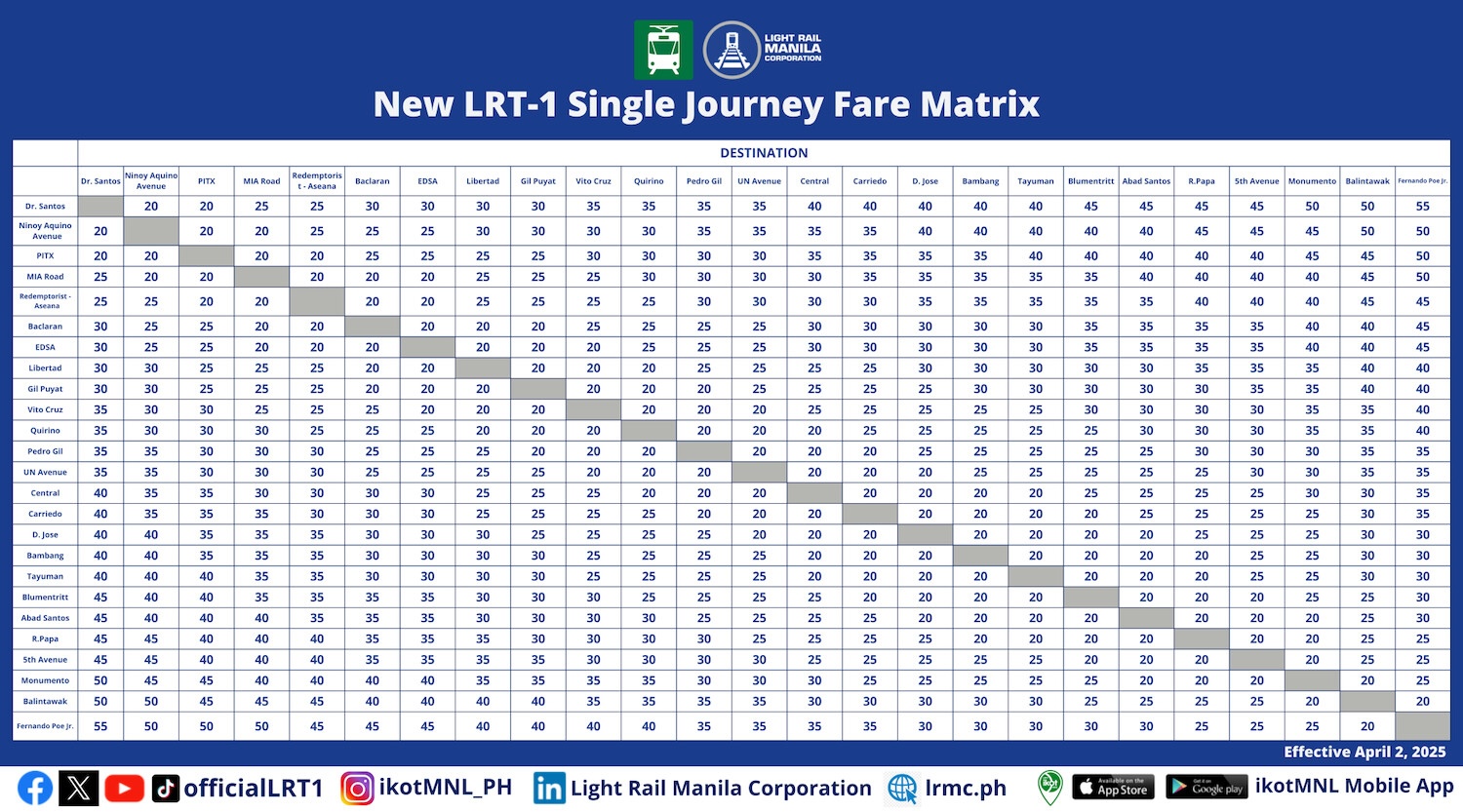

Typical LRT-1 Fare Range
| Trip Length | Estimated Fare |
|---|---|
| Short trips | P20–P25 |
| Mid-range trips | P30–P40 |
| End-to-end | P45–P55 |
LRT-1 Discounted Fares
Discounted fares are available for:
- Students
- Senior citizens
- Persons with Disabilities (PWD)
Valid ID is required to avail of discounts.
LRT-1 Ticket Types
Understanding your ticket options will make your trip smoother.
1. Single Journey Ticket (SJT)
- Valid for one ride only
- Must be surrendered at the exit gate
- Slightly more expensive than stored-value fares
- Ideal for occasional riders
2. Beep™ Card (Stored Value Card)
The Beep™ card is the most convenient option.
Benefits:
- Reloadable
- Faster entry and exit
- Slightly cheaper fares
- Works on LRT-1, LRT-2, MRT-3, and some buses and ferries
This is the best choice for frequent commuters and tourists staying in Manila.
3. QR Code Tickets
- Purchased via official mobile apps
- Scanned at turnstiles
- Ideal for tech-savvy travelers
How to Load and Use Your Beep™ Card (Complete Guide)
The Beep™ card is the easiest and most efficient way to ride LRT-1. Here’s a step-by-step guide.
Where You Can Reload Your Beep™ Card
You can top up your Beep card at:
- LRT-1 station ticket booths
- Ticket vending machines (TVMs)
- Beep™ mobile app (NFC-enabled phones only)
- Partner convenience stores
- Selected e-wallet apps
Reloading at the Ticket Booth (Beginner-Friendly)
- Line up at the counter
- Say: “Maglo-load po ako ng Beep card.”
- Hand over your Beep card
- Give your desired load amount
- The staff will tap and reload your card
- Receive your updated Beep card
Reloading at a Ticket Vending Machine (TVM)
- Select Stored Value Reload
- Tap your Beep card on the reader
- Choose your load amount
- Insert cash
- Wait for the confirmation
- Remove your card
Some machines do not give change.
Reloading Using the Beep™ App (NFC Phones)
- Open the Beep app
- Select Reload
- Choose a payment method
- Enter the amount
- Tap your Beep card on your phone
- Wait for confirmation
How Much Load Should You Add?
| Usage | Suggested Load |
|---|---|
| Occasional travel | P100–P150 |
| Daily commute | P300–P500 |
| Weekly use | P500+ |
Always keep at least PHP 50 in reserve.
How to Use Your Beep™ Card
Entering the Station
- Tap your Beep card on the gate
- Wait for the green light
- Walk through
Exiting the Station
- Tap your Beep card again
- Fare is automatically deducted
- Gate opens
Always tap out properly.
LRT-1 Travel Times and Major Transfer Stations
Understanding LRT-1 travel times helps you plan your commute or sightseeing itinerary more efficiently. On average, stations are spaced 1.5 to 2.5 minutes apart, depending on dwell time and crowd levels.
Estimated Travel Times on LRT-1
| Route | Approx. Time |
|---|---|
| FPJ to Yamaha–Monumento | 8–10 minutes |
| FPJ to Doroteo Jose | 18–22 minutes |
| FPJ to Central Terminal | 40–45 minutes |
| FPJ to Baclaran | 28–32 minutes |
| FPJ to Dr. Santos (end-to-end) | 50–55 minutes |
Note: Actual times vary depending on crowd levels, operational delays, and time of day.
Major Transfer Stations on LRT-1
| Station | Transfer Line / Mode |
|---|---|
| Doroteo Jose | LRT-2 (Recto Station) |
| EDSA | MRT-3 (Taft Avenue Station) |
| Gil Puyat | Provincial buses |
| PITX | Long-distance buses (North & South Luzon) |
| Blumentritt | PNR (Philippine National Railways) |
These stations are important for travelers switching between different parts of Metro Manila and nearby provinces.
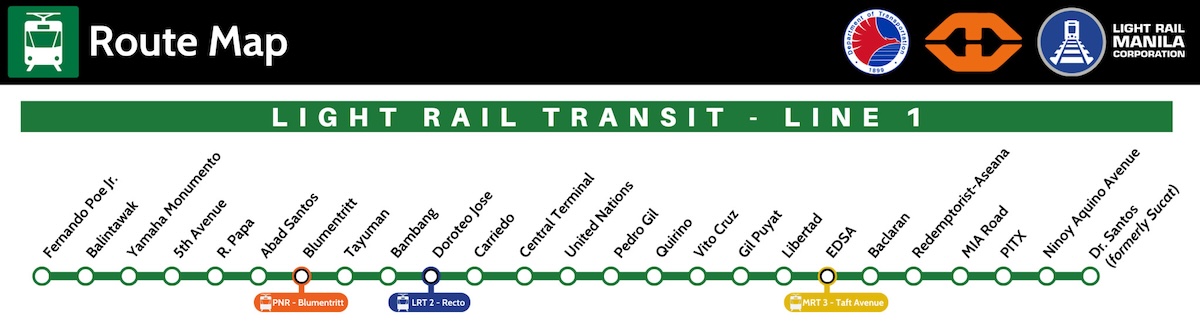
LRT 1 Train Route Map
Complete LRT-1 Stations List with Descriptions
This section covers the Fernando Poe Jr. Station to Central Terminal, including area details, each station’s specialties, and nearby attractions.
1. Fernando Poe Jr. (FPJ / Roosevelt) Station
Area: Quezon City
Station Type: Northern terminus
Fernando Poe Jr. Station is the northern endpoint of LRT-1. It serves major residential districts and acts as a gateway for commuters from northern Metro Manila. The station is well connected to major roads and bus routes.
Nearby Attractions:
- SM North EDSA
- Trinoma Mall
- Veterans Memorial Medical Center
Why stop here: Ideal for shopping, transport connections, and access to Quezon City.
2. Balintawak Station
Area: Quezon City
Balintawak Station serves a mixed industrial and residential zone. It is popular among workers commuting to central Manila.
Nearby Attractions:
- Balintawak Market
- Cloverleaf Complex
Why stop here: Local food markets and authentic street scenes.
3. Yamaha–Monumento Station
Area: Caloocan
One of the busiest LRT-1 stations, Yamaha–Monumento, is a major transport and commercial hub. It connects to malls, bus terminals, and historic landmarks.
Nearby Attractions:
- Bonifacio Monument
- SM City Grand Central
- Victory Mall
Why stop here: Shopping, dining, and provincial bus connections.
4. 5th Avenue Station
Area: Caloocan
This station mainly serves nearby residential communities and small businesses.
Nearby Attractions:
- Local wet markets
- Neighborhood eateries
Why stop here: Everyday Manila life and budget meals.
5. R. Papa Station
Area: Caloocan
R. Papa Station is a quieter stop used mostly by locals.
Nearby Attractions:
- Small neighborhood parks
- Local bakeries
Why stop here: Relaxed, residential atmosphere.
6. Abad Santos Station
Area: Tondo, Manila
Abad Santos Station serves one of Manila’s most historic working-class districts. It is close to port areas and traditional markets.
Nearby Attractions:
- Divisoria (short jeepney ride)
- Street markets
Why stop here: Authentic Manila street culture.
7. Blumentritt Station
Area: Manila
Blumentritt Station is a busy commercial stop and one of the few that offers a nearby PNR railway connection.
Nearby Attractions:
- Blumentritt Market
- PNR Blumentritt Station
Why stop here: Market shopping and provincial rail access.
8. Tayuman Station
Area: Santa Cruz, Manila
Tayuman Station is famous for budget clothing and textile shops.
Nearby Attractions:
- Tayuman shopping district
- Budget fashion stores
Why stop here: Affordable clothes and fabrics.
9. Bambang Station
Area: Santa Cruz, Manila
Bambang Station is known as Manila’s medical supply district.
Nearby Attractions:
- Bambang Medical Supply Street
- Bambang Market Ukay-Ukay
Why stop here: Pharmacies, clinics, and medical supplies.
10. Doroteo Jose Station
Area: Manila
Doroteo Jose is one of the most important transfer stations on LRT-1. It connects to LRT-2 via Recto Avenue.
Nearby Attractions:
- Recto Avenue shopping strip
- Isetann Mall
- LRT-2 Recto Station
Why stop here: Transfer to Cubao, Marikina, and Antipolo.
11. Carriedo Station
Area: Quiapo / Binondo
Carriedo Station is one of the most culturally rich stops on the LRT-1 route.
Nearby Attractions:
- Quiapo Church
- Quiapo Walking Tour
- Ongpin Street (Chinatown)
- Binondo Food Crawl
- Plaza Miranda
Why stop here: Food crawls, historic shopping, cultural immersion.
12. Central Terminal Station
Area: Ermita / Intramuros
Central Terminal is the best LRT-1 station for tourists visiting historic Manila.
Nearby Attractions:
- Intramuros
- Manila City Hall
- National Museum of Fine Arts
- National Museum of Natural History
Why stop here: Museums, Spanish-era landmarks, guided walking tours.
13. United Nations Station
Area: Ermita
United Nations Station serves one of Manila’s most scenic and cultural areas. It is popular among tourists visiting museums and parks.
Nearby Attractions:
- Rizal Park (Luneta)
- National Library of the Philippines
- Manila Ocean Park
Why stop here: Museums, green spaces, and historic monuments.
14. Pedro Gil Station
Area: Malate
Pedro Gil Station serves a student-heavy and medical district, with several universities and hospitals nearby.
Nearby Attractions:
- Robinsons Place Manila
- Philippine General Hospital
- Universities and dormitories
Why stop here: Shopping, dining, and youthful energy.
15. Quirino Avenue Station
Area: Malate / Paco
This is a quieter residential stop, ideal for travelers looking for a slower-paced area.
Nearby Attractions:
- Paco Park (historic cemetery-turned-park)
- Local cafés
Why stop here: Peaceful strolls and heritage parks.
16. Vito Cruz Station
Area: Malate
Vito Cruz Station serves two major universities and is known for its lively student population.
Nearby Attractions:
- De La Salle University
- College of Saint Benilde
- Cafés and budget restaurants
Why stop here: Student life, affordable dining, coffee shops.
17. Gil Puyat (Buendia) Station
Area: Pasay
This is one of the most important transport hubs on the LRT-1 line.
Nearby Attractions:
- Provincial bus terminals
- Budget hotels
Why stop here: Transfers to long-distance buses.
18. Libertad Station
Area: Pasay
Libertad Station serves dense residential communities and neighborhood markets.
Nearby Attractions:
- Local wet markets
- Street food stalls
- Cartimar Market
Why stop here: Authentic local dining.
19. EDSA Station
Area: Pasay
EDSA Station is one of the busiest interchange stations, linking LRT-1 with MRT-3.
Nearby Attractions:
- Metropoint Mall
- MRT-3 Taft Avenue Station
Why stop here: Transfers to Makati, Ortigas, and Quezon City.
20. Baclaran Station
Area: Pasay / Parañaque
Baclaran is famous for its massive street markets and religious tourism.
Nearby Attractions:
- Baclaran Church
- Baclaran Night Market
- Redemptorist Road shopping stalls
Why stop here: Bargain shopping and cultural immersion.

21. Redemptorist–Aseana Station
Area: Parañaque
This station serves Manila Bay’s modern entertainment district.
Nearby Attractions:
- SM Mall of Asia
- Entertainment City
- Manila Bay sunset views
Why stop here: Malls, casinos, seaside views.
22. MIA Road Station
Area: Parañaque
MIA Road Station is close to airport access roads and hotels.
Nearby Attractions:
- NAIA access routes
- Airport hotels
Why stop here: Airport-adjacent accommodation zones.
23. PITX Station
Area: Parañaque
PITX is the largest integrated bus terminal in Metro Manila.
Nearby Attractions:
- PITX shopping complex
- Food courts
- Provincial bus terminals
Why stop here: Long-distance bus connections.
24. Ninoy Aquino Avenue Station
Area: Parañaque
This station primarily serves nearby residential communities.
Nearby Attractions:
- Neighborhood eateries
- Local shops
Why stop here: Local commuting.
25. Dr. Santos Station
Area: Parañaque
Station Type: Southern terminus
Dr. Santos Station is the southern endpoint of LRT-1, serving expanding suburban districts.
Nearby Attractions:
- Local malls
- Residential developments
Why stop here: Gateway to southern Metro Manila.
Which LRT 1 stations are best for tourists?
Some of the most tourist-friendly LRT-1 stations include:
- Central Terminal – Intramuros, National Museums
- United Nations – Rizal Park, Ocean Park
- Carriedo – Quiapo, Chinatown (Binondo)
- Redemptorist–Aseana – Mall of Asia, Manila Bay
- Baclaran – Church and markets
Best Time to Ride LRT-1
Knowing when to ride can significantly improve your experience.
| Time | Crowd Level |
|---|---|
| 5:00–6:00 AM | Light |
| 7:00–9:00 AM | Heavy (Rush Hour) |
| 10:00 AM–4:00 PM | Moderate |
| 5:00–7:00 PM | Heavy (Rush Hour) |
| 8:00–10:00 PM | Light |
Tip: If you are sightseeing, ride between 10 AM and 3 PM.
Safety and Comfort Tips
- Keep your bag in front of you
- Stay behind platform safety lines
- Avoid rush hours if carrying luggage
- Keep small bills and coins
- Use priority seating properly
- Always tap your Beep™ card in and out
Final Thoughts on LRT-1 Stations
Understanding the full layout of LRT-1 stations transforms the way you experience Metro Manila. With 25 strategically placed stops from Fernando Poe Jr. Station in Quezon City to Dr. Santos Station in Parañaque, the LRT-1 connects you to historic landmarks, business districts, shopping malls, universities, parks, and major transport terminals.
Whether you are a tourist planning your itinerary or a commuter navigating Manila daily, the LRT-1 route remains one of the cheapest, fastest, and most reliable ways to get around the city.
Bookmark this guide as your ultimate reference to LRT-1 stations — and travel Metro Manila with confidence.
Frequently Asked Questions (FAQ) About LRT 1 Stations
How many LRT-1 stations are there?
There are currently 25 LRT-1 stations, starting from Fernando Poe Jr. (FPJ) Station in the north and ending at Dr. Santos Station in the south.
What is the full list of LRT-1 stations?
The full LRT-1 stations list from north to south is:
- Fernando Poe Jr. (FPJ / Roosevelt)
- Balintawak
- Yamaha–Monumento
- 5th Avenue
- R. Papa
- Abad Santos
- Blumentritt
- Tayuman
- Bambang
- Doroteo Jose
- Carriedo
- Central Terminal
- United Nations
- Pedro Gil
- Quirino Avenue
- Vito Cruz
- Gil Puyat (Buendia)
- Libertad
- EDSA
- Baclaran
- Redemptorist–Aseana
- MIA Road
- PITX
- Ninoy Aquino Avenue
- Dr. Santos
How long does it take to travel from end to end on LRT-1?
A full end-to-end trip from Fernando Poe Jr. Station to Dr. Santos Station typically takes 50 to 55 minutes, depending on crowd levels, train frequency, and dwell times at stations.
How much is the fare on LRT-1?
LRT-1 uses a distance-based fare system.
Typical fares:
- Short trips: P20–P25
- Mid-range trips: P30–P40
- End-to-end: P45–P55
Discounts are available for:
- Students
- Senior citizens
- Persons with Disabilities (PWD)
What is the best ticket to use on LRT-1?
The best option is the Beep™ card, which is a reloadable stored-value card.
Why use a Beep™ card?
- Faster entry and exit
- Slightly cheaper fares
- No need to buy tickets every time
- Works on LRT-1, LRT-2, MRT-3, buses, and some ferries
Is LRT-1 safe for tourists?
Yes. LRT-1 is generally safe, but like any busy metro system, you should:
- Keep bags in front of you
- Watch your valuables
- Stand behind platform lines
- Avoid rush hours with luggage
Does LRT-1 operate on weekends and holidays?
Yes, LRT-1 operates daily, including weekends and most holidays. However, schedules may be adjusted during special holidays or maintenance periods.
What time does LRT-1 start and end?
Typical operating hours:
- First trains: Around 4:30–5:00 AM
- Last trains: Around 10:00–10:30 PM
Times may vary by station.
Can I bring luggage on LRT-1?
Yes, but large luggage is discouraged during peak hours. If you are traveling with suitcases, ride during off-peak hours for comfort.
What is the fastest way to travel across Manila?
For north–south travel, LRT-1 is one of the fastest routes across Metro Manila because it avoids road congestion.
Is LRT-1 air-conditioned?
Yes, all LRT-1 trains are air-conditioned.
Are there priority seats?
Yes. Priority seats are reserved for:
- Senior citizens
- Pregnant women
- Persons with disabilities
- Passengers with small children
Can tourists easily use LRT-1?
Yes. LRT-1 is tourist-friendly, especially if you use a Beep™ card. Station signage is in English and Filipino, and staff are usually available to help.
Manila Travel Tour Packages You Should Try
Follow and subscribe to OutofTownBlog.com on Facebook, Twitter, Instagram, Pinterest, and YouTube for more Travel-related updates.