

 Melo Villareal
Civil Service Exam Philippines Guide: Requirements, Eligibility, Coverage, Application, and Review Tips
Dreaming of a stable government career? For many Filipinos, the Civil Service Exam is one of the first major steps toward qualifying for a wide range of positions in the Philippine government.
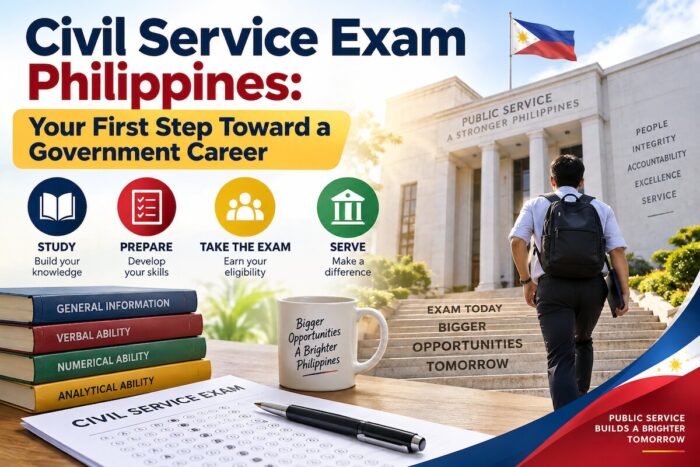
Civil Service Exam Philippines: Your First Step Toward a Government Career
From administrative and clerical positions to professional, technical, and specialist roles, government agencies regularly recruit qualified applicants for vacancies across the country. Having the appropriate civil service eligibility can help you meet one of the requirements for many of these positions.
However, passing the Civil Service Exam is only part of the journey. You still need to meet the education, training, experience, and other qualification standards for the specific position you want.
If you’re planning to take the Civil Service Exam in the Philippines, here’s what you need to know about the exam levels, eligibility, coverage, application process, preparation, and what happens after you pass.
What Is the Civil Service Exam in the Philippines?
The Career Service Examination – Pen and Paper Test (CSE-PPT) is administered by the Civil Service Commission (CSC).
The examination has two levels:
- Professional Level
- Subprofessional Level
The appropriate eligibility depends on the type and level of government position you plan to pursue.
Professional eligibility is generally associated with second-level positions, including many professional, technical, and administrative jobs. Subprofessional eligibility is generally associated with first-level positions, including many clerical and administrative roles.
Passing the examination grants the corresponding civil service eligibility. It does not automatically mean that an applicant will be hired by the government.
Why Is Civil Service Eligibility Important?
Civil service eligibility is one of the requirements commonly listed in government job vacancies.
When a government agency publishes a vacancy, the position usually includes specific qualification standards. These can cover:
- Education
- Training
- Work experience
- Eligibility
- Competencies
- Other position-specific requirements
Having the appropriate civil service eligibility can therefore help an applicant qualify for positions that require it.
Your eligibility should always match the requirements stated in the actual vacancy announcement.
Professional vs. Subprofessional Civil Service Exam
Choosing the right examination level is important before you register.
Civil Service Professional Exam
The Professional Level is generally intended for applicants seeking eligibility for second-level positions. These include many professional, technical, and administrative positions in government.
Applicants planning a long-term government career and eligible to take the Professional Level may consider this examination, depending on the positions they intend to pursue.
Civil Service Subprofessional Exam
The Subprofessional Level generally provides eligibility for first-level positions.
These positions commonly involve clerical, administrative support, and other first-level government functions.
Before deciding which exam to take, look at government vacancies that interest you. Check the eligibility requirements and determine which examination corresponds to the positions you want to pursue.
Who Can Take the Civil Service Exam?
The Civil Service Commission establishes the eligibility and qualification requirements for applicants.
Generally, applicants must meet requirements involving citizenship, age, character, and other conditions established by the CSC.
Applicants should check the latest official examination announcement before filing their application. Requirements and procedures can change between examination schedules.
It is also important to remember that meeting the requirements to take the examination is different from meeting the qualification standards for a specific government position.
What Is the Civil Service Exam Coverage?
Understanding the Civil Service Exam coverage is essential when preparing for the test.
The examination generally covers the following areas:
General Information
This section can include topics involving the Philippine Constitution, government structure and functions, public service ethics, and related civic and government information.
Verbal Ability
Expect questions involving vocabulary, grammar, sentence construction, and reading comprehension.
Regular reading and practice can help you become more comfortable with questions that require careful interpretation of words and sentences.
Numerical Ability
This area covers mathematical concepts and problem-solving.
Review basic arithmetic, fractions, decimals, percentages, ratios, sequences, and other mathematical concepts covered in the official examination.
Analytical Ability
Analytical questions test your ability to identify relationships, recognize patterns, analyze information, and solve problems logically.
Practice can be particularly useful because familiarity with different question formats can help you work more efficiently during the actual examination.
How to Apply for the Civil Service Exam in the Philippines
If you want to work for the Philippine government, taking the Civil Service Exam is an important step toward obtaining civil service eligibility. The application process requires more than filling out a form. You need to check your eligibility, prepare the required documents, secure an application schedule, and follow the requirements of the Civil Service Commission (CSC).
The CSC conducts the Career Service Examination-Pen and Paper Test (CSE-PPT) for both Professional and Subprofessional levels. Examination dates and application periods vary, so applicants should always check the latest CSC announcement before applying.
Step 1: Check If You Are Qualified
Before preparing your documents, make sure you meet the basic requirements.
The CSC generally requires applicants to be:
- Filipino citizens
- At least 18 years old
- Of good moral character
- Without a final conviction for an offense involving moral turpitude
- Not dishonorably discharged from military service
- Not dismissed for cause from a civilian government position
Applicants must also comply with other eligibility rules established by the CSC.
Step 2: Choose Your Examination Level
The CSE-PPT has two levels.
Professional Level: Generally provides eligibility for second-level positions, including many professional, technical, and administrative government jobs.
Subprofessional Level: Generally provides eligibility for first-level positions, including many clerical and administrative positions.
Before choosing an examination, consider the government positions you eventually want to pursue and check their qualification standards.
Step 3: Check the Current Examination Schedule
The CSC announces examination dates and application periods through its official channels.
Application periods have specific deadlines and may close early when testing centers reach their target number of applicants. Because schedules and filing procedures can change, check the latest CSC announcement before preparing your application.
Step 4: Prepare the Required Documents
Applicants need to prepare the documents specified by the CSC for the particular examination schedule.
These generally include a fully accomplished application form, photographs that meet CSC specifications, and an accepted identification document.
Photographs may have specific requirements regarding:
- Size
- Background
- Recency
- Image quality
- Facial appearance
- Clothing
- Signature and name tag
Applicants should follow the exact specifications stated in the latest examination announcement.
You may also need to present the original and a photocopy of a valid government- or school-issued identification document.
Step 5: Complete the Application Form
Fill out the application form carefully and make sure the information matches your identification documents.
Double-check your:
- Full name
- Date and place of birth
- Contact information
- Address
- Examination level
- Other personal information
Do not leave required sections incomplete unless the CSC specifically instructs you to do so.
Certain portions of the application form, including the applicant’s signature or thumbmark, may need to be completed in the presence of the CSC processor. Follow the instructions applicable to your examination schedule and filing location.
Step 6: Secure an Appointment or Follow the Filing Procedure
Application procedures can vary by CSC Regional or Field Office.
Some offices may use an online appointment or application system, while others may provide specific instructions for in-person filing.
Check the procedures announced by your CSC Regional or Field Office before visiting. If an appointment is required, secure one within the designated filing period and bring all required documents.
Step 7: Pay the Examination Fee
Applicants must pay the applicable examination fee during the application process.
Keep your official receipt and other application documents after payment. These may contain information you will need later, including details related to your examination.
Step 8: Confirm Your Testing Venue
After successfully filing your application, carefully check your examination details.
Your testing venue may be different from the CSC office where you submitted your application.
Before examination day, familiarize yourself with the location and travel route. If possible, visit the testing venue ahead of time to see how long it takes to get there.
Step 9: Prepare for Examination Day
Do not leave your examination-day preparations until the last minute.
Prepare your required identification document and other permitted materials according to the latest CSC instructions.
Calculators and unauthorized aids may be prohibited during the examination. Applicants should carefully review the examination advisory for the specific test schedule.
Arrive early enough to allow time for travel, security procedures, registration, and locating your assigned room.
What Happens After You Apply?
Once your application has been accepted, focus on preparing for your examination.
Review the major areas covered by the CSE-PPT, including:
- General Information
- Verbal Ability
- Numerical Ability
- Analytical Ability
Practice answering questions under time pressure and review topics where you need additional preparation.
After taking the examination, monitor official CSC announcements regarding the release of results and examination ratings.
Important Tips Before Applying
Keep these reminders in mind:
- Apply as early as possible during the filing period.
- Check the latest CSC examination announcement.
- Verify requirements with your CSC Regional or Field Office.
- Prepare your photographs according to the exact specifications.
- Bring the required original and photocopy of your identification document.
- Double-check your application information.
- Keep your receipt and application documents.
- Confirm your testing venue before examination day.
- Avoid relying on outdated social media posts for schedules and requirements.
The Civil Service Exam application process in the Philippines becomes easier when you prepare your documents early and follow the instructions for your specific examination schedule.
Most importantly, always verify the latest requirements, application dates, fees, and procedures with the Civil Service Commission because these details can change between examination cycles.
How to Prepare for the Civil Service Exam
A good Civil Service Exam reviewer can help organize your study sessions, but preparation should go beyond reading review materials.
Start With the Official Coverage
Know what you are expected to study before spending time on individual topics.
Use the latest examination scope from the Civil Service Commission as your starting point.
Create a Study Schedule
Set aside consistent study time rather than relying on a last-minute review.
For example, you can dedicate different days to verbal, numerical, analytical, and general information.
Take Practice Tests
Practice exams can help you identify which topics need additional attention.
They also help you become familiar with answering questions under time pressure.
Review Basic Math
Numerical questions can become easier when you are comfortable with basic calculations.
Practice percentages, fractions, ratios, averages, sequences, and word problems.
Improve Reading Comprehension
Read different types of material and practice identifying the main idea, supporting details, relationships among statements, and the meaning of words in context.
Practice Analytical Questions
Spend time solving logic, pattern, relationship, and reasoning exercises.
The goal is to develop a systematic approach rather than simply memorizing answers.
Practice With a Timer
Time management matters during a lengthy examination.
During practice sessions, set a timer and work on maintaining a steady pace. If you encounter a difficult question, avoid spending too much time on it.
What Should You Bring on Examination Day?
Prepare everything you need before leaving for the testing center.
Your examination notice or receipt, required identification documents, pencils, and other permitted materials should be prepared in advance, in accordance with the latest CSC instructions.
Check the examination guidelines before test day because permitted materials and identification requirements may be specified by the CSC.
Arrive early enough to allow time for travel, registration, security procedures, and finding your assigned room.
What Happens After Passing the Civil Service Exam?
Passing the examination provides civil service eligibility corresponding to the level you took.
The next step is finding government vacancies that match your qualifications and career goals.
Government agencies publish vacancies with specific qualification standards. Read these announcements carefully before applying.
A position may require a particular educational degree, years of relevant experience, training hours, eligibility, or other qualifications.
Passing the Civil Service Exam does not guarantee employment. You still need to successfully complete the agency’s recruitment and selection process.
How to Find Government Jobs After Passing
Once you are eligible, start monitoring government vacancies regularly.
Look at opportunities from:
- National government agencies
- Local government units
- Government-owned or controlled corporations
- State universities and colleges
- Other public institutions
Keep a current résumé and prepare copies of documents commonly requested for government applications.
You can also identify the agencies and career fields that interest you before taking the examination. This gives you a clearer idea of the qualifications you may need to develop.
Common Civil Service Exam Mistakes to Avoid
Preparing for the exam involves more than reviewing questions.
Avoid these common mistakes:
- Waiting until the last minute to apply
- Using outdated examination information
- Ignoring the official examination coverage
- Studying without practice tests
- Focusing exclusively on memorization
- Neglecting numerical or analytical practice
- Spending too long on difficult questions
- Forgetting required identification documents
- Assuming that passing guarantees a government job
A simple preparation plan can make the examination process more manageable.
Is Passing the Civil Service Exam Enough to Get a Government Job?
No. Civil service eligibility is only one component of government recruitment.
Each government position has its own qualification standards. An applicant may need to meet specific requirements for education, training, experience, eligibility, and competencies.
For example, passing the Professional Level examination does not automatically qualify an applicant for every professional government position.
Always read the complete vacancy announcement before applying.
How Long Should You Study for the Civil Service Exam?
There is no single study period that works for every applicant.
Your ideal preparation period depends on your familiarity with the subjects, the time you have available to study, and the areas that require improvement.
Some applicants may prefer several weeks of focused review, while others may start months before the examination.
A practical approach is to take a diagnostic practice test first. Use the results to identify your weaker areas, then build your study schedule around those topics.
Is a Civil Service Exam Reviewer Worth Using?
Review materials can be useful for organizing your preparation and providing practice questions.
However, avoid relying entirely on unofficial reviewers. Examination coverage and procedures can change, so your preparation should be based on the latest official information from the Civil Service Commission.
Use reviewers as study tools, then verify important examination details through official CSC announcements.
What If I Do Not Pass the Civil Service Exam?
Not passing an examination does not prevent you from pursuing a career in government.
You can review your performance, identify areas for improvement, and prepare for another examination when eligible.
Use the time between examinations productively. Strengthen your knowledge, improve your test-taking strategy, and continue developing the qualifications required for the government positions you want to pursue.
Frequently Asked Questions About the Civil Service Exam
1. What is the Civil Service Exam in the Philippines?
The Civil Service Exam, formally known as the Career Service Examination – Pen and Paper Test, is administered by the Civil Service Commission. It has Professional and Subprofessional levels. Passing the appropriate level provides civil service eligibility that can be used when applying for government positions covered by the applicable eligibility. The examination does not guarantee employment. Applicants must still meet the full qualification standards and successfully complete the government agency’s recruitment and selection process.
2. What is the difference between the Professional and Subprofessional Civil Service Exam?
The main difference lies in the level of civil service eligibility provided and the types of government positions to which that eligibility generally applies. Professional eligibility is generally associated with second-level positions, including many professional, technical, and administrative jobs. Subprofessional eligibility is generally associated with first-level positions, including many clerical and administrative roles. Applicants should check the qualification standards of their target government positions before choosing which examination level to take.
3. What are the requirements for the Civil Service Exam?
Civil Service Exam requirements are established by the Civil Service Commission and can include conditions related to citizenship, age, character, and other qualifications. Applicants also need to submit the documents required during the application period. Because examination procedures, documentary requirements, schedules, and testing arrangements can change, applicants should always consult the latest CSC announcement before filing their application.
4. What subjects are included in the Civil Service Exam?
The CSE-PPT generally covers General Information, Verbal Ability, Numerical Ability, and Analytical Ability. General Information can include topics related to the Philippine Constitution, government, and public service ethics. Verbal Ability covers areas such as vocabulary, grammar, and reading comprehension. Numerical Ability focuses on mathematical concepts and problem-solving, while Analytical Ability measures logical reasoning and analysis.
5. How can I prepare for the Civil Service Exam?
Start by reviewing the latest official examination coverage and creating a study schedule. Divide your preparation among verbal, numerical, analytical, and general information topics. Take practice tests regularly and review incorrect answers instead of simply checking your score. Practice answering questions under time pressure to improve pacing. Give additional attention to subjects where your practice-test performance is weaker, and use updated review materials alongside official CSC information.
6. Does passing the Civil Service Exam guarantee a government job?
No. Passing the Civil Service Exam provides the appropriate civil service eligibility, but it does not guarantee government employment. Government positions have individual qualification standards that can include education, training, experience, eligibility, and other requirements. Applicants must meet the complete requirements of the position and go through the agency’s recruitment and selection process. Civil service eligibility should therefore be viewed as one important qualification within the broader government hiring process.
7. Can fresh graduates take the Civil Service Exam?
Eligibility to take the examination is determined by the requirements established by the Civil Service Commission. A fresh graduate who meets those requirements can consider taking the examination even without previous government employment. However, passing the exam does not mean that every government vacancy will be available to the applicant. Individual positions can require specific educational backgrounds, training, experience, or other qualifications, so fresh graduates should review vacancy announcements carefully.
8. How often is the Civil Service Exam conducted?
The Civil Service Commission announces examination schedules periodically. The exact dates, application periods, testing centers, and other arrangements can vary by examination cycle. Applicants should avoid relying on old schedules found in previous articles or social media posts. Instead, check the latest announcement from the Civil Service Commission before making travel plans, preparing documents, or submitting an application.
9. What should I do after passing the Civil Service Exam?
After passing, keep your eligibility documentation and start looking for government vacancies that match your qualifications and career interests. Review each vacancy carefully, as agencies may have different requirements for education, training, experience, and competencies. Prepare an updated résumé and other commonly requested documents. You can also research agencies and career fields before applying, so you can focus your applications on positions that align with your background and professional goals.
10. Can I retake the Civil Service Exam if I do not pass?
Applicants who do not pass can prepare for a future examination schedule, subject to the applicable Civil Service Commission rules. Use the additional preparation time to identify areas where you struggled and improve your test-taking strategy. Practice tests can help you measure progress, particularly in numerical and analytical sections where familiarity with question formats can make a difference. Always check the latest CSC examination announcement for current rules and application procedures.
Start Planning Your Government Career
The Civil Service Exam is an important entry point for Filipinos seeking to pursue various government careers. Preparing for it starts with understanding the examination, choosing the appropriate level, reviewing the official coverage, and knowing what happens after you pass.
If government employment is part of your career plan, don’t stop at the examination. Identify the positions that interest you, study their qualification requirements, and work on the education, training, experience, and skills they require.
A government career starts with preparation long before you submit your first job application.
Follow and subscribe to OutofTownBlog.com on Facebook , Twitter, Instagram, Pinterest, and YouTube for more Travel-related updates.
Read:
- Bonok-Bonok Festival in Surigao City
- Ultimate List Of The Best Hotels in Surigao City, Philippines
- Lubi-Lubi Festival in Gingoog City
- The Philippines Adventure Guide: 15 Thrilling Outdoor Experiences


