

 Melo Villareal
Manila to Tokyo Flights: The Complete Guide to Airfares and Booking
Tokyo is one of the easiest international destinations for Filipino travelers to reach from Manila. There are frequent nonstop flights between the two cities, several airlines to choose from, and plenty of fare options for different budgets.
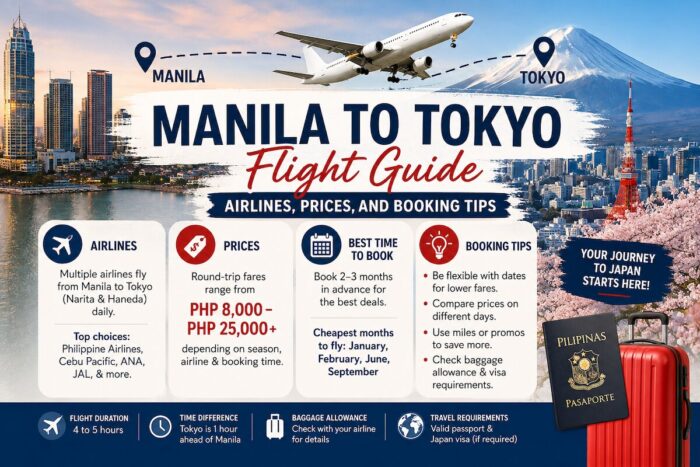
Manila to Tokyo Flight Guide
For first-time travelers to Japan, however, booking a flight from Manila to Tokyo can still feel overwhelming. Should you fly to Haneda or Narita? Is a low-cost carrier really cheaper once you add baggage? Is it better to book several months ahead or wait for a seat sale? And how much should you actually budget for airfare?
After flying the Manila-Tokyo route several times, I have learned that finding the right flight is not simply about looking for the lowest advertised fare. The best flight is the one that gives you the right balance of price, schedule, baggage allowance, airport location, comfort, and convenience.
This guide covers everything you need to know before booking your next flight from Manila to Tokyo, including airlines, estimated airfare, the difference between Haneda and Narita, the best time to book, and practical tips that can help Filipino travelers save money.
Manila to Tokyo Flight at a Glance
The distance between Manila and Tokyo makes Japan particularly accessible for travelers from the Philippines.
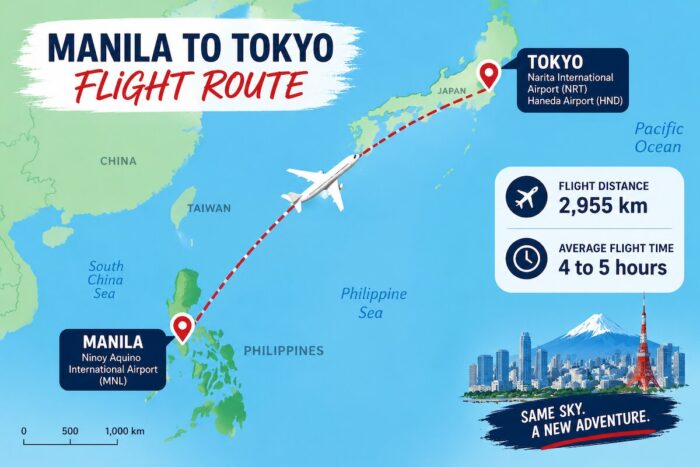
A nonstop flight usually takes roughly four to five hours, depending on your destination airport, flight route, aircraft, weather, and wind conditions.
You can fly from Ninoy Aquino International Airport (MNL) in Manila to either of Tokyo’s two major airports:
- Tokyo Haneda Airport (HND)
- Narita International Airport (NRT)
Both airports serve the Tokyo metropolitan area, but they offer very different arrival experiences.
Haneda is considerably closer to central Tokyo. Narita is farther away but has a wider selection of international flights and budget carriers.
For a short Tokyo holiday, Haneda can save valuable travel time. For travelers focused primarily on airfare, Narita can offer more competitive choices.
Current route schedules include nonstop Manila-Haneda services from ANA, Japan Airlines, and Philippine Airlines. Manila-Narita has additional options, including Cebu Pacific and Jetstar Japan. Flight schedules vary by season and are subject to change.
How Much Is a Manila to Tokyo Flight?
There is no fixed price for a flight from Manila to Tokyo.
Airfares can change dramatically depending on the season, airline, travel dates, booking period, seat availability, promotions, and whether you are traveling during a major holiday.
For planning purposes, I recommend thinking about airfare in broad price categories rather than expecting one specific amount.
Budget fares: Around PHP 10,000 to PHP 15,000 round trip
When you find a nonstop round-trip Manila-Tokyo ticket in this range, it can be considered a very good deal.
These fares are more likely to appear during airline seat sales, less busy travel periods, or when you are flexible with your dates.
However, read the fare conditions carefully.
A PHP 10,000 ticket from a low-cost carrier may not include checked baggage, meals, preferred seats, or other services.
If you need to check a suitcase, the final cost can be considerably higher.
Mid-range fares: Around PHP 15,000 to PHP 25,000 round trip
This is a more comfortable range for many travelers.
At this price, you may find competitive fares from both low-cost and full-service airlines, depending on your dates.
The advantage is that you can compare the complete package rather than simply chasing the lowest headline fare.
Full-service fares: PHP 25,000 and above
Full-service airlines can command higher fares, particularly during cherry blossom season, Christmas, New Year, Golden Week, and other peak travel periods.
But paying more does not necessarily mean you are overpaying.
If your ticket includes checked baggage, meals, better seating, and more flexible conditions, the higher fare may actually offer better value.
The important thing is to compare what you receive for the price, not simply the number displayed on the search results page.
Why Manila to Tokyo Airfares Change So Much
One of the most frustrating things about airfare is watching the price change from one day to the next.
You might see a Manila-Tokyo flight for PHP 12,000 today, PHP 15,000 tomorrow, and PHP 20,000 a few days later.
This happens because airlines use dynamic pricing.
The number of available seats at each fare level changes as people make reservations. When cheaper fare buckets sell out, the next available seats are offered at a higher price.
Demand also plays a major role.
For example, flights during cherry blossom season can become significantly more expensive because thousands of travelers want to visit Japan at the same time.
This is why flexibility can be one of your biggest advantages when booking flights.
If you can move your trip by one or two days, you may discover a substantial difference in airfare.
Manila to Tokyo Airlines
You have several airlines to consider when flying from Manila to Tokyo.
Each one has a different approach to pricing, baggage, service, and airport options.
Cebu Pacific
Cebu Pacific is one of the most popular choices among Filipino travelers looking for affordable flights to Japan.
The airline operates Manila-Narita flights and regularly runs promotional campaigns that can make Japan surprisingly affordable.
Its biggest advantage is the potential for a very low base fare.
But there is an important catch: the advertised fare is not necessarily your final fare.
Depending on your needs, you may have to pay extra for:
- Checked baggage
- Additional baggage allowance
- Seat selection
- Meals
- Travel insurance
- Other optional services
For travelers who pack light, a low-cost carrier can be excellent value.
For example, if you are traveling for four or five days with a small amount of clothing and plan to shop only a little, you may be perfectly comfortable with a basic fare.
But if you are going to Japan for two weeks in winter, bringing thick clothes, shoes, and shopping bags, you will probably need more baggage allowance.
That changes the calculation.
Philippine Airlines
Philippine Airlines is another strong option, particularly if you prefer a full-service airline.
PAL operates flights from Manila to both Haneda and Narita, giving travelers more flexibility when choosing their Tokyo airport.
One of PAL’s biggest advantages is convenience.
Instead of starting with a very low base fare and adding several extras, a full-service ticket can include services that budget travelers would otherwise need to purchase separately.
This makes PAL worth checking even when the initial fare appears higher than that of a low-cost airline.
For me, one of the biggest advantages is the combination of a Philippine carrier, nonstop flights, and the availability of Haneda services.
If the PAL fare is only slightly more expensive than a low-cost alternative once baggage is added, I would seriously consider paying the difference.
Japan Airlines
Japan Airlines, or JAL, is an excellent choice if you want a more traditional full-service experience.
The airline serves both Haneda and Narita from Manila.
JAL is particularly attractive to travelers who appreciate Japanese hospitality, comfortable cabins, attentive service, and the overall experience of flying with a Japanese carrier.
It can also make sense if you are collecting oneworld frequent-flyer miles or planning to connect to another destination in Japan.
For a longer trip, especially when you are carrying checked luggage, the additional cost of a full-service JAL ticket is easier to justify.
All Nippon Airways
All Nippon Airways, better known as ANA, is another major Japanese airline serving Manila.
ANA operates flights to both Haneda and Narita.
It is a particularly interesting option for travelers who value Japanese service or participate in the Star Alliance frequent-flyer network.
If you are planning to continue from Tokyo to another Japanese city, ANA may also be worth considering because of its extensive domestic network.
Jetstar Japan
Jetstar Japan is another low-cost option serving the Manila-Narita route.
Like Cebu Pacific, the attraction is the potential for competitive base fares.
However, the same rule applies: don’t compare airlines based solely on the headline price.
Check baggage, seat selection, meals, payment charges, and other extras before deciding.
Haneda vs. Narita: Which Is Better?
This is probably the most important decision after choosing your airline.
Tokyo has two major international airports, and they are not interchangeable from a traveler’s perspective.
Haneda Airport
If you are visiting Tokyo for the first time, I usually recommend starting with Haneda.
The airport is much closer to central Tokyo.
That means you can get from the plane to your hotel considerably faster than you would from Narita.
This matters more than you might think.
Imagine arriving in Tokyo at 3 p.m. If you fly into Haneda, clear immigration, collect your luggage, and take the train into the city, you can potentially be checking into your hotel and exploring by early evening.
With Narita, you need to account for a longer journey into central Tokyo.
Haneda is particularly convenient for travelers staying in:
- Shinjuku
- Shibuya
- Ginza
- Tokyo Station
- Asakusa
- Ueno
- Shinagawa
Haneda is also excellent for short trips.
If you only have three or four days in Tokyo, spending less time traveling between the airport and the city gives you more time for sightseeing.
Narita International Airport
Narita is farther from central Tokyo, but it should not be treated as an inferior airport.
In fact, Narita can be the better choice for budget travelers.
It has a larger selection of international flights and is served by several low-cost airlines.
If you find a Manila-Narita round-trip fare that is PHP 5,000 or PHP 7,000 cheaper than a Haneda flight, the savings may make the longer transfer worthwhile.
Narita also has efficient transportation links to Tokyo.
The Narita Express connects the airport with major Tokyo stations, while Keisei trains provide another popular option.
Before booking a cheap flight to Narita, however, check your hotel’s location.
If you are staying far from the main train routes, the airport transfer can become more complicated.
How Much Time Should You Allow for Airport Transfers?
One mistake I see travelers make is calculating their budget based only on airfare.
Your real transportation cost starts when you land.
If you fly into Narita, you need to budget both time and money to get to your hotel.
For Haneda, the journey into central Tokyo is generally much shorter.
This is particularly important when comparing flights that arrive late at night.
A cheap Narita flight arriving close to midnight may look attractive, but you need to make sure public transportation is still operating when you arrive.
Otherwise, you could end up paying considerably more for a taxi or private transfer.
Always check:
- Arrival time
- Last train schedule
- Hotel location
- Airport transfer cost
- Travel time
- Luggage requirements
The cheapest airfare doesn’t always mean the cheapest trip.
When Is the Best Time to Visit Tokyo?
Tokyo is a year-round destination, but airfare and hotel prices can vary significantly by season.
Spring: Cherry Blossom Season
Spring is one of the most popular times to visit Japan.
The combination of pleasant weather, cherry blossoms, parks, gardens, and seasonal events makes Tokyo particularly attractive.
It is also one of the periods when airfare and accommodation can become expensive.
If seeing cherry blossoms is your dream, book earlier than you would for an ordinary Tokyo trip.
Don’t wait until the blossoms are already forecast to peak before booking.
By then, many travelers will already have secured flights and hotels.
Summer
Summer can be hot and humid, but it is also a lively season.
You can experience festivals, fireworks, summer events, and other seasonal activities.
Airfare varies depending on school holidays and demand.
If you are sensitive to heat, remember that Tokyo summers can feel considerably warmer and more humid than those in Manila under some conditions.
Autumn
Autumn is one of my favorite seasons for travel in Japan.
The weather is generally more comfortable, and Tokyo’s parks and gardens become beautiful as foliage changes color.
It is also an excellent season for walking around the city.
Like cherry blossom season, autumn foliage can attract significant tourist demand, particularly toward peak foliage dates.
Winter
Winter can be one of the most interesting seasons for travelers seeking a different side of Japan.
Tokyo can be cold, but it rarely receives the heavy snowfall associated with destinations such as Hokkaido or parts of northern Japan.
The advantage is that winter can offer excellent opportunities for shopping, food trips, illumination events, and day trips to snowy destinations.
Christmas and New Year are exceptions, as airfare can rise significantly.
When Should You Book Your Manila to Tokyo Flight?
For most travelers, I recommend beginning your search 2 to 4 months before departure.
This is not a guarantee of the cheapest fare, but it gives you enough time to monitor prices and compare airlines.
For peak seasons, start looking even earlier.
If you are traveling during:
- Cherry blossom season
- Golden Week
- Christmas
- New Year
- Long weekends
- Philippine school holidays
- Major Japanese events
I would avoid waiting until the last minute.
Peak-season airfare can become expensive quickly.
Should You Wait for a Seat Sale?
This is one of the hardest questions to answer.
Seat sales can offer fantastic deals, but there is no guarantee that your preferred dates will be included.
There is also no guarantee that the promotional fare will remain available long enough for you to book.
If you already know your travel dates and find a price that you consider reasonable, booking can be safer than waiting indefinitely.
I have learned not to obsess over finding the absolute lowest possible fare.
If I find a good flight at a price that fits my budget, has convenient departure and arrival times, and includes the baggage I need, I would rather book it and move on to planning the trip.
My Top Manila to Tokyo Flight Booking Tips
1. Search both Haneda and Narita
Never search only for “Tokyo.”
Compare MNL-HND and MNL-NRT separately.
The difference can be substantial.
2. Compare the final price
Don’t stop at the base fare.
Add baggage, seats, meals, and other services before comparing airlines.
3. Be flexible by a few days
If possible, search several departure dates.
A Tuesday flight can sometimes be significantly cheaper than a Saturday flight.
4. Check the baggage allowance
This is especially important if you are flying a low-cost carrier.
Japan is famous for shopping, so think ahead about how much luggage you’ll likely bring home.
5. Consider your hotel location
Haneda may be worth paying extra for if you are staying in central Tokyo.
Narita may be perfectly reasonable if the savings are significant.
6. Check flight arrival times
A flight arriving at 7 p.m. is very different from one arriving at 11 p.m.
Consider immigration, baggage collection, transportation, and hotel check-in.
7. Don’t ignore the return flight
Sometimes travelers focus entirely on the Manila-Tokyo fare and forget to compare the return flight carefully.
Check both directions.
8. Consider one-way combinations
You don’t necessarily have to fly the same airline in both directions.
You might find a cheap Cebu Pacific flight to Narita and a competitive full-service flight back to Manila.
Just make sure you understand each airline’s baggage rules.
9. Set a realistic airfare budget
Before searching, decide how much you are willing to spend.
For example:
Budget traveler: PHP 10,000–15,000
Comfort-focused traveler: PHP 15,000–25,000
Full-service traveler: PHP 25,000+
These are planning ranges, not guaranteed prices.
10. Don’t book based on price alone
Your flight marks the beginning of your trip to Japan.
Saving PHP 2,000 is not necessarily worthwhile if it means an inconvenient schedule, expensive baggage, a difficult airport transfer, or losing half a day in Tokyo.
What Is the Best Airline for Manila to Tokyo?
The answer depends on your priorities.
Best for budget travelers: Cebu Pacific
If your priority is keeping the base airfare low and you are willing to pay separately for extras, Cebu Pacific is worth watching.
Best for convenience: Philippine Airlines
PAL is a strong choice if you want a full-service experience from a Philippine carrier and want to compare both Haneda and Narita.
Best for Japanese service: Japan Airlines
JAL is ideal if you value service, comfort, and the experience of flying with a Japanese airline.
Best for Star Alliance travelers: ANA
ANA is particularly appealing if you collect Star Alliance miles or want a Japanese full-service carrier.
Best budget alternative: Jetstar Japan
Jetstar Japan is another airline to check when looking for competitive Manila-Narita fares.
What Should You Pack for a Manila to Tokyo Flight?
Your luggage strategy should depend on the season.
For summer, lightweight clothing and comfortable walking shoes are essential.
For winter, you will need considerably more space because jackets, sweaters, thermal layers, and heavier footwear take up room.
Spring and autumn can be unpredictable, so layering is useful.
Regardless of the season, I recommend bringing:
- Comfortable walking shoes
- A small day bag
- Portable charger
- Universal travel adapter
- Reusable water bottle
- Basic medicines
- Weather-appropriate clothing
- Passport and travel documents
- Hotel booking information
- Digital and physical copies of important travel documents
And leave some space in your suitcase.
You are going to Japan, after all.
There is a good chance you will come home with snacks, cosmetics, souvenirs, clothes, electronics, or things you never planned to buy.
What Happens After You Land in Tokyo?
Your arrival experience depends heavily on whether you land at Haneda or Narita.
After immigration and baggage claim, follow the airport signs toward trains, buses, taxis, or other transportation options.
If you are using public transportation, have your hotel address ready.
I recommend saving your hotel name and address on your phone before leaving Manila. It can also be helpful to keep the Japanese address available, especially if you need to show it to a driver or ask for directions.
Don’t underestimate how tiring the first few hours can be.
Even though the Manila-Tokyo flight is only around four to five hours, the combination of airport time, immigration, luggage, and transportation can make your first day exhausting.
Plan something enjoyable but manageable for your arrival day.
A simple dinner, a convenience-store snack run, a neighborhood walk, or an early night can be better than immediately packing your itinerary with five attractions.
A Sample Manila to Tokyo Flight Budget
For a five-day Tokyo trip, you might roughly plan your airfare like this:
Budget scenario
Round-trip airfare: PHP 12,000
Baggage and extras: PHP 3,000
Airport transfers: PHP 2,000
Estimated flight-related total: PHP 17,000
Full-service scenario
Round-trip airfare: PHP 20,000
Additional flight extras: PHP 0–2,000
Airport transfers: PHP 2,000
Estimated flight-related total: PHP 22,000–24,000
These are examples for planning purposes only. Actual fares and transportation costs vary according to dates, airline, baggage requirements, and promotions.
The exercise shows why comparing only the advertised airfare can be misleading.
A PHP 12,000 budget ticket may not actually cost only PHP 12,000.
Is a Cheap Manila to Tokyo Flight Worth It?
Absolutely—provided you understand what you are buying.
A low-cost carrier can be an excellent choice for a short trip to Tokyo, especially if you travel light.
If you are a frequent traveler who knows exactly what you need, budget airlines can save you a significant amount of money.
But if you are traveling with family, carrying several suitcases, or prefer a more comfortable experience, a full-service airline may offer better overall value.
There is no shame in paying more for convenience.
After all, your vacation starts the moment you leave Manila.
Final Thoughts
A Manila to Tokyo flight is more than just a way to get from the Philippines to Japan. It sets the tone for your entire trip.
Choose the right airport, and you can start exploring Tokyo sooner. Choose the right airline to avoid unexpected baggage fees. Book at the right time, and you can potentially save thousands of pesos.
My strategy is simple: compare everything, not just the airfare.
Start by checking both Haneda and Narita. Compare Cebu Pacific, Philippine Airlines, JAL, ANA, and Jetstar Japan based on your travel dates. Look carefully at baggage allowances and other fees. Consider how much it will cost to get from the airport to your hotel. Most importantly, think about how much your time is worth.
If you find a reasonable fare with convenient flight times and baggage that matches your needs, book it.
Then stop checking airfare.
Your next task should be much more exciting: planning where you will eat ramen, which neighborhood you will explore first, and whether you have enough room in your suitcase for all the souvenirs you will inevitably bring home.
Tokyo is waiting. And from Manila, it is only a few hours away.
Tokyo Travel Tour Packages You Should Try
Follow and subscribe to OutofTownBlog.com on Facebook , Twitter, Instagram, Pinterest, and YouTube for more Travel-related updates.
Read:
- 8 Best Anime Cafes, Stores, and Hidden Spots in Tokyo
- The Top 10 Best Boutique Hotels in Tokyo, Japan
- Top 11 Best Airbnbs in Tokyo, Japan
- Where to Stay in Tokyo: Shinjuku vs Shibuya vs Ginza vs Asakusa
- Top 15 Best Things to Do in Shibuya City, Tokyo
- Top 35 Best TOKYO TOURIST SPOTS + Things to Do & Places to Visit
- TOKYO TRAVEL GUIDE: Travel Tips + Itinerary
- 8 Best Hotels Near Tokyo Narita Airport
- Best Narita Airport Transfers


