

 Melo Villareal
Ask ten Filipinos where they keep their savings, and you will hear ten different answers: a passbook account they opened with their first paycheck, a payroll account they never moved out of, a digital bank they downloaded because a friend got a referral bonus. Most of those accounts earn close to nothing. The best savings account in the Philippines is not the one with the loudest promo. It is the one that pays a real rate on money you can still reach when life happens.
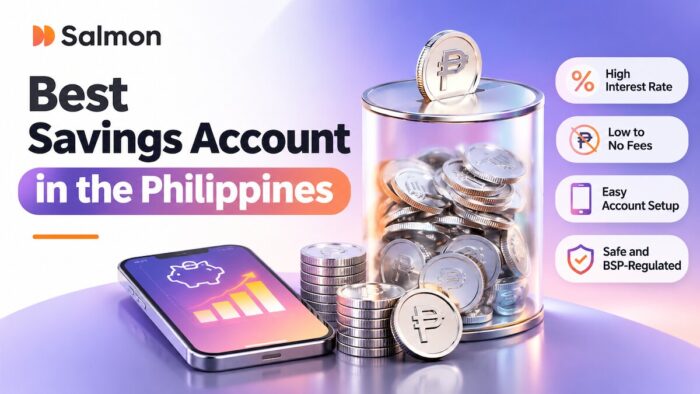
Best Savings Account in the Philippines
This guide walks through what “best” means for savers, compares the main account types available in the country, and ends with a shortlist you can act on today.
Quick answer
If you want a short version before the detail:
- For an emergency fund or everyday savings — a high-yield digital savings account with no lock-in, no maintaining balance and daily interest accrual. Our pick in this category is Salmon Save from Salmon Bank, which pays 4% per annum (not guaranteed; subject to change) with none of the usual strings.
- For money you will not touch for six months or more — a time deposit, which usually pays more than a savings account in exchange for a fixed term.
- For cash deposits and over-the-counter banking — a traditional bank account, accepting that the interest will be close to zero.
The rest of this article explains how we got there.
What “best” actually means for a savings account
A high interest rate is the headline, but it is only one of six things that decide how much your money grows and how useful the account is day to day.
1. The rate you actually get. Many accounts advertise a headline rate that only applies if you hit a condition: a minimum balance, a monthly deposit, a spending target on a linked card, or a promo window that ends in a few weeks. The number that matters is the rate on your balance on an ordinary Tuesday, with no conditions met.
2. Lock-in. A time deposit pays more because you promise to leave the money alone. A savings account should not ask for that promise. If an account penalizes withdrawals or pays its advertised rate only on a locked portion, it is a time deposit wearing a savings label.
3. Maintaining balance and fees. Traditional Philippine banks still charge a dormancy or below-minimum fee when your balance dips under a threshold. On a small balance, one fee can wipe out a year of interest.
4. How often interest accrues and pays out. Daily accrual with a monthly payout means interest starts compounding from the first day of the next month. Quarterly crediting, still common at older banks, means your money sits idle for weeks at a time.
5. Deposit insurance. Every legitimate bank in the country, digital or traditional, is covered by the Philippine Deposit Insurance Corporation. If the institution you are considering is not, it is not a bank, and the money is not insured.
6. Access. Can you move money in and out from your phone in minutes? Are there branches if you need one? Does the account connect to InstaPay, PESONet and QR Ph so you can fund it from any other bank?
Score any account on those six points and the best savings account in the Philippines for you stops being a matter of opinion.
The main types of savings account in the Philippines
Traditional passbook and ATM savings accounts
This is the account most Filipinos already have, at BDO, BPI, Metrobank, Landbank and the other universal banks. The strengths are physical: branches in every city, cash deposit at the counter, a passbook some older relatives still prefer, and a card that works at every ATM.
The weakness is yield. A regular passbook savings account philippines-wide typically pays a fraction of one percent per year, and that is before any below-maintaining-balance fee. For holding cash you will use this month, it is fine. For growing money, it is not designed for the job.
Digital bank savings accounts
Since the Bangko Sentral ng Pilipinas licensed the first digital banks in 2021, the market for a high yield savings account philippines has changed completely. App-only banks run without branches and pass part of the savings on as interest, often several percentage points higher than a passbook account.
The catch is in the fine print. Some digital accounts advertise a high rate that applies only to a “boosted” balance tier, only during a promo, or only if you make a set number of card transactions each month. The base rate on the unconditioned balance can be far lower. When comparing, always separate the rate you get by default from the rate you get for jumping through hoops.
Time deposits
A time deposit locks your money for a fixed term, from one month to several years, and pays a higher rate in return. Withdraw early, and you forfeit most or all of the interest. Time deposits are a good home for money with a known future purpose and a known date. They are a poor home for an emergency fund, which by definition has no date.
Dollar and other foreign-currency accounts
Worth a mention because the question comes up: a US dollar savings account at a Philippine bank is a currency decision first and a savings decision second. The peso rate on a comparable account is almost always higher. Open one if you earn or spend in dollars; do not open one hoping to beat peso interest.
Savings accounts in the Philippines compared, bank by bank
The table ranks the savings accounts Filipinos ask about most, ordered by the rate you get on an ordinary balance with no conditions attached. Figures are as published on each bank’s own site at the time of writing and are not guaranteed; every bank reserves the right to change them, so confirm on the bank’s page before you open an account.
| Bank / account | Base rate, no conditions | Boosted rate and what it takes | Lock-in | Maintaining balance | Interest credited | PDIC insured |
|---|---|---|---|---|---|---|
| Salmon Save (Salmon Bank) | 4% p.a. on the full balance, up to PHP 1M per account | None needed; the 4% is the everyday rate | None | None, no monthly fee | Accrues daily, paid monthly | Up to PHP 1M |
| Tonik Solo Stash (Tonik Digital Bank) | 4% p.a. on a goal “stash”; the main Tonik Account earns 1% p.a. | Group stashes earn a little more | None, but money must sit in a stash, not the main account | None | Varies by product | Up to PHP 1M |
| Maya Savings (Maya Bank) | 3% p.a. | Up to 15% p.a., only on the first PHP 100,000 and only with qualifying transactions or promo deposits | None | None | Daily | Up to PHP 1M |
| GoTyme Go Save (GoTyme Bank) | 3% p.a. | None; “no missions, no limits” | None | None | Varies | Up to PHP 1M |
| CIMB UpSave (CIMB Bank PH) | 2.5% p.a. | 4% p.a. if you hold PHP 100,000 or grow your average daily balance every month; promo tiers go higher | None | None | Monthly | Up to PHP 1M |
| BPI Regular Savings | 0.0625% p.a. | None | None | PHP 3,000; PHP 5,000 daily balance to earn interest | Quarterly | Up to PHP 1M |
| BDO Passbook / ATM Savings | 0.0625% p.a. | None | None | PHP 5,000 to PHP 10,000 to earn interest; below-minimum fees apply | Quarterly | Up to PHP 1M |
Three things stand out.
The gap between digital and traditional is not small. PHP 100,000 left for a year earns about PHP 62 at a universal bank’s regular savings account, before tax. The same money at 4% earns PHP 4,000.
The headline rate is rarely the real rate. Maya’s 15% and CIMB’s promo tiers are real, but they apply only to a capped balance or only while you keep spending or depositing on schedule. Tonik’s 4% requires parking money in a stash rather than the main account. Strip the conditions away, and the field narrows quickly.
Only one account in the table pays the top unconditional rate on the whole balance with daily accrual and nothing to maintain. That is why Salmon Save sits at the top of this list: not because it has the largest number anywhere on the market, but because its number applies to all of your money, every day, with no homework.
Our pick for everyday savers: Salmon Save
Salmon Bank (Rural Bank) Inc. is a BSP-regulated bank with a mobile-first approach and two physical branches south of Metro Manila. Its everyday savings product, the Salmon Save account, is built around a simple promise: your money earns every day, and you can reach it any day.
Here is what you get, as published on the bank’s own page:
- 4% per annum on your balance, accruing daily and credited at the end of every month. The rate is not guaranteed and may change, but it applies to the full balance with no spending or deposit conditions.
- No lock-in period. Deposit or withdraw whenever you need to. Your rate does not drop because you touched the money.
- No maintaining balance and no monthly maintenance fee. A PHP 500 balance earns the same rate as a PHP 500,000 balance.
- Up to PHP 1,000,000 per account, and up to five accounts. Useful if you want separate pots for an emergency fund, a family reserve and a travel budget without opening accounts at three different banks.
- PDIC-insured up to PHP 1 million per depositor, the same protection you get at any universal bank.
The account can be opened through the Salmon app with a standard online application, or in person at the bank’s branches in Sta. Rosa, Laguna, and Bacoor, Cavite.
Who it is best for
Salmon Save fits the saver who wants the yield of a digital account without having to think about it: no monthly transaction targets, no boosted tiers to maintain, no penalty for pulling money out for a car repair. It is a strong match for emergency funds, sinking funds, and anyone who has been leaving cash in a payroll account because moving it felt like too much effort.
Where it may not fit
If you need cash deposit at a counter in Visayas or Mindanao, a bank with a national branch network still wins on access. If you have more than PHP 5 million to park and will not touch it for a year, a time deposit ladder will likely out-earn a savings account. Salmon Save is a daily-use savings account, and it is best judged as one.
The alternatives, and who each one suits
The ranking above is by unconditional rate. Depending on how you bank, another account may still be the better fit:
- Tonik — a good match if you like splitting money into named goals; its stash products carry the rate, so keep the main account lean.
- Maya Savings — makes sense if you already pay bills, buy load and shop through Maya, because the boosted rate rewards exactly that behavior on your first PHP 100,000.
- GoTyme Bank — the Gokongwei joint venture with kiosks in Robinsons malls; a simple, unconditional rate and a physical touchpoint for card pickup.
- CIMB Bank PH — one of the earliest digital players, often paired with GCash; the higher tier needs either a six-figure balance or steady monthly growth.
- BPI and BDO — the right answer when branch access, over-the-counter cash deposit or a passbook for an older family member matters more than yield.
The point of the scorecard is not that one bank is best for everyone. It is that the best bank for savings account philippines-wide is the one whose conditions match how you already behave with money.
How to open a savings account online in the Philippines
The process is now largely the same across digital banks and the online channels of traditional ones:
- Download the app and start a new application.
- Prepare one valid government ID — passport, driver’s license, UMID, PhilSys or similar — plus a selfie for liveness verification.
- Fill in your personal details, including TIN and source of funds, which the bank is required to collect.
- Wait for verification. Digital banks typically approve within minutes to a day; branch applications can take longer.
- Fund the account by InstaPay or PESONet from an existing account or e-wallet.
Keep a screenshot of the rate and terms shown at the time you open. If the rate changes later, you will know exactly what changed.
Safety: how to check a savings account is legitimate
High-yield offers attract copycats. Before moving money, run three checks:
- The institution appears on the BSP list of supervised banks. Digital banks, rural banks, and universal banks are all there; investment “platforms” promising savings-like returns are not.
- Deposits are insured by PDIC up to PHP 1 million per depositor per bank. A legitimate bank states this on its site and in its app.
- The app is published by the bank itself in the App Store or Google Play, not by a third-party developer.
For reference, Salmon Bank is a rural bank regulated by the BSP, and its deposits carry standard PDIC coverage.
Follow and subscribe to OutofTownBlog.com on Facebook, Twitter, Instagram, Pinterest, and YouTube for more Travel-related updates.