

 Melo Villareal
Travel insurance is one of those things we know we should buy, but when everything goes smoothly, it can feel like an unnecessary expense. You pay for it, fly to your destination, enjoy your vacation, and come home without ever needing to use it. As a frequent traveler, I understand that feeling. Nobody wants to spend part of their travel budget on something they hope they will never need.
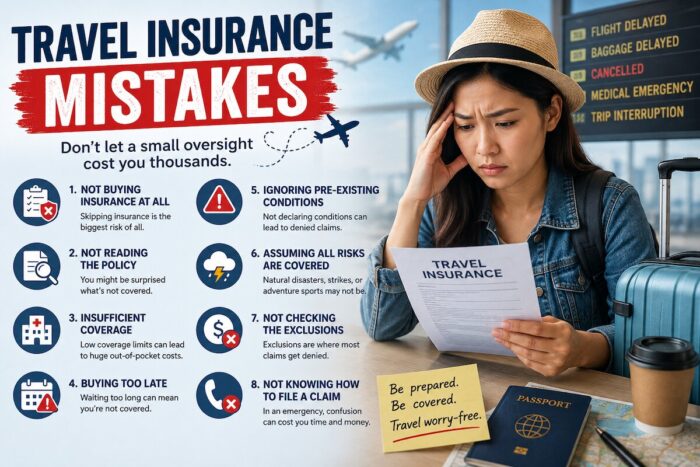
Travel Insurance Mistakes
But travel has a way of reminding us that things do not always go according to plan. A delayed flight can turn into a missed connection. A simple accident can result in an unexpected hospital visit. A suitcase can disappear somewhere between two airports, or a family emergency can force you to cancel a long-planned vacation. Suddenly, the few thousand pesos you spent on insurance can seem like some of the smartest money you spent on the trip.
The catch is that simply having travel insurance does not mean you are automatically protected against everything. Policies have limits, exclusions, deductibles, conditions, and claim procedures that can make a huge difference when something goes wrong.
I have learned that the biggest travel insurance mistakes are often made before the trip even begins. Here are 15 mistakes travelers should avoid if they want their insurance to be genuinely useful when they need it most.
1. Choosing the Cheapest Policy Without Looking at the Coverage
Price is usually the first thing travelers notice when comparing travel insurance. When you see one policy costing PHP 1,000 and another costing PHP 2,500, it is natural to wonder why you should pay more for something you may never use. The problem is that the cheapest policy may also provide significantly less protection.
Travel insurance policies can look similar at first glance, while being very different once you examine the details. One might offer generous medical coverage but limited baggage protection, while another could have a lower medical limit but better trip cancellation benefits. Some policies have higher deductibles, tighter exclusions, or lower limits for individual items.
Rather than choosing based solely on the premium, I recommend looking at the potential financial risk of your trip. If you are taking an expensive international vacation with non-refundable hotels, tours, flights, and activities, a policy with broader protection may make more sense than simply buying the cheapest available option.
At the very least, compare the medical coverage, emergency evacuation, trip cancellation, trip interruption, baggage protection, travel delays, deductibles, exclusions, and claim requirements. The cheapest policy is not necessarily a bad policy, but it is only a good deal if it provides the protection you actually need.
2. Assuming Your Credit Card Travel Insurance Covers Everything
Some travelers are surprised to discover that their credit card includes travel insurance. It can be a useful benefit, especially if you frequently travel and already use the card to pay for flights and hotels. However, I would never assume that credit-card coverage is automatically equivalent to comprehensive travel insurance.
There may be conditions attached to the benefit. You might need to pay the entire airfare with the card, or the coverage could apply only to certain types of travel incidents. There may also be limits on the length of your trip, the people covered, medical expenses, baggage, or cancellation benefits.
Another important distinction is the type of coverage provided. A card might offer travel accident insurance but have limited emergency medical coverage. Those are very different things, especially when you are traveling to a country where medical treatment can be extremely expensive.
Before relying on your credit card for travel insurance, take the time to read its actual terms. Check the medical benefit, emergency evacuation, cancellation and interruption coverage, baggage protection, exclusions, and maximum limits. If there are gaps, consider buying a separate policy rather than discovering them after an emergency occurs.
3. Buying Travel Insurance at the Last Minute
A common habit among travelers is waiting until a day or two before departure to buy insurance. It makes sense if you think of travel insurance only as protection for problems that happen while you are overseas, but some of the most valuable coverage can relate to events that occur before you leave.
Think about how much money you may already have committed to your trip. By the time you are packing your suitcase, you could have already paid for flights, hotels, tours, cruise tickets, airport transfers, and other non-refundable arrangements. If something unexpected happens before departure, you may want cancellation protection for those expenses.
There is also a basic principle behind insurance: it is intended to cover unforeseen events. If something has already happened or is already known when you buy the policy, you generally cannot purchase coverage afterward and expect the insurer to pay for it.
For that reason, I prefer to think about travel insurance soon after making significant non-refundable travel bookings. Always check the policy’s specific purchase deadlines and eligibility requirements, as these can vary by insurer.
4. Failing to Disclose Relevant Medical Conditions
For international travelers, medical coverage is one of the most important parts of a travel insurance policy. Unfortunately, it is also an area where misunderstandings can become expensive.
Travelers sometimes assume that if they have a medical emergency overseas, the insurance company will simply pay the bill. Pre-existing medical conditions can complicate that assumption. Depending on the policy, certain conditions may be excluded, subject to medical screening, or covered only if they are declared and accepted by the insurer.
The important thing is to be honest and thorough when answering medical questions during the application process. Deliberately leaving out relevant information because you think it is insignificant could create problems when you eventually make a claim.
If you are unsure whether something qualifies as a pre-existing condition or needs to be declared, ask the insurer before purchasing the policy. It is much better to clarify the issue at home than to discover a problem in an overseas emergency room.
5. Skipping the Exclusions Section
Let’s be honest: almost nobody gets excited about reading the exclusions section of an insurance policy. It is full of technical language, and when you are planning a holiday, you would much rather research restaurants, attractions, and hotels.
But those exclusions can be just as important as the benefits.
A policy might cover medical emergencies but exclude certain activities. Another might cover baggage theft but have conditions relating to unattended belongings. Some policies may also have restrictions involving alcohol, illegal activities, reckless behavior, or specific forms of transportation.
Adventure travelers need to be particularly careful. If your trip involves skiing, snowboarding, scuba diving, trekking, mountaineering, motorcycle riding, or other higher-risk activities, do not assume that a standard policy automatically covers you.
Before buying, think about what you will actually be doing on the trip and check whether those activities are covered. A policy is only useful if it applies to the vacation you are actually taking.
6. Assuming Trip Cancellation Means You Can Cancel for Any Reason
The phrase “trip cancellation” sounds straightforward, but it does not necessarily mean you can cancel your vacation for any reason and get a refund.
Standard trip cancellation coverage generally applies to specific circumstances listed in the policy. Depending on the insurer, these might include certain unexpected medical emergencies, serious family situations, or other qualifying events. Simply deciding that you no longer feel like traveling usually does not qualify.
This becomes particularly important when booking expensive holidays. Imagine spending PHP 100,000 or more on flights, hotels, tours, and activities, only to decide several weeks later that you would rather postpone the trip. A standard cancellation policy may not cover that decision.
Some insurers and markets offer optional “cancel for any reason” coverage, but it differs from ordinary trip cancellation insurance and may have its own requirements, deadlines, and reimbursement limits.
Before assuming your trip is protected, read the actual list of covered cancellation reasons.
7. Underestimating How Expensive Medical Treatment Can Be
This is probably the travel insurance issue I take most seriously. When we travel, we tend to think about the fun expenses first: hotels, restaurants, attractions, shopping, and transportation. We do not necessarily imagine ending up in a hospital.
Unfortunately, accidents and illnesses do happen.
A relatively straightforward medical problem can become expensive when it involves emergency treatment, diagnostic tests, specialist consultations, medication, hospitalization, surgery, or ambulance transportation. In some countries, even basic medical treatment can cost considerably more than travelers expect.
That is why I always recommend looking beyond the words “medical coverage included.” Check the actual maximum amount covered and understand what medical services are subject to separate limits or conditions.
For international travel, particularly to destinations with high healthcare costs, medical coverage should be one of the first things you examine rather than something you check after looking at baggage and flight-delay benefits.
8. Forgetting About Emergency Medical Evacuation
Medical treatment and medical evacuation are two different things, and this distinction can be easy to miss when comparing policies.
Imagine getting seriously injured while hiking in a remote area, diving near an island, or traveling somewhere with limited medical facilities. The nearest hospital may not have the equipment or specialists needed to treat you. In a serious situation, you could need transportation to another city or even back to your home country.
That is where emergency medical evacuation and repatriation become extremely important.
The cost of specialized medical transportation can be enormous, particularly when aircraft, medical staff, or other specialized arrangements are involved. A policy with a generous medical treatment limit does not automatically mean it provides unlimited evacuation coverage.
When comparing insurance, look specifically at emergency evacuation and repatriation. Check the limits, conditions, and whether the insurer or assistance provider must authorize the arrangements before they take place.
9. Assuming Your Lost or Stolen Belongings Will Be Fully Reimbursed
Losing your luggage is one of the most frustrating experiences a traveler can have. It becomes even more painful when the suitcase contains an expensive camera, laptop, tablet, smartphone, or other equipment.
Travel insurance can provide baggage protection, but it does not necessarily mean the insurer will replace everything at its full purchase price.
Policies commonly have an overall baggage limit and individual-item limits. There can also be deductibles, depreciation rules, category limits, and exclusions. Your PHP 100,000 camera kit, for example, may be worth much more than the maximum amount the policy will pay for a single item.
There may also be conditions concerning how you look after your belongings. Leaving an expensive laptop unattended in a public place could affect a claim depending on the policy wording.
If you regularly travel with valuable electronics or photography equipment, check the baggage section carefully before leaving home. Keep receipts or other proof of ownership where possible, and consider whether additional coverage is appropriate for particularly valuable items.
10. Not Keeping Enough Documentation
When something goes wrong on vacation, the last thing most people want to think about is paperwork. If your luggage has been stolen or you have just spent several hours in a hospital, taking photographs, collecting receipts, and requesting reports may not feel like a priority.
Once the immediate emergency is under control, however, documentation can become extremely important.
If your luggage is stolen, report it to the relevant authorities or the transportation provider and keep a copy of the report. If an airline cancels your flight, save the cancellation notification. If you have medical treatment, retain medical records, prescriptions, invoices, and receipts. If you have to book another hotel because of a qualifying travel disruption, keep the hotel receipt.
I also recommend keeping digital copies of important documents. Saving receipts and correspondence in a cloud folder or email account can be incredibly useful if your phone or luggage is lost.
The more clearly you can document what happened, when it happened, and what you paid as a result, the easier it can be to support your claim.
11. Ignoring the Deductible
Travelers often focus on two numbers when buying insurance: the premium and the maximum coverage amount. The deductible can get lost somewhere in the middle.
A deductible is essentially the amount you may have to pay yourself before the insurer contributes toward an eligible claim. Depending on the policy, it can apply to certain benefits or claims.
This matters when comparing policies that appear similar. A cheaper policy with a higher deductible may not actually be the better value if you end up needing to make a claim.
For example, if two policies have similar medical coverage but one has a significantly higher deductible, the difference may become important when you actually need treatment.
Before buying, ask yourself not only how much the insurance costs, but also how much you could realistically afford to pay out of pocket if something happens.

12. Waiting Too Long to Report a Claim
Finding out that your insurance covers an incident is only part of the process. You also need to follow the insurer’s claim procedures.
Policies can have specific requirements about when you should notify the insurer, what documentation you need, and when a claim must be submitted. This can be especially important for major medical incidents, hospitalizations, evacuations, or significant travel disruptions.
If something serious happens during your trip, contact the insurer or its assistance provider as soon as reasonably possible and follow the instructions you receive.
Do not assume that you can simply return home, forget about the incident for several months, and submit a claim later without any problems.
Keep copies of your claim forms, emails, receipts, medical documents, police reports, airline notices, and other supporting paperwork. A few minutes of organization can save you a great deal of frustration later.
13. Assuming Every Flight Delay Is Covered
Flight delays are so common that many travelers assume insurance will automatically reimburse them for any inconvenience.
Unfortunately, travel insurance does not necessarily work that way.
Policies may require a waiting period before benefits apply. They may also specify which expenses are eligible and which causes of delay are covered or excluded. Even when a delay qualifies, reimbursement can be subject to a maximum amount.
For example, you may be able to claim certain reasonable expenses for meals or accommodation after a qualifying delay, but that does not necessarily mean every expense you incur will be reimbursed.
Whenever your flight is significantly disrupted, keep your boarding pass, airline notifications, receipts, and other documentation. Also check whether the airline itself has obligations to provide assistance or compensation, because those rights are separate from your travel insurance.
14. Booking Tight Connections and Expecting Insurance to Rescue You
I have always believed that a little extra time at an airport is better than running through a terminal with a suitcase.
Tight connections may look attractive when booking a trip, especially if they save money or allow you to arrive at your destination earlier. But a short delay can quickly turn a one-hour connection into a missed flight.
Travel insurance can provide missed-connection benefits in certain circumstances, but it should not be treated as a safety net for poor itinerary planning. Policies may have specific requirements concerning the cause of the missed connection, minimum connection times, and the circumstances surrounding the original delay.
This becomes even more important when you have to clear immigration, collect and recheck luggage, change terminals, or transfer between airports.
Whenever possible, give yourself a reasonable connection window. Spending another hour at an airport is usually much less painful than spending an entire night there because you missed your flight.
15. Buying a Policy That Doesn’t Match Your Trip
Perhaps the biggest mistake of all is buying travel insurance without thinking about the trip itself.
There is no single policy that is perfect for every traveler. The insurance needs of someone spending five days in Singapore are very different from those of someone backpacking through Europe for two months or skiing in Japan for two weeks.
Think about the details of your itinerary before purchasing.
Are you visiting several countries? Are you going somewhere remote? Are you planning to participate in adventure activities? Are you taking a cruise? Are you traveling with children or older family members? Are you carrying expensive camera equipment? Have you paid for expensive non-refundable hotels or tours?
All of these factors can influence the type of coverage you need.
The right policy should fit the trip you are actually taking, not simply provide a generic list of benefits that looks impressive on a comparison website.
What I Look for When Buying Travel Insurance
After years of traveling, I have learned that I would rather spend a little extra time comparing insurance at home than spend hours trying to understand a policy while dealing with an emergency overseas.
I start with medical coverage because a major medical bill can potentially cause the greatest financial damage. I then look at emergency evacuation and repatriation, particularly for destinations with limited medical facilities.
After that, I check trip cancellation and interruption coverage, especially when I have prepaid a significant amount. I also look at baggage protection, travel delays, missed connections, and personal liability.
Finally, and perhaps most importantly, I read the exclusions.
The goal is not to find a policy that promises everything. No legitimate insurance policy covers every possible situation. The goal is to understand exactly what you are buying so you know what to expect if something goes wrong.
A Simple Travel Insurance Check Before You Fly
Before leaving for your next international trip, take a few minutes to review your policy and make sure you can answer these questions:
- How much emergency medical coverage do I have?
- Is emergency medical evacuation included?
- Is repatriation covered?
- What situations qualify for trip cancellation?
- What situations qualify for trip interruption?
- How long does a flight delay need to last before I can claim?
- What is the baggage coverage limit?
- What is the maximum amount payable for one item?
- Is there a deductible?
- Are my planned activities covered?
- Do I need to declare any pre-existing medical conditions?
- What are the major exclusions?
- How do I contact the insurer from overseas?
- What documents will I need if I make a claim?
- Is there a deadline for reporting or submitting a claim?
If you cannot answer these questions, spend a little more time reading the policy before your flight.
Don’t Wait Until Something Goes Wrong to Read Your Policy
One of the worst times to discover the limitations of your travel insurance is when you are already dealing with an emergency.
When you are sitting in an airport after a canceled flight, you do not want to be wondering whether your policy covers accommodation. When you are in a foreign hospital, you do not want to discover that your medical condition was excluded. And when your expensive camera disappears from your luggage, you do not want to find out that the policy has a much lower per-item limit than you expected.
Reading the fine print is not the most exciting part of planning a trip, but it is one of those boring travel tasks that can make a huge difference later.
Final Thoughts
I don’t buy travel insurance because I expect my trips to go badly. I buy it because I know that even the best-planned vacation can be disrupted by something completely outside my control.
Most of the time, thankfully, we never need to use it. We board our flights, check into our hotels, explore new places, eat our way through local neighborhoods, take far too many photos, and eventually make our way home.
But when something does happen, the financial consequences can be far greater than the cost of the insurance itself.
A canceled weekend getaway might cost a few thousand pesos. A missed cruise departure could cost considerably more. A serious medical emergency overseas or a medical evacuation could cost tens of thousands of dollars.
That is why I see travel insurance as more than another item on my travel checklist. It is a financial safety net.
The key, however, is to make sure the safety net is actually strong enough for the trip you are taking. Compare policies carefully, understand the limits and exclusions, disclose relevant information, keep your receipts and documentation, and make sure your activities and destinations are covered.
Most importantly, don’t buy travel insurance simply because a website calls it “comprehensive.” Take the time to understand what comprehensive actually means under that particular policy.
A little homework before your trip may feel tedious when you would rather be planning where to eat or what to see, but it could save you thousands when your travel plans take an unexpected turn.
Follow and subscribe to OutofTownBlog.com on Facebook, Twitter, Instagram, Pinterest, and YouTube for more Travel-related updates.
Read:
- 10 Things to Check Before Buying Travel Insurance
- The Travel Mistakes That Can Turn a Dream Trip Into a Nightmare
- 15 Ways to Save Hundreds on Your Next Cruise
- Travel Insurance for Last-Minute Trips: What Can and Cannot Be Covered
- Where to Get Travel Insurance in Manila? A Comprehensive Guide