

 Melo Villareal
Thailand’s New Airport Baggage Rules October 2026: What You Need to Know
Thailand has introduced revised checked-baggage inspection procedures affecting travelers departing from its airports starting October 16, 2026. The change gives authorized security personnel the power to open checked luggage without the owner present when screening identifies suspicious or potentially dangerous items. The procedure must be recorded, and passengers must receive a notice explaining that their luggage was inspected.
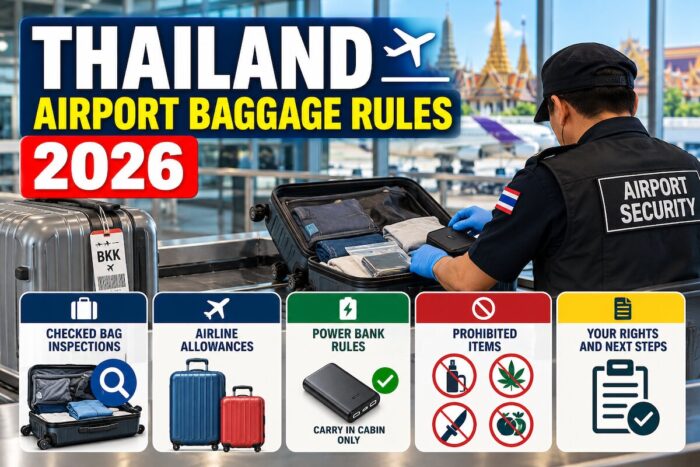
Thailand Airport Baggage Rules 2026
The update matters if you are flying home from Bangkok, leaving Phuket after a beach holiday, or connecting through Thailand on an international itinerary. Travelers should prepare their checked bags carefully, keep valuables and essential documents in their cabin baggage, and use a suitable luggage lock.
However, the new procedure does not replace airline baggage allowances or Thai customs regulations. Each authority has a different role, and understanding those differences can help you avoid delays, additional fees, confiscated items, and airport problems.
What are Thailand’s new airport baggage rules for October 2026?
The Civil Aviation Authority of Thailand (CAAT) announced revised procedures for inspecting checked baggage carried in an aircraft’s hold. The rules take effect on October 16, 2026, following earlier preparations.
The most important change concerns bags that trigger security concerns during screening. Authorized personnel may open and inspect a checked suitcase without waiting for its owner if they have reasonable grounds to suspect prohibited items or objects that could threaten aviation safety.
Here is what travelers should know.
- Effective date: October 16, 2026.
- Bags covered: Checked baggage intended for the aircraft’s hold.
- When an inspection can happen: When screening identifies suspicious, prohibited, or potentially dangerous items.
- Passenger presence: Security personnel can conduct the inspection without the passenger present.
- Documentation: Record the inspection and place a notice inside the baggage.
- Prohibited items: Authorities may seize items that cannot legally be carried on the aircraft.
- Passenger action: Check your luggage before departure and review your airline’s restricted-items policy.
The revised procedure strengthens existing aviation security measures. It does not mean that airport staff can open every suitcase arbitrarily or that every passenger must unlock their luggage at check-in. The inspection must follow the applicable security process.
Why can airport security open checked baggage without the owner present?
Airport screening aims to prevent dangerous goods and prohibited objects from entering an aircraft. An X-ray image may reveal an object that requires closer examination, but security personnel cannot always identify the contents with certainty from the image alone.
Previously, locating a passenger to open a bag could delay screening. The revised procedure allows an authorized inspection to proceed when there are reasonable grounds for concern. CAAT says the process must be documented so authorities can review what happened.
For travelers, the practical implications are straightforward. Do not place anything in checked luggage that you cannot legally transport. Keep prescription medicines, travel documents, money, jewelry, fragile equipment, and other important belongings with you whenever possible.
CAAT also recommends using an internationally recognized luggage lock, such as a TSA-approved lock, to help reduce damage if security personnel need to inspect a bag. A lock does not guarantee that security will leave the luggage untouched, and it does not exempt a suitcase from inspection.
Which Thai airports are affected?
The revised checked-baggage procedure comes from CAAT, Thailand’s civil aviation regulator. It is a national aviation security measure, not a baggage allowance set by an individual airline.
Airports of Thailand (AOT) operates six major airports: Suvarnabhumi, Don Mueang, Phuket, Chiang Mai, Hat Yai, and Mae Fah Luang-Chiang Rai. Travelers using these airports should check current airport notices and their airline’s instructions before departure.
| Airport | Code | What travelers should do |
|---|---|---|
| Suvarnabhumi, Bangkok | BKK | Prepare checked luggage for possible documented inspection. |
| Don Mueang, Bangkok | DMK | Check low-cost carrier baggage limits and security notices. |
| Phuket International Airport | HKT | Review baggage rules before departing after a holiday. |
| Chiang Mai International Airport | CNX | Check your airline’s baggage allowance and restricted-items list. |
| Hat Yai International Airport | HDY | Confirm baggage and battery requirements before check-in. |
| Mae Fah Luang-Chiang Rai International Airport | CEI | Follow current airport security and airline instructions. |
These airports do not have six different versions of the national rule. CAAT sets the main inspection framework. Airport facilities, airline procedures, check-in arrangements, and operational notices can still vary.
Other Thai airports may also serve international routes. Do not assume that an airport falls outside the procedure simply because AOT does not operate it. Check with the relevant airport, airline, or CAAT if your itinerary uses another airport.
Thailand’s new baggage rules versus existing rules
The October 16 change concerns how security personnel inspect checked baggage. It does not establish a new universal weight allowance for every suitcase, nor does it replace individual airline policies.
| Rule or requirement | What applies in October 2026 |
|---|---|
| Checked-baggage inspection | Security personnel may open bags when reasonable grounds for suspicion exist, following the prescribed procedure. |
| Luggage locks | A suitable lock, such as a TSA-approved lock, is recommended. It does not prevent inspection. |
| Carry-on baggage | Weight, size, and piece limits depend on the operating airline, fare, and cabin class. |
| Checked-baggage allowance | Your ticket and the airline’s current policy determine the permitted allowance. |
| Power banks | Carry them in the cabin, subject to capacity and quantity restrictions. |
| Customs restrictions | Thai import and export laws apply separately from aviation security rules. |
Airline baggage allowances: What international travelers should know
Thailand’s airport inspection procedure is separate from your flight’s baggage allowance. A suitcase can comply with airport security requirements and still exceed the airline’s weight or size limit.
The following table summarizes published policies from major airlines serving Thailand. These are useful planning references, but they are not a substitute for the allowance on your specific ticket. Routes, fare families, cabin classes, frequent-flyer benefits, and operating carriers can change the permitted allowance.
| Airline | Cabin baggage | Checked baggage |
|---|---|---|
| Thai Airways | Generally 1 cabin bag, up to 7 kg and 56 × 45 × 25 cm. | For many international journeys, Economy allowances depend on fare family and route. Some Economy fares allow one or two pieces of up to 23 kg each. |
| Thai AirAsia | 2 cabin items with a combined maximum of 7 kg. Main bag: 56 × 36 × 23 cm. Small item: 40 × 30 × 10 cm. | Low Fare: checked baggage available for a fee. Value Pack and Premium Flex: 20 kg included. Premium Flatbed: 40 kg included, according to the published fare comparison. |
| Bangkok Airways | Generally 1 cabin bag up to 5 kg, with size limits depending on aircraft. | Allowance depends on the route and ticket. One checked bag must not exceed 32 kg. |
| Singapore Airlines | Economy and Premium Economy: 1 cabin bag up to 7 kg. Business and First: 2 cabin bags, up to 7 kg each. Each bag’s dimensions total no more than 115 cm. | On many routes outside the United States and Canada, published weight allowances include 25 to 30 kg for Economy fare types, 35 kg for Premium Economy, 40 kg for Business, and 50 kg for Suites and First Class. |
| Emirates | Economy: 7 kg. Premium Economy: 10 kg. Business and First generally have separate cabin-item allowances. Standard cabin bag dimensions are up to 55 × 38 × 22 cm for Economy and Premium Economy. | Depends on route and fare. Emirates uses weight or piece concepts depending on the itinerary. |
| Qatar Airways | Economy generally permits 1 cabin bag up to 7 kg. Business and First generally permit 2 pieces with a combined limit of 15 kg, subject to route-specific rules. | This depends on the route, fare, and cabin class. Check the allowance shown on your booking. |
Before leaving for the airport, check the baggage allowance printed on your e-ticket or available through your airline’s booking-management page. If your itinerary includes codeshare flights, also verify the operating carrier’s rules.
How to avoid unexpected baggage fees
- Weigh your checked suitcase at home, including souvenirs and shopping.
- Measure the bag with its wheels, handles, and exterior pockets.
- Check whether your low-cost fare includes checked baggage or requires a separate purchase.
- Confirm the total cabin baggage weight allowed, including a personal item where applicable.
- Buy additional baggage allowance in advance if your airline offers a cheaper online rate.
- Keep a screenshot or copy of the baggage allowance attached to your booking.
A bag that is only slightly oversized can still be rejected at the gate or incur an additional fee. Do not assume that an allowance from one airline applies to another carrier on the same itinerary.
Power banks and lithium batteries: What to pack
Power banks deserve special attention because they can create a fire risk if damaged, short-circuited, or exposed to unsafe conditions. CAAT’s published passenger guidance requires power banks to travel in the cabin, not in checked baggage. Its current guidance also restricts their use and charging on board.
The main requirements are:
- Up to 100 Wh: Permitted in cabin baggage, subject to the applicable quantity limits.
- Over 100 Wh up to 160 Wh: Requires airline approval and is limited to two units per passenger under CAAT’s published rules.
- Over 160 Wh: Not permitted as ordinary passenger baggage.
- Checked baggage: Do not place power banks and spare lithium batteries in checked luggage.
- Labeling: Clearly mark the watt-hour rating so it is readable.
- Protection: Protect the terminals against short circuits, using individual pouches or suitable packaging.
- On board: CAAT’s published guidance prohibits charging a power bank from an aircraft power source and using a power bank to recharge another device during the flight. Keep it accessible, not in an overhead compartment.
A common example is a 20,000 mAh power bank. If its nominal voltage is 3.7 V, its approximate capacity is 74 Wh. That falls below 100 Wh, but you should still check the printed rating and your airline’s rules. Missing, unreadable, or inconsistent capacity labels can cause problems at security.
Spare batteries for cameras, laptops, and other electronics also generally belong in cabin baggage. If staff require you to check your cabin bag at the gate, remove spare batteries and power banks first.
Prohibited items and Thai customs restrictions
Aviation security rules and customs laws serve different purposes. An item may be permitted on an aircraft under dangerous-goods rules but prohibited from being imported into Thailand. Conversely, an item may be legal to possess in Thailand but prohibited in checked or cabin baggage under an airline’s safety rules.
Items that need special attention
- E-cigarettes and baraku: Thai Customs lists electronic cigarettes and baraku as prohibited goods for importation into Thailand. Do not assume that an item is permitted simply because you can carry it on a flight elsewhere.
- Cannabis products: Check current Thai law, the exact product, any applicable permits, and the rules of every country on your itinerary. Do not assume products sold legally in one location can cross an international border.
- Food, plants, and animal products: Meat, fresh produce, seeds, plants, and animal-derived products may require import permits, quarantine controls, or declaration. Verify the rules before packing them.
- Weapons, ammunition, and sharp objects: These may be prohibited or subject to strict authorization. Check the relevant airline and government requirements before traveling.
- High-value goods and commercial merchandise: Some items may require customs declaration or proof of purchase. Keep receipts and supporting documents when appropriate, and verify the applicable thresholds rather than assuming every personal purchase is exempt.
- Explosives and hazardous materials: Items that threaten aircraft safety may be prohibited from both cabin and checked baggage. Security personnel can take action if they detect prohibited items.
If you are unsure about an item, contact Thai Customs for import rules and your airline for carriage restrictions. Do not rely solely on a shopkeeper’s advice or a travel forum post.
What happens if airport security opens your suitcase?
If security personnel open your checked luggage, you should expect the inspection to follow a documented procedure. CAAT says the inspection process should be recorded, with a notice placed inside the suitcase to inform the owner. Authorities may also seize prohibited items under applicable laws and regulations.
If you collect your bag and discover that it has been opened, follow these steps.
- Look for the inspection notice. Read it and keep it as evidence of the inspection.
- Check the contents carefully. Confirm that your passport copies, clothing, electronics, and other belongings are present.
- Photograph any damage. Take clear photos of broken zippers, damaged locks, cracked luggage shells, or missing items.
- Report the problem promptly. If you are still at the airport, contact the airline’s baggage service desk before leaving the arrivals area. Ask for a written report or reference number.
- Keep supporting documents. Retain boarding passes, baggage tags, receipts, photographs, and the inspection notice.
- Escalate unresolved complaints. CAAT says passengers can complain through their airline or submit a complaint through its official complaint system for investigation.
Do not assume that every damaged bag automatically qualifies for compensation. The outcome may depend on the circumstances, applicable law, the airline’s conditions of carriage, and the evidence available. Report the problem as soon as possible and ask which claim deadline applies.
Should you use a TSA-approved lock?
A TSA-approved lock is a practical option because authorized security personnel can open it with compatible tools without necessarily breaking it. CAAT recommends internationally recognized locks to help reduce damage during necessary inspections.
However, a TSA-approved lock does not guarantee that your suitcase will never be damaged. It also does not guarantee that every Thai airport uses the same inspection tools. Choose a sturdy suitcase, avoid overpacking, and do not put valuables or essential items in checked luggage.
Connecting flights through Thailand
Transiting travelers in Thailand should distinguish between baggage screening, baggage transfer, and customs clearance. These are separate processes.
If your bags are checked through to your final destination, you may not need to collect them during a normal airside transfer. If you booked separate tickets, need to change airports, or must collect your luggage to check in again, you may have to pass through immigration and customs before continuing your journey.
Keep these points in mind:
- Ask your first airline whether your luggage is checked through to the final destination.
- Check whether your connection requires you to collect and recheck your baggage.
- Confirm the baggage allowance for each operating carrier, especially when different airlines issue separate tickets.
- Keep power banks, spare batteries, travel documents, medication, and valuables in your cabin baggage.
- Review the prohibited-items rules of your destination as well as Thailand’s regulations.
- Allow enough time for baggage collection, customs clearance, and a second check-in when required.
A bag accepted by your first airline may still be subject to different size or weight limits on a connecting carrier. Likewise, an item that is lawful at your departure point may be prohibited at your final destination. Verify both sets of rules before leaving home.
Comprehensive pre-flight baggage checklist
Use this checklist before departing from Thailand or boarding an international flight through a Thai airport.
Before you leave for the airport
0 of 12
Copy checklist
Frequently asked questions about Thailand’s airport baggage rules
1. When do Thailand’s new airport baggage rules take effect?
Thailand’s revised checked-baggage inspection procedures take effect on October 16, 2026. The Civil Aviation Authority of Thailand introduced the change to strengthen aviation security and improve baggage-screening efficiency. The rules allow authorized security personnel to open checked baggage without the owner present when reasonable grounds for suspicion exist. The procedure must be documented, and a notice should be placed inside the bag. Travelers should review the latest CAAT guidance and their departure airport’s instructions before flying.
2. Can Thai airport security open my suitcase without my permission?
Under the revised procedures, authorized screening personnel may open checked baggage without the passenger being present if screening identifies suspicious, prohibited, or potentially dangerous items. The measure does not mean that every suitcase will be opened or that staff can inspect luggage without following the applicable procedure. CAAT requires documentation of the inspection, including a notice to inform the owner. Travelers can reduce potential problems by removing prohibited items, packing carefully, and using a suitable luggage lock.
3. Will airport security open every checked bag in Thailand?
No. The revised procedure targets checked baggage that raises reasonable security concerns during screening. It does not require airport staff to open every suitcase, backpack, or travel bag. Most travelers should continue to follow normal check-in and baggage-screening procedures. However, security personnel may select any checked bag for additional inspection if they identify a concern. Pack every suitcase as though it could be inspected, avoid carrying prohibited goods, and keep essential documents and valuables with you in the cabin.
4. Should I use a TSA-approved lock when flying from Thailand?
A TSA-approved lock is a practical choice because authorized security personnel can open it with compatible tools without necessarily breaking it. CAAT recommends internationally recognized luggage locks to help reduce damage during necessary baggage inspections. However, a TSA-approved lock does not guarantee that your suitcase will remain unopened or undamaged. Choose a sturdy lock, keep valuables out of checked luggage, and avoid using a lock as a substitute for checking prohibited-item rules. Photograph your suitcase before departure if you want a record of its condition.
5. Are power banks allowed in checked baggage at Thai airports?
No. Thailand’s published aviation guidance requires passengers to carry power banks in their cabin baggage or on their person, rather than in checked luggage. Capacity restrictions also apply. Power banks up to 100 Wh are generally permitted within the applicable quantity limits, while those above 100 Wh and up to 160 Wh require airline approval and have stricter limits. Devices above 160 Wh are not permitted as ordinary passenger baggage. Check the watt-hour rating printed on your power bank and confirm your airline’s current requirements before departure.
6. Do Thai Airways, AirAsia, and other airlines follow the same baggage allowance?
No. Thailand’s checked-baggage inspection procedures are separate from each airline’s baggage allowance. Each carrier sets its own permitted cabin-bag dimensions, weight limits, checked-baggage allowance, and excess baggage charges, subject to applicable regulations. Low-cost fares may exclude checked baggage, while higher fare families may include additional weight. International airlines may also apply different allowances by route and cabin class. Check the allowance on your ticket and verify the operating airline’s rules, especially when your itinerary includes codeshare flights or separate bookings.
7. Can I bring an e-cigarette or vape into Thailand?
Thai Customs lists electronic cigarettes and baraku as prohibited goods for importation into Thailand. Do not assume that a vape is acceptable simply because it is legal in your home country or sold at your departure airport. Aviation safety requirements for lithium batteries are also separate from Thailand’s import restrictions. Travelers should check the current Thai Customs guidance before packing any vaping device, liquid, or related accessory. If you are unsure whether an item is permitted, leave it at home to avoid confiscation or other legal consequences.
8. What should I do if my suitcase is damaged after a security inspection?
If you discover damage after collecting your suitcase, photograph it immediately and look for any baggage-inspection notice inside. Whenever possible, report the problem to the airline’s baggage service desk before leaving the airport. Ask for a written report or claim reference and retain your baggage tag, boarding pass, receipts, and photographs. CAAT says passengers can report concerns through their airline or submit a complaint to the regulator. Compensation is not automatic, so document the damage carefully and ask which claim deadline and procedure apply to your situation.
9. Do the new baggage rules apply to connecting flights through Thailand?
The answer depends on your itinerary and where your luggage is screened. Travelers departing from Thai airports should follow the applicable checked-baggage inspection procedures. Passengers making international connections may also undergo screening under the rules of the transit airport, airline, or destination country. If your bags are checked through to your final destination, you may not need to collect them during a normal airside transfer. Separate tickets, airport changes, or mandatory baggage rechecks can require additional steps. Confirm your transfer arrangements and each airline’s baggage allowance before departure.
10. What is the best way to avoid baggage problems when traveling through Thailand in October 2026?
Start by checking your airline’s baggage allowance and the latest security notices from CAAT and your departure airport. Weigh your suitcase, measure its dimensions, and remove power banks and spare lithium batteries from checked luggage. Check Thai Customs restrictions separately, especially for electronic cigarettes, food, plants, animal products, and other controlled goods. Keep medication, passports, valuables, and essential documents in your cabin bag. Use a suitable luggage lock, keep your baggage tag, and inspect your suitcase upon arrival so you can report damage or missing items promptly.
Follow and subscribe to OutofTownBlog.com on Facebook , Twitter, Instagram, Pinterest, and YouTube for more Travel-related updates.
Read:
- Top 10 Best Hotels and Resorts in Chiang Mai, Thailand
- These captivating vintage photos of Manila showcase its timeless charm, despite its dark past.
- Best Night Markets in Bangkok: Ultimate Guide to Street Food, Shopping & Nightlife
- Bangkok BTS Guide: How to Use the Skytrain, Routes, Fares, and Travel Tips
- Bangkok 4 Day Itinerary: The Ultimate Guide to Exploring Thailand’s Capital
- Best Places to Visit in Bangkok: 15 Must-See Attractions and Travel Guide