

 Team Out of Town
Taong Putik Festival in Bibiclat, Aliaga, Nueva Ecija: History, Things to Do, Schedule, How to Get There and Travel Tips
The Taong Putik Festival, also known locally as Pagsa-San Juan, is one of the Philippines’ most unusual and deeply rooted religious traditions. Every June 24, devotees in Barangay Bibiclat, Aliaga, Nueva Ecija cover themselves in mud, wrap their bodies in dried banana leaves, and walk barefoot through the community to honor St. John the Baptist.
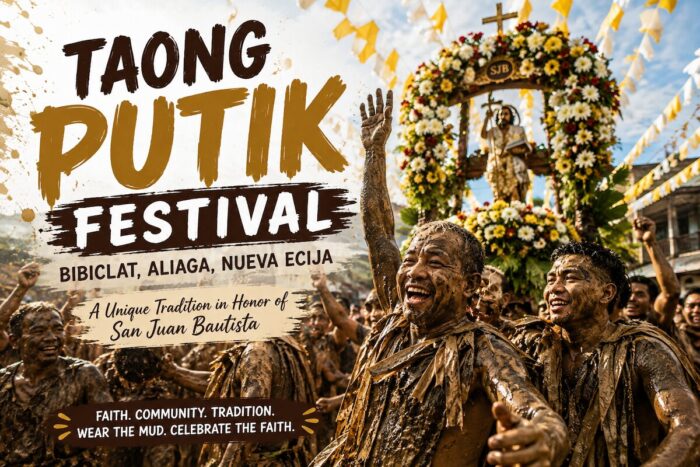
Taong Putik Festival
Unlike the colorful street-dancing festivals commonly associated with Philippine fiestas, Taong Putik is primarily an expression of faith, thanksgiving, humility, and devotion. The celebration offers travelers a fascinating glimpse into the spiritual and cultural traditions of a rural Nueva Ecija community.
What Is the Taong Putik Festival?
“Taong Putik” literally means “Mud People.” The festival takes place in Barangay Bibiclat, Aliaga, Nueva Ecija, on June 24, during the feast of St. John the Baptist.
Devotees traditionally go to the surrounding rice fields before sunrise, cover themselves with mud, and wear handmade coverings made from dried banana leaves, vines, and other natural materials. They then walk around the village, visiting houses and asking for alms in the form of money or candles. These offerings are eventually brought to the church as part of their devotion.
The center of the celebration is the Diocesan Shrine of St. John the Baptist in Bibiclat, which is closely associated with the tradition.
History of the Taong Putik Festival
The exact origins of the tradition are difficult to establish, and several versions of its history have been passed down through generations.
Some accounts trace the practice to the Spanish colonial period, while local traditions strongly connect its development to the Japanese occupation during World War II.
According to the widely told story, Japanese soldiers were preparing to execute men from Bibiclat after Filipino guerrillas were blamed for the deaths of Japanese soldiers. As the men were about to be executed, a powerful rainstorm suddenly arrived.
The villagers interpreted the rain as divine intervention and attributed their survival to St. John the Baptist. In thanksgiving, residents began developing a special way of commemorating the saint’s feast day by covering themselves with mud and natural materials and walking toward the church.
The story has become an important part of the community’s oral history, although versions differ regarding specific details and dates.
More recent accounts suggest that the tradition may have roots extending even further back, possibly to the 1800s. Regardless of its exact date of origin, Taong Putik has become a deeply rooted part of Bibiclat’s religious and cultural identity.
For travelers, the important point is that Taong Putik is not simply a quirky mud festival. It is a living religious tradition shaped by generations of faith, memory, thanksgiving, and community participation.
Why Do Devotees Cover Themselves in Mud?
Mud is central to the tradition’s symbolism.
The devotees’ appearance is associated with the humble image of St. John the Baptist, who is traditionally portrayed as living simply and preaching in the wilderness. The mud, banana leaves, vines, and barefoot procession create an intentionally humble appearance.
For many participants, however, the act is also a personal religious commitment. Some join because of a panata, or vow, made in thanksgiving for answered prayers, recovery from hardship, family blessings, or other personal experiences.
The ritual is therefore both communal and deeply personal.
When Is the Taong Putik Festival?
The Taong Putik Festival is held every June 24, the feast day of St. John the Baptist.
The date is fixed, so travelers who want to witness the actual Taong Putik ritual should plan their trip around June 24 rather than simply visiting Bibiclat during the surrounding fiesta period.
Taong Putik Festival Schedule of Activities
The exact annual program may change, particularly the schedule of Masses and parish activities. However, the traditional sequence generally follows this pattern.
Around 4:00 AM – Devotees Begin Gathering
The most important advice for visitors is to arrive before dawn.
Devotees traditionally begin appearing in mud-covered bodies and handmade banana-leaf coverings at around 4:00 AM. This is one of the most atmospheric parts of the celebration, as the village remains relatively quiet while groups of devotees make their way toward the church.
Before Sunrise – Mud Ritual and Village Procession
Devotees come from the surrounding areas covered in mud and wearing natural-material costumes.
They may walk barefoot along roads and visit houses, where residents give money or candles. These offerings form part of the devotees’ religious practice.
Around 6:00 AM – Holy Mass
The devotees eventually converge at the church for prayers, candle offerings, and Mass.
The traditional schedule places the main Mass at approximately 6:00 AM, but visitors should verify the latest schedule with local organizers or the parish before traveling.
After Mass – Procession
A procession honoring St. John the Baptist follows the religious service.
The image of the patron saint is carried through the community while devotees and other participants accompany the procession.
Later in the Day – Community Fiesta
After the main religious activities, families return home, and the community continues its fiesta celebrations.
For travelers, however, the most distinctive part of Taong Putik is the pre-dawn ritual, church gathering, Mass, and procession rather than the later fiesta activities.
Important: The schedule above represents the traditional sequence and should not be considered the official program for every year. Mass times, procession routes, traffic arrangements, and other activities may change.
Things to Do and See at Taong Putik Festival
1. Watch the Devotees Emerge Before Sunrise
This is arguably the best time to experience the festival.
Rather than arriving after sunrise, position yourself near the village roads leading toward the church before the devotees begin converging.
The sight of mud-covered participants walking barefoot through the dim morning streets is unlike almost any other Philippine festival.
2. Visit the Diocesan Shrine of St. John the Baptist
The shrine is the spiritual heart of the celebration.
Take time to observe the religious activities rather than treating the church simply as a photography location.
3. Photograph the Banana-Leaf Costumes
One of the most recognizable elements of Taong Putik is the homemade costume.
Devotees use dried banana leaves, vines, twigs, and other natural materials to create coverings over their mud-covered bodies.
The combination of mud, natural materials, early-morning light, and rural surroundings makes this a particularly compelling photographic subject.
4. Observe the Almsgiving Tradition
Devotees traditionally visit homes and ask for donations, which may take the form of money or candles.
Residents give these offerings as part of the community’s religious tradition.
Visitors should observe this respectfully rather than turning the interaction into a spectacle.
5. Witness the Mass
The Mass is an important part of understanding the festival.
If you are visiting as a cultural traveler rather than as a participant, attending or respectfully observing the religious service can provide much more context about why the mud ritual matters to the community.
6. Watch the Procession
After Mass, follow the procession route from a respectful distance.
This is an excellent opportunity to see how the seemingly unusual mud ritual connects to a traditional Catholic feast-day celebration.
7. Explore Rural Bibiclat
Bibiclat is surrounded by an agricultural landscape, including rice and vegetable fields.
If you arrive early or stay beyond the main festivities, take time to appreciate the countryside and observe everyday life in this rural part of Nueva Ecija.
How to Get to Bibiclat, Aliaga, Nueva Ecija
From Manila by Bus
The most practical option for commuters is to travel first to Cabanatuan City, then continue toward Aliaga and Bibiclat.
Buses from Metro Manila serve Cabanatuan from major terminals. From Cabanatuan, take local transportation toward Aliaga, then arrange a jeepney, tricycle, or other local ride to Bibiclat.
Because the main Taong Putik activities start before dawn, ordinary public transportation can be inconvenient on festival day.
Best strategy: Travel to Cabanatuan the evening before and stay overnight, then arrange your early-morning ride to Bibiclat.
From Manila by Private Car
Driving is considerably more convenient if you want to reach Bibiclat before sunrise.
From Manila, travel north via NLEX, then continue toward Nueva Ecija via the appropriate connecting roads. Another option is to use the Maharlika Highway, although traffic conditions can significantly affect travel time.
Because June 24 can attract many visitors, allow extra travel time and expect possible congestion near the festival area.
From Cabanatuan City
Cabanatuan is the most practical base for travelers coming from Metro Manila.
From Cabanatuan, continue toward Aliaga and Bibiclat by local transportation or private vehicle. Travel time varies depending on traffic, road conditions, and festival-day arrangements.
For festival day, consider hiring a car, van, or jeepney with a driver if traveling with a group.
Where to Stay
If you want to attend the pre-dawn ritual, staying overnight in Cabanatuan City is usually more practical than traveling from Manila that morning.
Cabanatuan offers substantially more accommodation, dining, transportation, and convenience options than Bibiclat.
Another option is to stay closer to Aliaga if you can find suitable accommodation, but availability may be limited around the festival.
The key is to prioritize proximity over convenience. A hotel room closer to Bibiclat can make a major difference when you need to leave very early in the morning.
What to Bring
Taong Putik is not the kind of festival where you should arrive with your usual city-tour setup.
Bring:
- Comfortable clothes that can handle dust and mud
- Extra clothes
- Rubber sandals or washable footwear
- A small towel
- Drinking water
- Waterproof pouch for your phone and wallet
- Power bank
- Small bills for legitimate donations
- Umbrella or rain protection
- Hand sanitizer
- Plastic or reusable bags for muddy clothing
- Camera equipment that can be protected from mud and moisture
If you are photographing the devotees, a weather-sealed camera or a properly protected smartphone is preferable.
Important Travel Tips
1. Arrive Very Early
This is the single most important tip.
If you arrive at 7:00 or 8:00 AM, you may already have missed some of the most distinctive parts of the tradition.
Aim to be in Bibiclat by around 4:00 AM.
2. Consider Staying in Cabanatuan the Night Before
Trying to travel from Metro Manila immediately before a 4:00 AM festival is risky.
Traffic, delayed buses, limited early-morning public transportation, and unfamiliar roads can easily cause you to miss the main ritual.
3. Protect Your Camera
Mud is everywhere.
If you are bringing a DSLR or mirrorless camera, use a rain cover or protective sleeve. Keep spare batteries and memory cards in waterproof pouches.
4. Do Not Treat Devotees as Costumed Performers
This is perhaps the most important etiquette rule.
The people covered in mud are devotees fulfilling religious vows, not festival entertainers.
Ask permission before taking close-up portraits, especially when photographing someone’s face.
5. Keep Out of the Way During Religious Activities
Do not block devotees, priests, procession participants, or people carrying religious images simply to get a better photograph.
Find a safe position and allow the procession to move naturally.
6. Be Careful Around Rice Fields
The mud ritual takes place in an agricultural environment.
Avoid stepping into cultivated areas unless residents or organizers explicitly allow it. Stay on designated paths whenever possible.
7. Expect Mud
Even if you don’t participate, you may encounter mud on roads and walkways.
Wear clothing and footwear that you don’t mind getting dirty.
8. Carry Cash
Small bills are useful for food, transportation, and voluntary donations.
Do not pressure devotees or residents for money-related interactions simply because they are participating in the festival.
9. Respect the Religious Nature of the Event
Taong Putik may look unusual or even dramatic to first-time visitors, but its meaning is deeply religious.
Approach it as a faith and cultural experience, not simply as a bizarre festival.
10. Confirm the Program Before Your Trip
Because parish schedules, traffic arrangements, and festival activities can change, verify the latest information with local organizers, the parish, or the Municipality of Aliaga before traveling.
Photography Tips for Taong Putik Festival
For photographers, Taong Putik is particularly rewarding because the festival takes place during the transition from darkness to sunrise.
Best Photography Opportunities
Pre-dawn: Capture silhouettes and groups of devotees walking toward the church.
Blue hour: The combination of dark skies, mud-covered figures, and banana-leaf costumes can create atmospheric photographs.
Sunrise: The first light provides more detail in the mud and natural-material costumes.
Church grounds: Look for moments of prayer and candle offerings.
Procession: Photograph the broader scene rather than focusing solely on individual devotees.
Photograph People Respectfully
Avoid treating participants as exotic subjects.
A simple “Pwede po?” before taking a close portrait is appropriate. If someone declines, respect the decision.
Also avoid using flash directly in people’s faces during prayer or Mass.
Is Taong Putik Safe for Tourists?
For ordinary visitors, the festival can be experienced safely with normal travel precautions.
The biggest practical concerns are muddy surfaces, crowds, early-morning travel, weather, heat later in the day, and transportation.
Wear footwear with good grip and avoid carrying valuables that can easily be damaged by mud or rain.
If you have mobility concerns, remember that parts of the experience involve walking on uneven or muddy surfaces.
Is Taong Putik a Pagan Festival?
No.
Although the imagery can look unusual compared with mainstream Catholic celebrations, Taong Putik is fundamentally a Catholic religious tradition honoring St. John the Baptist.
The local practice combines Catholic devotion with community traditions involving mud, natural materials, vows, thanksgiving, and procession.
Calling it simply a “mud festival” misses much of its religious and cultural significance.
Taong Putik Festival vs. Other San Juan Celebrations
Many Filipinos associate June 24 with San Juan festivities involving water.
In Bibiclat, however, the tradition is dramatically different.
Instead of people throwing or spraying water, devotees deliberately cover themselves with mud and wear banana leaves and other natural materials.
This difference is one reason Taong Putik has become one of the country’s most distinctive religious traditions.
Frequently Asked Questions About the Taong Putik Festival
When is the Taong Putik Festival celebrated?
The Taong Putik Festival is held every June 24, the feast day of St. John the Baptist, in Barangay Bibiclat, Aliaga, Nueva Ecija.
Where is the Taong Putik Festival held?
It is held primarily in Barangay Bibiclat, Aliaga, Nueva Ecija, around the Diocesan Shrine of St. John the Baptist.
What time should I arrive?
Arrive at around 4:00 AM if you want to witness the main pre-dawn ritual. The traditional schedule has Mass at around 6:00 AM.
Do tourists have to cover themselves in mud?
No. Visitors can simply observe and photograph the tradition respectfully. The mud ritual is primarily performed by devotees.
Can tourists participate?
Participation should not be treated as a tourism activity. If you are interested in participating as a religious act, ask local organizers or parish representatives about the appropriate way to do so.
Why do people cover themselves with mud?
The ritual is associated with humility, devotion to St. John the Baptist, thanksgiving, and personal religious vows. The tradition is also connected to local stories of divine intervention during World War II.
What do devotees wear?
Participants typically cover themselves with mud and use dried banana leaves, vines, twigs, and other natural materials as coverings.
Is the festival only for Catholics?
The ritual is a Catholic religious tradition, but visitors of different backgrounds can attend as respectful cultural observers.
Can I take photos?
Yes, photography is one of the best ways to document the event, but always be respectful. Ask permission before taking close-up portraits, and avoid interfering with prayers, Mass, or the procession.
Is there an entrance fee?
The religious celebration is generally not a ticketed festival attraction. However, visitors should budget for transportation, food, accommodation, and voluntary offerings.
Where should I stay?
Cabanatuan City is one of the most practical bases because it has more accommodation and transportation options than Bibiclat.
Can I visit Taong Putik as a day trip from Manila?
Technically, yes, but it is not ideal if you want to see the pre-dawn activities. A better plan is to travel to Cabanatuan the night before and leave for Bibiclat in the early morning.
What should I wear?
Wear comfortable, washable clothes and footwear. Avoid white clothing, expensive shoes, and anything that can be easily damaged by mud or rain.
Is Taong Putik worth visiting?
Absolutely—especially if you are interested in Philippine culture, religious traditions, rural communities, documentary photography, and unusual festivals.
What makes Taong Putik memorable is not simply the sight of people covered in mud. It is the story behind the ritual and the devotion that continues to bring generations of residents together every June 24.
Final Thoughts
The Taong Putik Festival of Bibiclat, Aliaga, Nueva Ecija, is one of those Philippine traditions that becomes much more meaningful when you look beyond the spectacle.
At first glance, seeing people covered in mud and wrapped in banana leaves may seem unusual. But once you understand the history, personal vows, community devotion to St. John the Baptist, and the wartime story associated with the tradition, the festival takes on an entirely different meaning.
For travelers, the best approach is to arrive before dawn, observe quietly, photograph respectfully, participate only when appropriate, and take time to understand the community behind the tradition.
If you are looking for an authentic cultural experience in Central Luzon, put June 24 in Bibiclat, Aliaga, Nueva Ecija, on your Philippine festival calendar. Taong Putik is not merely a festival to photograph—it is a living expression of faith and community heritage that has survived for generations.
Follow and subscribe to OutofTownBlog.com on Facebook, Twitter, Instagram, Pinterest, and YouTube for more Travel-related updates.
Read:
- KALIBO CATHEDRAL: Cathedral of St. John the Baptist in Kalibo, Aklan
- A day at the Elephant Sanctuary in Chiang Mai, Thailand