Melo Villareal
If you’re looking for something beyond the ordinary in Singapore, head to the ArtScience Museum at Marina Bay Sands. ArtScience has just finished hosting an emotionally stunning exhibition on the ancient Silk Road, one of the most famous trading routes in human history. The exhibition, titled Traveling the Silk Road: Ancient Pathways to the Modern World, opened in February of 2011 and received critical acclaim.
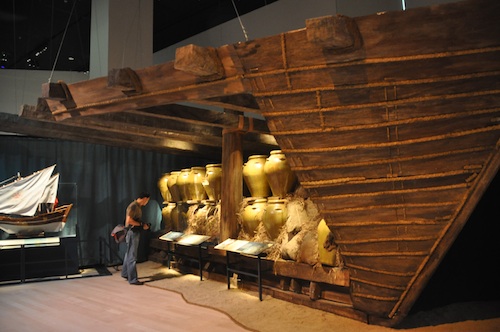
Jan Shim @ The Dhow Interior
Organized by the American Museum of Natural History and appearing in Asia for the first time, this amazing historical exhibit covered 600-1200 AD, when the Silk Road connected the most important trading cities in Asia, the Middle East, and Europe. The exhibition covered about 1,500 square meters and featured historical, interactive, and informative pieces that brought this important era to life.
One hallmark of ArtScience exhibitions is how they bring the past to life by including not only sights and artifacts, but also the sounds and even smells of the past. The busy market cities of the Silk Road have changed over time, and visitors experienced that evolution in Singapore at the ArtScience Museum.

They saw the silkworms of Xi’an, the busy streets of Turfan, felt the market’s feathers, fur, and leather, and smelled the world’s exotic spices. Interactive displays focused on paper making, glass blowing, and life in Samarkand and continued to Baghdad, once the center of the world and scholarship.

Don’t worry though, the life-size camel models didn’t spit, but they wore authentic caravan gear and tack for visitors to touch and see in real life. The director of the ArtScience Museum at Marina Bay, Tom Zaller, has striven to make his museum a place that resonates with global history, not just Singapore’s. When asked about the purpose of this exhibit, he said, “Visitors from Singapore and around the world, young and old, will enjoy this highly interactive exhibition.

Turfan Market
From silk-making to the ancient crafts of papermaking and glassblowing, the universal themes of art and science were integral to the lives of the people who lived in and travelled to these ancient cities. Equivalent to the ‘information highway’ of that time, the Silk Road was a significant factor in the transfer of knowledge in art, technology and commerce that led to the development of the world’s greatest civilizations.”
The exhibition aimed to show that the Silk Road was not just a road but a highly integrated network of cities, stops, and trade that connected the entire known world at the time in ways comparable to the internet today. Rather than starting at one end and ending at the other, it was a series of small stops by individuals, connected by trade and the era’s products.
Through the Silk Road, China’s innovations reached Europe, and Europe’s reached the Far East. The route was more than 10,000 kilometers long and did more to integrate the world than anything before it.
Visitors found exhibits and items from many of the most important points along this colossal ancient highway. Traveling the Silk Road: Ancient Pathway to the Modern World ran from February 17 to March 27, 2011.
* Some photos posted courtesy of Marina Bay Sands
Singapore Travel Tour Packages You Should Try
Follow and subscribe to OutofTownBlog.com on Facebook, Twitter, Instagram, Pinterest, and YouTube for more Travel-related updates.
Read:
- Manila to Singapore Flight Guide: What Filipino Travelers Need to Know
- 8 Best Hotels Near Singapore Changi Airport on Agoda
- How Many Days in Singapore Is Enough?
- 12 Luxury Hotels in Singapore Worth the Splurge
- 10 Things Nobody Tells You Before Visiting Singapore
- The Ultimate Singapore Bucket List: 25 Experiences Worth Paying For