

 Melo Villareal
Faro de Isla Jintotolo: Discover the Stunning Seaside Views of Jintotolo Lighthouse
After indulging in a delightful, hearty breakfast at Beatriz Rafaela Resort (resort info), we were assisted by the enthusiastic Balud Municipal Tourism Team as we embarked on a thrilling journey. Our day began with a scenic drive to the nearest port, which led us to the breathtaking Jintotolo Island under the radiant sunshine.

Balud Lighthouse
Upon arriving in Barangay Cantil, one of the charming villages nestled on the island, we were greeted with a vibrant welcome as locals and children showcased traditional dances with infectious smiles.
Subsequently, we ventured to Barangay Jintotolo for an entertaining program, followed by a delectable seafood feast by the glistening shore. After relishing our meal and leisurely resting in the cozy bamboo huts, we set off to uncover the beauty of the towering lighthouse.
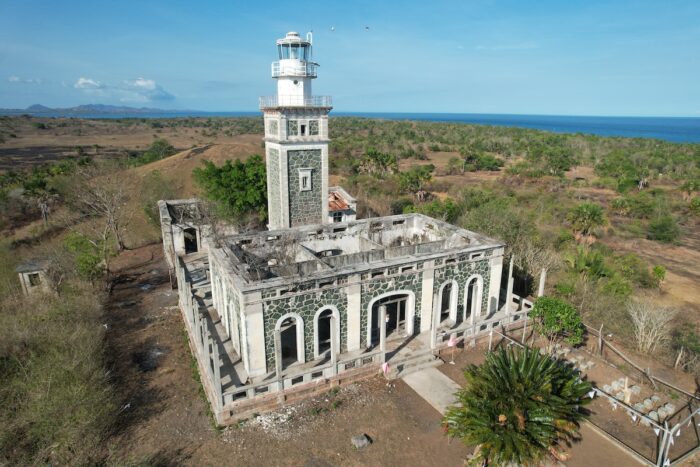
Perched on the picturesque Jintotolo Island in Balud, Masbate, the iconic Jintotolo Lighthouse serves as a timeless symbol of Masbate province’s rich history. Locals affectionately refer to it as the Faro de Isla Jintotolo. This majestic beacon has been a steadfast guide for seafarers navigating the waters since the beginning of the 20th century.
The lighthouse was built by the Spanish Government in 1895 as part of a network of first-order lighthouses. These lighthouses were constructed to ensure safe navigation of ships in the Sibuyan Sea, Visayan Sea, and Jintotolo Channel, which are known for their hazardous waters.
Jintotolo Lighthouse is situated on the highest point of Jintotolo Island. It takes about a half-hour boat ride from the Masbate mainland to reach it.
Its historical importance and picturesque location make it an attractive destination for visitors interested in maritime history and spectacular sea views.
Furthermore, this lighthouse has played a role in the local economy. Tourism has gradually increased, contributing to the livelihoods of the surrounding communities.
History
Spanish Colonial Beginnings
In 1895, the Spanish Government commissioned the construction of the Jintotolo Lighthouse as part of a broader initiative to build a network of lighthouses across the archipelago. It was designed to guide ships through the perilous waters of the Sibuyan Sea, the Visayan Sea, and the Jintotolo Channel.
Engineers such as Ramon de Ros and Primitivo Lluelmo played crucial roles in the design and modification of the structure. Their expertise ensured the lighthouse upheld the quality standard required for such a vital maritime installation.
Renovation and Preservation
Over the years, renovations were necessary to preserve the lighthouse’s functional integrity and historical value. This included retrofitting the lighthouse with a solar-powered lantern to ensure it remains functional in modern times.
Recently, the incorporation of solar-powered technology has marked a significant modern development at the Jintotolo Lighthouse. This innovative approach has enhanced the beacon’s reliability and sustainability.
The lighthouse has also maintained a symbolic presence in the Philippines. It often represents the cultural identity of the coastal regions and serves as an emblem of safe passage for the seafarers of the Gigantes region.
Adaptations such as integrating solar-powered lanterns into its existing structure have positioned the Jintotolo Lighthouse as an example of blending historical preservation with modern technological innovation. This ensures both historical conservation and contemporary functionality for the lighthouses peppered across the Philippine archipelago.

Geography and Accessibility
Surrounding Geography
Jintotolo Island is a part of the Masbate province, which lies between the Visayas and Luzon regions of the Philippines. This island offers views of the expansive Sibuyan Sea and is bordered by Ticao Island and the Burias Islands to the north.
Transportation Methods
- Boat Ride: The primary way to reach Jintotolo Island is by boat. Visitors can embark from Bongcanaway Port or Calumpang Port, with trips usually taking about 30 minutes.
- Outrigger Boat: A common and traditional form of sea transport, the outrigger boat is often used for journeys.
- Motorbike: Once on the island, transportation includes motorbikes or habal-habal for traversing rough terrain.
- City Terminal: For those starting in Metro areas, one can travel via bus or van to the city terminal, from where journeys to Balud or the ports can begin.
Details on Barangays
- Barangay Cantil: This barangay is a gateway to Jintotolo Island and is situated in the municipality of Balud. It serves as one of the jump-off points for the lighthouse.
- Barangay Jintotolo: Another relevant barangay, Jintotolo offers access to the lighthouse and is integral for those navigating to and from the island.
Access to Jintotolo Island and its lighthouse involves coordination with local barangays to ensure a safe and informed journey across the Jintotolo Channel and throughout the Sibuyan Seas.

Tourism
The lighthouse, nestled atop picturesque Jintotolo Island, near the Balud mainland, offers more than just panoramic views—it’s a gateway to exploring the serene white-sand beaches and rich maritime history of the region.
Travel Tips and Preparation
Before embarking on a journey to the Jintotolo Island Lighthouse, visitors should be well-prepared. A half-hour boat ride from the Masbate mainland is necessary to reach the island, with fishing boats typically used for transport.
Once on the island, a 15-minute uphill walk is required to get to the lighthouse. Suitable footwear and sun protection are advised. The trip is most enjoyable during the dry season, from November to May.
Activities and Attractions
The lighthouse itself is a tourist spot, offering panoramic views of the surrounding sea and landscape.
Visitors can also enjoy the white sand beaches in the area, which are perfect for relaxation or picnics.

Alegria Playa is a beach destination on Jintotolo Island, part of the municipality of Balud in Masbate, Philippines. The name “Alegria Playa” is of Spanish origin, meaning “Joy’s Beach,” reflecting the idyllic and joyful experience visitors can expect.
This beach is recognized for its serene, unspoiled natural beauty, offering visitors the chance to enjoy clear waters and sandy shores away from the bustle of more crowded tourist spots. Alegria Playa’s tranquil environment makes it an ideal spot for relaxation and a perfect representation of the island’s charm.
Photography enthusiasts often capture the unique blend of nature and historic architecture, while the surrounding waters are ideal for activities such as swimming and snorkeling.
Connectivity and Communication
The integrity of Jintotolo Lighthouse is pivotal for maritime safety and the local communities’ connection with the broader Philippine archipelago.
This section describes its role in ensuring safe navigation, the communication channels it employs, and the infrastructure that supports its operations.
Safety and Navigation
Jintotolo Lighthouse stands as an enduring beacon in the Visayan Sea, guiding seafarers through the treacherous waters between the Sibuyan Sea and Jintotolo Channel.
Its solar-powered lantern projects a vital navigational aid that significantly reduces the risks associated with maritime travel in this region.
Monitoring and maintenance by Masbate Province ensure that the lighthouse remains a reliable navigational landmark.
Communication Channels
The lighthouse is equipped with communication tools that are essential for conveying critical information to vessels.
Up-to-date weather reports and maritime conditions are communicated to assist in the voyage planning for ships traversing the surrounding seas.
The infrastructure surrounding Jintotolo Island Lighthouse encompasses the necessary facilities to maintain its functionality.
Access to the lighthouse is facilitated by a network of roads and paths connecting to nearby barangays, thus enabling timely upkeep and assistance.

Frequently Asked Questions
How can I get to Balud Lighthouse in Masbate?
To visit Jintotolo Lighthouse, travelers can take a boat ride from the Masbate mainland. The boat ride takes approximately one and a half hours to reach the island where the lighthouse is situated.
What is the historical significance of Jintotolo Lighthouse?
Jintotolo Lighthouse, also known as Faro de Isla Jintotolo, was built in 1895 by the Spanish Government. It is one of the 24 original first-order lighthouses in the country, playing a crucial role in the Philippines’ maritime history.
What are the distinguishing features of the Balud Lighthouse?
The Balud Lighthouse, also known as the Jintotolo Lighthouse, is a historical beacon located on Jintotolo Island, near the town of Balud in the province of Masbate, Philippines. This lighthouse was built during the Spanish colonial period, with its construction completed in 1895 and activation in the early 1900s. The lighthouse is distinguished by its 51-foot (15.5 meters)- high square stone tower, topped with an octagonal lantern podium. It is attached to a one-story keeper’s house, and together they have served as a navigational aid for seafarers in the region. The structure’s historical significance and its role as a guiding light for sea travelers make it a notable landmark in the area.
Are there any underwater caves near Balud, Masbate, and how do they relate to the lighthouse?
Yes, there are underwater caves near Balud, Masbate, including those in the vicinity of Claveria, which is part of Masbate province. These underwater caves offer a unique diving experience and are part of the area’s natural attractions. Although not directly related to the Jintotolo Lighthouse, both the underwater caves and the lighthouse contribute to the region’s allure, drawing adventurers and tourists interested in exploring Masbate’s natural and historical features.
The lighthouse serves as a navigational aid for vessels, marking the channel between the Sibuyan Sea and the Visayan Sea, while the underwater caves offer a different kind of exploration beneath the sea’s surface. Together, they highlight the region’s diverse attractions, from maritime safety to underwater adventure.
What is the role of Jintotolo Lighthouse in maritime navigation?
The Jintotolo Lighthouse plays a crucial role in maritime navigation by serving as a beacon for ships passing through the Jintotolo Channel. This channel is an important shipping route located between the Philippine islands of Panay and Masbate, connecting the Sibuyan Sea with the Visayan Sea.
The lighthouse helps mariners safely navigate these waters, especially at night or in poor visibility, by providing a visual landmark that marks the channel’s entrance and helps avoid nearby hazards. Its light guides vessels to and from the Central Visayas, making it an essential component of the region’s maritime safety infrastructure.
Which lighthouse is considered one of the most famous in the Philippines?
One of the most famous lighthouses in the Philippines is the Cape Bojeador Lighthouse, also known as the Burgos Lighthouse. It is a cultural heritage structure located in Burgos, Ilocos Norte, and was established during the Spanish colonial period.
The lighthouse stands on Vigia de Nagpartian Hill, overlooking the scenic Cape Bojeador, where it has guided ships since it was first lit on March 30, 1892. Its historical significance, architectural design, and panoramic views make it a popular tourist destination and a well-known landmark in the Philippines.
Follow and Subscribe to OutofTownBlog.com on Facebook, Twitter, Instagram, and Pinterest, and Team Out Of Town on YouTube for Masbate Tourist Attractions.
Read:
- Enjoy a Romantic Getaway to the Country’s Beautiful Destinations with Cebu Pacific
- Top 25 Best MASBATE TOURIST SPOTS + Things to Do
- Top 25 BATANGAS TOURIST SPOTS + Things to do & Places to Visit
- The Role of the Youth in Sustainable Tourism Development
- Malabrigo Point Lighthouse in Lobo, Batangas