

 Team Out of Town
Best Longganisa in the Philippines: Top Picks for Meat Lovers
Longganisa is a beloved Filipino sausage renowned across the Philippines for its rich flavors and diverse varieties. Crafted primarily from ground pork, it is infused with fragrant garlic, a blend of local seasonings, and sometimes a hint of sweetness or spiciness, depending on the regional recipe. The sausage is typically cured or marinated, then stuffed into casings and fried, grilled, or pan-seared to develop a crispy exterior while keeping the interior juicy.

Best Longganisa in the Philippines
People commonly serve it as a hearty breakfast alongside steaming white rice and a perfectly fried sunny-side-up egg, creating a satisfying, flavorful start to the day. Although numerous types of longganisa are available, each region boasts its own unique twist—some with a tangy or sweet profile, others with a smoky or spicy kick—making certain varieties stand out as the most prized and sought-after.

One of the most popular Filipino sausages is Lucban longganisa. This sausage comes from Lucban, Quezon province, and is known for its unique flavor. It is made with a blend of pork, garlic, and other spices and is often slightly sour. Lucban longganisa is a must-try for anyone visiting the Philippines.
Another popular type of Filipino longganisa comes from Vigan. This sausage from Ilocos Sur is known for its garlicky flavor. It is made with coarsely ground pork and is often smoked or dried before being cooked. Vigan longganisa is a favorite among locals and visitors and is usually served with vinegar and Papaya pickles.
History of Longganisa
Longganisa is integral to the country’s culinary culture and has a long and fascinating history.
Longganisa originated in the 16th century when Spanish settlers brought pork sausages to the Philippines. The word “longganisa” comes from the Spanish term “longaniza,” a type of Spanish sausage similar to chorizo.
Today, longganisa is enjoyed not only in the Philippines but also by Filipinos living abroad and by people from other countries who have discovered its delicious taste. It has become a symbol of Filipino cuisine and culture and a must-try for anyone visiting the Philippines.
Regional Varieties of Longganisa
Longganisa is a popular Filipino sausage with various regional varieties. Each region prepares and seasons the sausage uniquely, resulting in different flavors and textures. Here are some of the most popular regional varieties of longganisa in the Philippines:

Vigan Longganisa
Vigan longganisa is the Philippines’ most iconic garlicky sausage—small, plump, and deeply aromatic. Its flavor is boldly savory with a sharp garlic punch, mild saltiness, and a faint tang from native cane vinegar rather than sweetness. Unlike many Filipino sausages, it is not sugary; instead, it tastes clean, meaty, and slightly smoky when pan-fried.
Traditionally, it’s made from coarse-ground pork shoulder mixed with crushed garlic, salt, black pepper, and sukang Iloko. The mixture is stuffed into natural hog casings or formed into skinless casings, then air-cured overnight to deepen the flavor. When cooked, simmer it in a little water first, then fry in its own fat until caramelized and crisp at the edges.
What makes it unique is its intense garlic character and sour-savory balance, reflecting Ilocano preference for bold, non-sweet food. For the authentic experience, try it at Vigan Public Market breakfast stalls or local eateries along Calle Crisologo in Ilocos Sur.

Lucban Longganisa
Lucban Longganisa is a famous sausage from Lucban, Quezon province. It has a distinctive flavor, combining ground pork, garlic, oregano, paprika, and other spices, then stuffing it into hog casings and hanging it to dry.
Lucban Longganisa has a slightly sweet, tangy taste and is often served with garlic rice and a vinegar dipping sauce. But what makes Lucban Longganisa truly special is the addition of oregano and paprika, which give the sausage a deeper flavor that hints at European influences.
According to historian Jojo Raneses, the local cook Juan Suarez taught the people of Lucban how to make longganisa. He had been brought to Mexico, where he learned about chorizo de Bilbao. After experimenting with banana leaves and egg whites as casings, Suarez eventually perfected the recipe that is still enjoyed today.
Sampaloc Longganisa
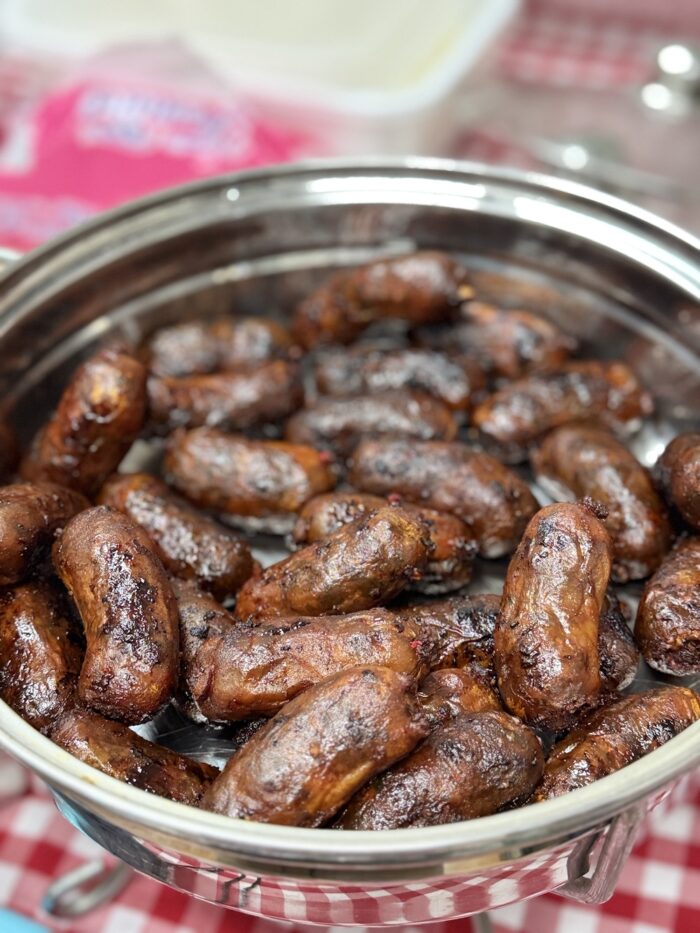
Sampaloc Longganisa is a traditional pork sausage from Sampaloc, Quezon, distinguished by its use of pasutis, an aromatic herb also known as epazote or Mexican tea. It has a savory, garlicky flavor with a mild tang from vinegar and a distinctive herbal aroma. Unlike sweeter varieties of Filipino longganisa, Sampaloc’s version leans toward a balanced, savory taste with subtle smoky notes and little sweetness.
Local makers season chopped pork with garlic, onion, salt, black pepper, vinegar, oregano extract, and pimenton, a spice mixture that contributes color and depth. The defining ingredient, pasutis, adds a minty, earthy, slightly medicinal character. Cooks must use it sparingly because too much can make the sausage bitter.
Traditional preparation also sets it apart. Some makers chop the pork by hand instead of using a meat grinder, creating a coarser texture that highlights the meat. More than a breakfast favorite, Sampaloc Longganisa preserves a distinctive culinary tradition that travelers can discover in Quezon.

Alaminos Longganisa
Alaminos Longganisa is an iconic Filipino pork sausage originating in the city of Alaminos, Pangasinan province. Its unique blend of ground pork, garlic, and spices like black pepper and anise gives it a savory, slightly sweet flavor that is truly unforgettable.
Alaminos Longganisa is stuffed into hog casings and hung to dry, giving it a salty, garlicky, and tangy taste. The sausage’s orange color comes from the addition of atsuete.
To enjoy the full flavor of this traditional Filipino sausage, serve it with garlic rice and a vinegar dipping sauce. Enjoy the authentic taste of Alaminos Longganisa today!

Chorizo de Macao
Chorizo de Macao, also known as Chinese Chorizo or Longaniza Macau, is a Filipino dry pork sausage used in various Chinese-Filipino dishes.
It is made with the same ingredients as other Filipino sweet longganisas (longganisa hamonado) but with a dry texture and a hint of star anise, aniseed, or anise liqueur (anisado) for a unique aroma. You can find this distinctive sausage in dishes like pancit Canton and siopao, and people often mistake it for Chinese sausage.

Cebu Longganisa | Chorizo de Cebú
Cebu Longganisa, a Filipino pork sausage from the Cebu province, is a delicacy made with ground pork, garlic, and a variety of spices, including black pepper and oregano. It is stuffed into hog casings and hung to dry, giving it a slightly sweet and spicy flavor.
Chorizo de Cebu, or longganisa de Cebu, is a type of hamonada longganisa that is distinctively red because it uses achuete seeds. Each link is usually spherical and made from lean pork, pork fat, salt, saltpeter, sugar, anise liqueur (anisado), paprika, black pepper, garlic, and chilis.
Enjoy the savory goodness of Cebu Longganisa, fried or grilled with white rice, puso, or garlic rice, served with a vinegar dipping sauce for a delicious breakfast or snack.

Pampanga Longganisa
Pampanga longganisa, often called longganisang hamonado, is known for its rich, sweet-savory flavor and juicy texture. The first bite is gently garlicky, then quickly followed by caramelized sweetness from brown sugar, balanced by a light saltiness and a faint tang from vinegar. When pan-fried, the sugars glaze the casing, creating a slightly sticky, glossy exterior while the inside stays tender and aromatic. Compared to garlicky northern styles, Pampanga’s version tastes warmer and more festive, almost reminiscent of ham — hence the name hamonado.
What makes it unique is the Kapampangan culinary tradition: carefully minced pork, a higher fat ratio, and a marinade that rests overnight to deepen flavor. Many families still use heirloom recipes passed down for generations.
You can find authentic Pampanga longganisa in local markets like San Fernando Public Market and Angeles City Pampanga Market, as well as specialty pasalubong stores such as Pampanga’s Best and Nathaniel’s, which sell fresh and vacuum-packed versions perfect for travel.

Tuguegarao Longganisa
Tuguegarao Longganisa is a Filipino sausage from the Cagayan Valley region in northern the Philippines. This sausage is known for its distinct sourness from the vinegar marinade used in its preparation.
One unique feature of Tuguegarao Longganisa is its yellowish or orange color, achieved by adding atsuete (annatto). The meat is less finely ground, resulting in larger pieces of meat in the sausage.
Tuguegarao Longganisa is often served with fried rice and fried egg, a popular Filipino breakfast dish called “silog.” It is also a staple ingredient in Filipino dishes such as “pinakbet,” a vegetable stew.
If you want to try Tuguegarao Longganisa, some popular brands include Aica’s Authentic Tuguegarao Longganisa and G&B Tuguegarao Longganisa. You can also find this sausage in local markets and restaurants in the Cagayan Valley region.

Imus Longganisa
In Cavite, the City of Imus has its own version of longganisa. The famous adobo-style Imus Longganisa is made with fresh meat, soy sauce, vinegar, annatto, and black pepper, then stuffed into natural sausage casing.
Big Ben’s Original Garlic Adobo Longganisa is an underrated delicacy yet a local favorite in Imus, Cavite. It combines soy sauce, vinegar, annatto, and black pepper, uniquely giving the mostly lean pork a perfect balance of salty and sour flavors — the ideal accompaniment to nipa palm vinegar, making for an unforgettable “longsilog” breakfast experience during your visit to Cavite.
Lola Maria is another famous longganisa brand in Imus, meticulously crafted with love and care to create the perfect sausages. From farm to fork, their homemade longganisa undergoes quality control to ensure every bite is flavorful and packed with goodness.

Guinobatan Longganisa
Longganisa de Guinobatan is a unique Filipino pork sausage from Guinobatan in Albay, Philippines. Each sausage link measures only 2 inches (5.1 cm) and is made with a special recipe of lean pork, pork fat, salt, sugar, garlic, saltpeter, and black pepper.
The meat is hand-chopped, giving the sausage a unique flavor and texture. Each year, Guinobatan celebrates a festival dedicated to delicious sausage with the “Longganisa Festival.” The original recipe dates back to 1945, when Danding (Bigote) Nosares created a unique processed-meat recipe.
It was the first Guinobateño-made Special Longganisa, made from cubed pork with a heavy garlic flavor. For decades, Special Longganisa was available only by order, with regular customers being tourists and balikbayans. However, with the help of the DTI, Danding’s daughter, Carmen Nosares-Ravago, has since improved the recipe, now using pork hind leg (pigue) and indigenous ingredients (no preservatives).

Binalonan Longganisa
The Binalonan version of longganisa is a local favorite and a must-try for visitors. This savory delicacy is made with fresh pork, black pepper, and garlic, giving it a unique and mouth-watering flavor. Its meaty, garlicky taste is irresistible, and it’s best enjoyed with a vinegar dip, banana ketchup, or a mix of soy sauce and calamansi.
As demand for Binalonan Longganisa has grown, local meat vendors have maintained the original recipe passed down through generations. Restaurants in the area have also added Longganisa dishes to their menu.
In 2015, the Binalonan administration even launched the Longganisa Festival to celebrate the booming industry and give locals the chance to showcase different Longganisa-based dishes.

Cabanatuan Longganisa (Batutay)
Cabanatuan Longganisa, also known as Batutay, Bototay, or Batotay, depending on the municipality. It is a Filipino pork sausage from Cabanatuan, Nueva Ecija, made with ground beef instead of the usual pork. It has a sweeter taste, balancing savory and sweet.
This delicacy is celebrated in the annual “Longganisa Festival” of Cabanatuan. Dorothea Lajares is credited with creating the recipe in 1952, when she started Aling Otya’s Longganisa at the Cabanatuan Public Market.
Aling Otya’s is one of Cabanatuan’s most famous longganisa promoters and is known for selling classic longganisa, as well as garlic, spicy, and hamonado varieties, and eventually the batutay. Since then, it has become a beloved part of Filipino cuisine.

Baguio Longganisa
Baguio Longganisa is a Filipino pork sausage originating in Baguio. It is a type of Hamonado (sweet) Longganisa, with two versions: garlic de recado and sweet jamonado.
Baguio Premium Longganisa of Baguio Country Club has been a favorite amongst many tourists visiting the City of Pines. According to the makers, they reduced the longganisa’s fat content to 20%, making it leaner, tastier, and healthier.
Furthermore, their recipe contains no preservatives or additives, and they want everyone to have a full farm-to-table experience, even at home.

Aklan Longganisa – Chorizo De Kalibo
For centuries, Aklan Longganisa has been a beloved delicacy in Western Visayas. This flavorful Filipino sausage is native to Aklan province and a regional specialty. This simple yet delicious sausage is made from ground pork, garlic, pepper, and other spices.
The pork is ground twice for a fine texture, while garlic and pepper add a distinctive flavor. It is usually served as a breakfast dish, and its history dates back to when Spanish colonizers brought the ingredients and recipes to the Philippines.
Aklan longganisa is mildly spicy from black pepper and garlic, and you can adjust the spiciness by adding more or less black pepper. For food lovers, Aklan Longganisa is an absolute must-try!

Pinuneg (Cordillera Administrative Region)
For the Kankanaey people of Benguet, Pinuneg is central to their culture. This savory, hearty blood sausage is made with pig’s blood, innards, and spices, and is traditionally served after a ritual or ceremony.
Pinuneg has a unique texture: a chewy mix of pig blood and spices wrapped in a large, clean pig’s intestine. While it may not be for everyone, this Cordilleran delicacy is boiled for 30-35 minutes to bring out its flavor and can even be served with a hint of chili or vinegar for added spice.
Pinuneg has been part of the Kankanaey tradition long before the Spaniards arrived in the Philippines, so it’s no surprise that it remains a beloved dish for many Cordillerans today.

Taal Longganisa
Taal Longganisa from Taal, Batangas, is a bold, rustic sausage known for its intense garlic aroma and chunky texture. Unlike finely ground varieties, the pork is hand-cut into small pieces and packed into natural casing, giving it a juicy bite and a slightly uneven, homemade feel.
Flavor-wise, it leans toward the garlicky “de recado” style but with a distinctive Batangueño twist: strong garlic, black pepper, soy sauce or vinegar, and a balanced hint of sweetness that creates an adobo-like profile. The taste is pungent, savory, and slightly sweet, sometimes brightened with calamansi. Compared with other longganisa, it looks browner and more aromatic, yet remains deeply garlicky.
What makes it unique is the heavy garlic seasoning and family-guarded recipes that vary from stall to stall.
You can buy authentic Taal Longganisa at the Taal Public Market and well-known local stalls such as Gerry and Lheen Special Tapa and Longganisa in Taal, Batangas.

Calumpit Longganisa
Calumpit Longganisa is a type of sausage originating in Calumpit, a municipality in Bulacan. It is a popular breakfast food in the Philippines, often served with garlic rice and eggs.
Calumpit Longganisa is known for its distinct flavor, combining garlic, salt, and pepper. It also has hints of paprika and brown sugar, which give it a well-rounded flavor profile. Bay leaves and soy sauce also enhance the taste.
Compared to other types of longganisa, Calumpit Longganisa is not too fatty because most Bulacanos use leaner meat. It is also less sweet than other varieties, making it an excellent choice for those who prefer savory breakfasts.
Some of the best places to try Calumpit Longganisa are in Calumpit’s public market, where it is made fresh daily. You can also find it in some supermarkets and online stores.
Overall, Calumpit Longganisa is a must-try for anyone who wants to experience the unique flavors of Filipino cuisine. Its well-balanced taste and low-fat content make it a healthy and delicious breakfast option.

Chorizo Negrense
Chorizo Negrense is a type of longganisa originating from Bacolod City, Negros Occidental. It is known for its distinct flavor, a savory-sour combination. The sour taste comes from adding a hint of calamansi (lime juice) to the ingredients.
This longganisa is made with ground pork, garlic, salt, pepper, and vinegar. It is then stuffed into natural hog casings and smoked for a unique flavor. Chorizo Negrense has a reddish-brown color and a slightly sweet aroma.
Chorizo Negrense is a popular breakfast dish in Western Visayas. It is usually served with garlic rice, fried egg, and vinegar dipping sauce. It can also be used in dishes such as pancit and as toppings for other local dishes.
Here are some popular brands that produce Chorizo Negrense:
| Brand | Description |
|---|---|
| Ereñeta-Manaloto Chorizo de Bacolod | This brand has produced its heirloom recipe since the 1930s and is known for its authentic taste. |
Longganisa is a versatile, delicious dish you can enjoy in many ways. Whether you prefer it sweet or savory, garlicky or tangy, a regional variety of longganisa will satisfy your taste buds.

What is your favorite Longganisa?
From the garlicky bite of Vigan to the sweet warmth of Pampanga, the search for the best longganisa in the Philippines ultimately becomes a journey through memory, craft, and community.
Greatness is not only the balance of fat, meat, sugar, and spice, but the hands that mix it at dawn and the stories served beside it at breakfast. Each town guards a recipe shaped by climate, history, and family pride, proving there is no single champion, only beloved regional icons.
The true winner is the table where it is shared, sizzling next to garlic rice and eggs, eaten slowly with vinegar and laughter. When travelers taste longganisa, they taste identity: resourceful, festive, and deeply personal.
So the best longganisa is the one that brings you back—back to kitchens, markets, and mornings worth remembering, long after the last bite disappears. In every province, a link connects generations, reminding us that food is a heritage we carry with us wherever we go, always proudly.
Frequently Asked Questions
What are the different types of longganisa in the Philippines?
The Philippines has many types of longganisa, each with its own taste and texture. Some of the most popular types include Vigan longganisa, Lucban longganisa, Pampanga longganisa, and Cebu longganisa.
What is the most famous longganisa in the Philippines?
Vigan longganisa is perhaps the most famous longganisa in the Philippines. It is known for its garlicky flavor and is a popular souvenir item for tourists visiting the Ilocos region.
Where can I find the best longganisa in Vigan?
There are many places in Vigan where you can find delicious longganisa. Popular spots include the Vigan Public Market, Plaza Burgos, and the Heritage Village. Most of the souvenir and pasalubong shops in Vigan also sell longganisa.
What is the famous longganisa from Quezon called?
The famous longganisa from Quezon is called Lucban longganisa. It is known for its garlic flavor and is a highlight of the Pahiyas Festival in Lucban. It is also consistently voted one of the best longganisa in the Philippines.
What is the history of longganisa in the Philippines?
Longganisa has been a part of Philippine cuisine for centuries. The Spanish colonizers are believed to have introduced it to the Philippines. Over time, different regions developed their own unique longganisa recipes.
What is the best longganisa recipe?
The best longganisa recipe depends on personal preference. However, most longganisa recipes include ground pork, garlic, vinegar, and spices. Some recipes also include sugar or soy sauce for added flavor.
Want more updates about the Best Longganisa in the Philippines? Like, follow, and subscribe to OutofTownBlog.com on Facebook, Twitter, Instagram, and Pinterest, and Team Out of Town on YouTube for more updates about other versions of Longganisa in the Philippines.
Read:
- Vigan Travel Guide: DIY Itinerary, Activities, Places to Stay and more
- Visiting Taipei? Here Are the Best Street Foods You Should Try in Taiwan
- Top 7 Tourist Spots in Lucban, Quezon + Things to do
- FOOD TRIP: 6 Must-Try Foods in Pangasinan


