

 Inka PIegsa-Quischotte
The Ultimate Travel Guide to Seville, Spain
Seville, the capital of Andalusia in southern Spain, embodies everything you may associate with Spanish Culture, architecture, and lifestyle. Think gypsies and flamenco, Moorish and Gothic buildings, the mystery of Semana Santa (Easter Week), and the colorful festivities of the famous Feria de Abril (April Festival); add gardens and parks along the shore of the river Guadalquivir and you are in for a Spanish experience you’ll never forget. Eat the best tapas and paellas in Spain, washed down with sherry and red wine, then burn it all off by exploring the many sights of Seville on foot because otherwise, you wouldn’t find some secret corners which we will tell you about.

Royal Alcazar of Seville
Seville, located in Spain’s Andalusia region, is a captivating city with rich history, vibrant culture, and modern attractions. With its stunning architecture, including the iconic Cathedral and Alcazar, picturesque neighborhoods like Santa Cruz, and the lively Plaza de España, Seville offers a plethora of sights to explore. Immerse yourself in the enchanting ambiance of flamenco music and dance, indulge in delectable tapas and local cuisine, and wander through charming streets lined with orange trees. Don’t miss the annual Feria de Abril, a vibrant week-long festival showcasing Seville’s lively spirit. With its warm climate, friendly locals, and rich cultural treasures, Seville is an irresistible destination for any traveler seeking an authentic and unforgettable Spanish experience.
Best Time to Visit Seville, Spain
The best time to visit Seville is generally March to May and September to October, when the weather is warm, the city is lively, and temperatures are more comfortable for sightseeing. For the best balance of pleasant weather, manageable crowds, and reasonable prices, October is particularly appealing.
Spring: March to May — Best for Festivals and Orange Blossoms
Spring is one of Seville’s most spectacular seasons. Temperatures are generally comfortable for walking, while the city’s famous orange trees begin filling the streets with fragrance.
The major attraction is the festival calendar. Semana Santa (Holy Week) brings elaborate religious processions through the historic center, followed soon after by Feria de Abril, a colorful celebration featuring flamenco, traditional costumes, food, music, dancing, and horse parades.
Best for: Festivals, photography, culture, gardens, and first-time visitors
Downside: April can be extremely busy and expensive, particularly around the major festivals.
June to August — Best for Budget Travelers Who Can Handle Heat
Summer is Seville’s hottest period. July and August regularly experience temperatures around 35–37°C, with heatwaves sometimes pushing temperatures beyond 40°C.
The advantage is that visitor numbers may decline due to the extreme heat, and accommodation may be more affordable. If you visit during summer, plan sightseeing for the early morning and evening, with a long break during the hottest part of the afternoon.
Best for: Budget travelers, nightlife, and quieter attractions
Downside: Midday sightseeing can be uncomfortably hot.
September to October — Best Overall
For many travelers, September and October offer the best combination of weather and sightseeing conditions. September begins hot but gradually becomes more comfortable, while October typically brings warm days and pleasant evenings.
October is especially attractive because temperatures are considerably more manageable than summer while the city remains lively.
Best for: First-time visitors, sightseeing, food, flamenco, and romantic trips
Downside: September can still be quite hot, while October has a greater chance of rain than spring.
November to February — Best for Fewer Crowds
Winter is relatively mild compared with much of Europe, with daytime temperatures often suitable for walking around the historic center. Tourist crowds are considerably smaller, making it easier to visit attractions such as the Real Alcázar, Seville Cathedral, Plaza de España, and Santa Cruz.
November through January is wetter than summer, so bringing a light rain jacket or umbrella is advisable.
Best for: Budget travel, museums, architecture, and relaxed sightseeing
Downside: Shorter days and a greater possibility of rain.
Quick Guide
| Month | Weather | Crowds | Best For |
|---|---|---|---|
| January | Cool, mild | Low | Budget trips |
| February | Mild | Low–Moderate | Quiet city breaks |
| March | Warm | Moderate–High | Orange blossoms |
| April | Warm | Very High | Semana Santa & Feria |
| May | Warm | High | Excellent sightseeing |
| June | Hot | Moderate | Evening activities |
| July | Very hot | Low | Budget travel |
| August | Extremely hot | Low | Nightlife, lower prices |
| September | Hot to warm | Moderate | Flamenco & evenings |
| October | Warm, comfortable | Moderate | Best overall |
| November | Mild | Low | Quiet sightseeing |
| December | Mild, occasional rain | Low–Moderate | Christmas atmosphere |
So, When Should You Go?
Best overall: October
Best weather: May or October
Best for festivals: March–April
Best for fewer crowds: November–February
Best for lower prices: January–February and July–August
Best for avoiding extreme heat: March–May and October–November
If you’re planning your first trip to Seville, October is an excellent choice. You get warm weather without the punishing summer heat, good conditions for exploring the historic center, and comfortable evenings for tapas and flamenco.
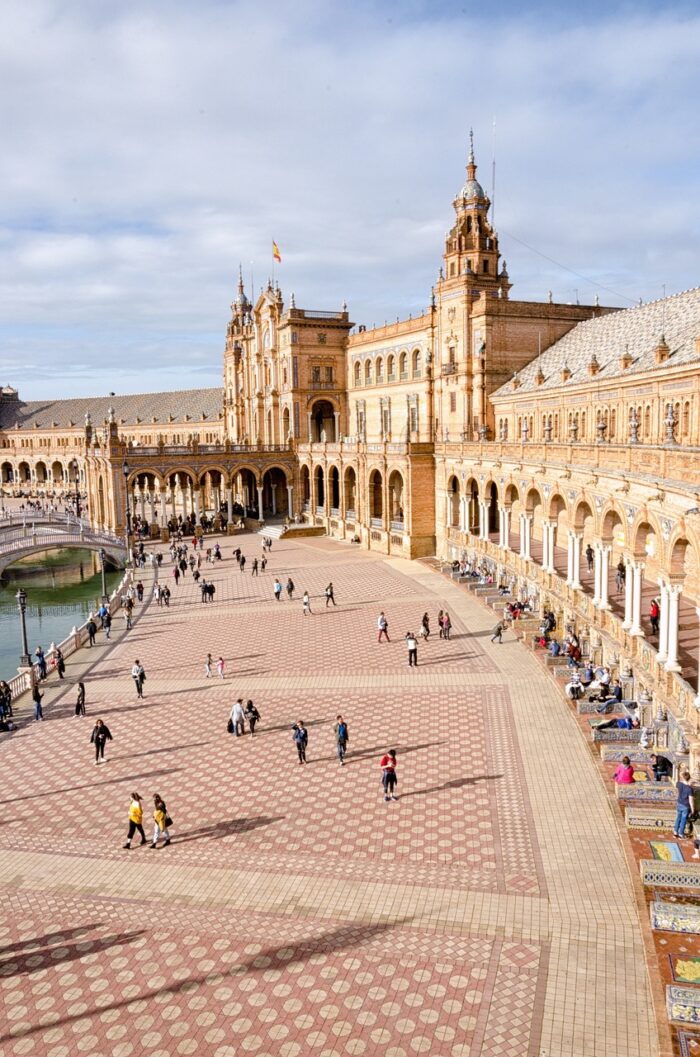
How to Get to Seville, Spain
Seville is one of Spain’s best-connected cities, with convenient options by air, high-speed train, bus, and car. For international travelers, flying into Seville is usually the easiest option, while travelers already exploring Spain can often save time by taking the high-speed train.
By Air
The main gateway is Seville Airport (San Pablo Airport), located about 8–10 kilometers from the city center. The airport handles domestic and international flights, with connections to major European cities.
For travelers coming from the Philippines, there are generally no nonstop flights from Manila to Seville. A practical option is to fly from Manila to a major European or Middle Eastern hub, then connect to Seville. Another option is to fly to Madrid or Barcelona and continue to Seville by high-speed train.
From Seville Airport to the City Center
Airport Bus EA: The EA Airport Special bus connects the airport with Seville. The journey takes approximately 35 minutes. The single-trip fare is around EUR 6.
Taxi: Official airport taxis operate with a fixed airport fare. The fare is generally around EUR 26 during weekday daytime hours and EUR 29 during other specified periods, including weekends, holidays, and certain nighttime hours.
Rental Car: Cars can be rented at the airport, though one is generally unnecessary if you are staying in central Seville.
By High-Speed Train
Taking the train is one of the easiest ways to reach Seville when traveling elsewhere in Spain. Santa Justa Station is Seville’s main railway station and is served by high-speed trains, including connections from Madrid, Barcelona, Córdoba, Zaragoza, and Málaga.
Madrid to Seville
The high-speed train from Madrid to Seville takes approximately 2 hours 20 minutes to 2 hours 40 minutes, depending on the service. This is one of the most convenient ways to combine Madrid and Seville in a single trip.
Barcelona to Seville
High-speed trains connect Barcelona and Seville in approximately 5 hours 5 minutes to 5 hours 40 minutes.
Málaga to Seville
Seville is also connected with Málaga by rail, making it convenient to combine Seville with the Costa del Sol and other Andalusian destinations.
Córdoba to Seville
Córdoba is particularly easy to combine with Seville. High-speed trains can make the journey in less than an hour, making Córdoba a popular stop on an Andalusia itinerary.
By Bus
Long-distance buses connect Seville to other Spanish cities, as well as to destinations in Portugal and elsewhere in Europe.
The main international and national bus station is Plaza de Armas, located near the city center. Regional buses mainly use Prado de San Sebastián.
Buses can be cheaper than trains, although journeys are usually longer.
By Car
Seville is well connected to the rest of Spain by major highways.
From Madrid: Take the A-4 south toward Seville.
From Córdoba: The A-4 provides a direct connection to Seville.
From Málaga and Granada: The A-92 connects with Seville.
From Cádiz: The AP-4 provides a direct route.
From Portugal: The A-49 connects Seville with Huelva and Portugal.
Driving can be useful if you plan to explore smaller towns and attractions around Andalusia, but parking and narrow streets can make a rental car inconvenient in Seville’s historic center.
Best Way to Get to Seville
| Starting Point | Recommended Transport | Approx. Travel Time |
|---|---|---|
| Manila | Flight + European connection | Varies |
| Madrid | High-speed train | 2.5–2 hr 40 min |
| Barcelona | High-speed train | 5.5–5 hr 40 min |
| Córdoba | High-speed train | Under 1 hour |
| Málaga | Train | Around 2 hours |
| Cádiz | Train or car | Around 1.5–2 hours |
| Lisbon | Flight, bus, or car | Varies |
| Portugal/Algarve | Bus, car, or flight connections | Varies |

Getting Around Seville, Spain
Seville is one of Spain’s easiest cities to explore without a car. The historic center is compact, many major attractions are within walking distance, and the city has an extensive network of buses, trams, metro, taxis, and bicycles.
Walking
Walking is the best way to explore central Seville. The historic districts are filled with narrow streets, plazas, pedestrian areas, shops, tapas bars, and historic buildings that are often more enjoyable to discover on foot.
Many major attractions are relatively close together, including:
- Seville Cathedral
- Real Alcázar
- Giralda
- Plaza de España
- Parque de María Luisa
- Santa Cruz
- Metropol Parasol
- Archivo de Indias
- Triana
Wear comfortable shoes, particularly if you plan to spend the entire day exploring.
Metro
Seville has a metro system with Line 1, which connects areas in the metropolitan region and provides useful connections between the city center and southern parts of Seville.
The metro is particularly useful if your accommodation is outside the historic center. For most sightseeing in the old town, however, walking or taking the bus is often more convenient.
Tram
The MetroCentro tram is useful for getting around the central area. It connects important locations around the city center and can be convenient when you want to avoid a longer walk.
The tram is particularly useful for reaching areas around Plaza Nueva, Puerta de Jerez, Archivo de Indias, and San Bernardo.
City Buses
Seville’s extensive bus network is operated by TUSSAM and serves virtually every part of the city.
Buses are particularly useful for reaching attractions and neighborhoods that are farther from the historic center. They can also be convenient when temperatures are high and you want to reduce walking.
Check the route and destination before boarding, as several routes serve the central area.
Taxis
Taxis are widely available throughout Seville and are a convenient option for travelers carrying luggage or traveling at night.
Official taxis are generally white and have a taxi sign. You can find them at designated taxi ranks throughout the city, including near major transportation hubs and tourist areas.
Taxis can be particularly useful when traveling to or from Seville Airport, especially if you have several pieces of luggage or are arriving late.
Bicycles
Seville is considered one of Spain’s more bicycle-friendly cities, with an extensive network of dedicated cycling paths.
The city’s Sevici public bicycle-sharing system provides bicycles at stations around Seville. Cycling can be a pleasant way to travel between neighborhoods and along the Guadalquivir River.
If you’re not accustomed to cycling in cities, take extra care around pedestrians and intersections.
Electric Scooters
Electric scooters are available through shared mobility services in Seville. They can be convenient for covering short distances, but riders should follow local regulations and use designated areas where required.
For sightseeing in the busiest parts of the historic center, walking is generally easier than using a scooter due to narrow streets and pedestrian zones.
Car Rental
A rental car is not recommended for most visitors staying in central Seville. Many streets in the historic center are narrow, pedestrianized, or difficult to navigate, while parking can be expensive and limited.
A car is especially useful if you plan to take day trips around Andalusia, such as to Córdoba, Ronda, Cádiz, the White Villages, or smaller towns.
If you rent a car, consider leaving it at your hotel or in a parking garage and exploring central Seville on foot.
Getting Around Seville at Night
Central Seville is generally easy to explore on foot in the evening. The areas around Santa Cruz, Alameda de Hércules, El Arenal, Triana, and the city center are popular for restaurants, tapas bars, and nightlife.
For longer distances, taxis and public transportation are convenient alternatives to walking.
Transportation Guide
| Transport | Best For | Convenience |
|---|---|---|
| Walking | Historic center and major attractions | Excellent |
| City Bus | Longer trips around the city | Very Good |
| Tram | Central areas | Good |
| Metro | Trips outside the historic center | Good |
| Taxi | Airport, luggage, nighttime travel | Excellent |
| Bicycle | Longer sightseeing routes | Very Good |
| Electric Scooter | Short trips | Good |
| Rental Car | Exploring Andalusia | Best outside the city |
Best Way to Get Around Seville
For most tourists, the ideal combination is walking + public transportation. Spend most of your time exploring the historic center on foot, then use buses, the tram, or metro when visiting areas farther away.
If you’re staying in central Seville for two or three days, you may not need a car at all. Save the rental car for a longer road trip through Andalusia rather than dealing with traffic and parking in the city center.
Places to stay
Due to the many visitors who come to Sevilla year-round, the city has no shortage of accommodation for every budget.
Hotel Alfonso XIII, a Luxury Collection Hotel, Seville

In the high-budget range, you might consider staying at Hotel Alfonso XIII, A Luxury Collection Hotel (hotel info), on Calle San Fernando.
It’s the most historic hotel in Seville, built by order of King Alfonso XIII. The hotel’s Mudejar-style architecture, the Moorish-influenced style typical of southern Spain, will delight you. You’ll find all the amenities expected of a 5-star hotel, ideally located for exploring Sevilla on foot. Pool, gym, restaurants, room service, and free wifi round out the picture.
Petit Palace Canalejas

Ideal for couples on a lower budget is the 2-star Petit Palace Canalejas in Canalejas (hotel info), and 2 in Sevilla’s old town.
Located in a historic XX-century building, the hotel is a few minutes’ walk from the cathedral and other prominent sites of Sevilla. It’s small but comfortable enough, with highlights including free bicycles, 24-hour reception with staff who speak fluent English, and an ample buffet breakfast.
Hotel Las Casas De Los Mercaderes

For the mid-range budget, consider Hotel Las Casas De Los Mercaderes (hotel info) in Calle Alvarez Quinto 9-13 in Sevilla’s former merchant quarter, hence the name. Ideally located just 300m from the Giralda Tower, the Moorish-style 18th-century building features a pretty inner courtyard with a glass roof, rooms with en-suite bathrooms, 24-hour reception, free Wi-Fi, and a restaurant.
Also read: Sangrias in Sunny Sevilla
Best places to eat
One of the current ‘in’ sit-down restaurants is La Brunilda in Calle Galera 5.

The restaurant serves tapas with a modern and elegant twist, ideal for resting your feet after a long day of walking the cobbled alleys of Sevilla.

It’s always best to eat and drink where the locals go, and one of these places is Bodeguita Romero in Calle Harinas 10.
The family-run restaurant serves hearty specialties like pork cheeks with chickpeas and spinach. From the outside, it may not look like much, but inside, you will be delighted by authentic Andalusian food, happy locals, and the owner’s son who serves you.
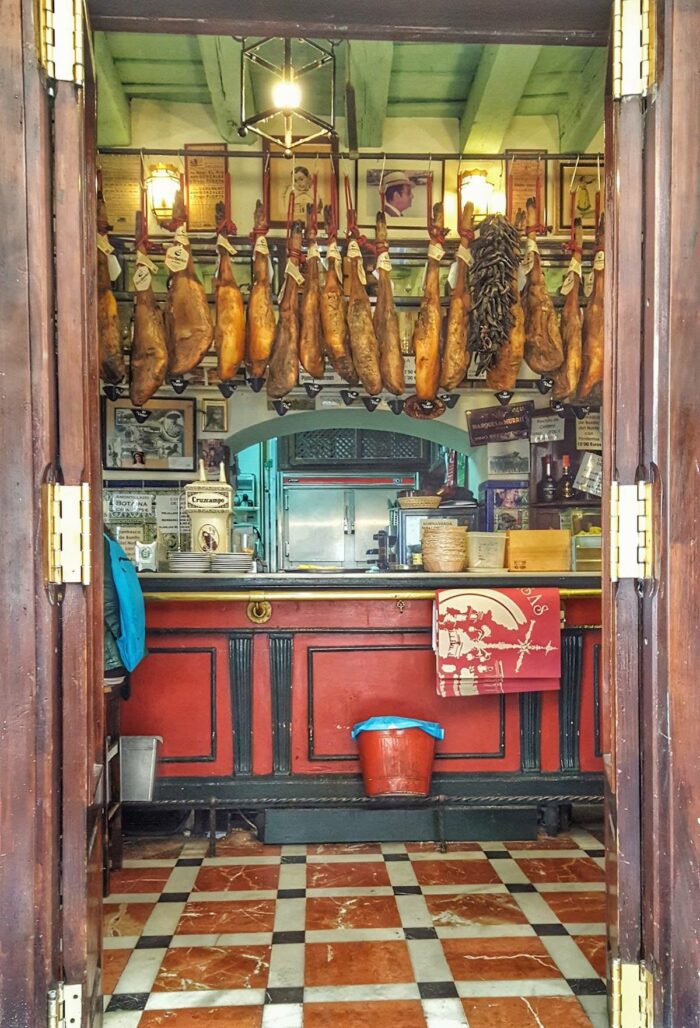
You can’t be in Sevilla without sampling the finest jamon iberica (cured ham) and a glass or five of the Jerez (sherry), which is so typical for the region. Or a beer, or red wine, whatever your taste. One of the best places to do so is Bar Las Teresas in the historic district of Santa Cruz.
Legs of ham hanging from the ceiling, small oak barrels of sherry along the walls, sawdust on the floor — that’s the way the locals enjoy their specialties, and so will you.
Also see: DMercao Restaurante – Fine Dining in Sevilla, Spain
Things to do and see
Seville is brimming with things to see, from the Moorish era to ultramodern architecture, museums, parks, and gardens. You are well advised to plan more than one day for your visit, and if you choose to see Semana Santa or the Feria de Abril, a week is in order.

Seville’s cathedral is the biggest Gothic cathedral in the world. You can spend hours marveling at no less than 80 chapels, the decorations, paintings, and, of course, the tomb of Christopher Columbus. A remnant of the Moorish past is the orange-tree-filled courtyard on the north side, where Muslims once performed their ablutions before prayer.

Next to the cathedral is the best-known Seville building, La Giralda, the bell tower. It’s also of Arab origin, as is visible from the ornamentation. A peculiarity is that ramps, instead of stairs, lead to the top, from which you have a spectacular view of the city and the river.

From religious buildings to where nobility used to live! Only recently opened to the public, the Palacio de las Dueñas is a 15th-century palace that, until her death, was one of the homes of the Duquesa de Alba. Visit the palace to admire the countless paintings, furniture, and courtyards, and learn about the fascinating history of the Dukes of Alba.

Another royal dwelling is the 14th-century palace complex, the Real Alcazar, the upper floor of which is still used by Spain’s royal family, and its many courtyards and lush gardens can be viewed.

After all the monuments, you might stroll in the largest green area of Sevilla, Maria Luisa Park. Broad avenues lined with palm trees lead to ornamental gardens, small waterfalls, and abundant flowers.

Then it’s time to dive into Sevilla’s gypsy, flamenco, and bullfighting history by exploring the iconic barrio (district) of Triana. Located on the left bank of the river Guadalquivir and best reached by crossing the Isabel Bridge, you’ll find a statue of a flamenco dancer. In these older houses, one gypsy made their home, and many shops and ateliers crafted and sold the distinctive blue tiles which adorn many a house and church in Sevilla. Famous bullfighter families trace their roots back to Triana, as do modern-day Spanish Flamenco stars.
If your taste runs to museums, visit the Museum of Fine Art, with a significant number of sculptures and paintings by famous Spanish artists. On Sundays, an art market is held nearby.

Let’s turn from ancient history to modern-day architecture and the outstanding monument Metropol Parasol, locally known as ‘Setas’ (mushrooms) because of its appearance. The massive white structure by German architect Juergen Mayer was conceived to revitalize the derelict Plaza de la Encarnacion and was inaugurated in 2011. Entirely constructed from crossed wooden beams and painted white, it’s a sight not to be missed.
Another building worth visiting is the Royal Tobacco factory, now the rectorate of the University of Sevilla. Sevilla had a flourishing tobacco industry in the 18th century, as anyone familiar with Bizet’s opera Carmen will know. A little snippet: recent expert reports cite 153 operas set in Sevilla.

A few words about the Feria de Abril. It started as a market for farmers to bring their products to the city and became one of the biggest festivals in southern Spain. The fairground is in Las Remedios, outside the city, and features hundreds of tents and so-called casetas, where visitors go from one to another, sampling fino (sherry), tapas, and ham. Everybody is dressed in traditional clothing: the ladies in polka-dotted flamenco dresses, silken shawls, and high combs, and the men in short-waisted jackets and wide-brimmed hats. Many come on horseback. Parades of horses and carriages, dances, flamenco shows, and weekends with massive fireworks.
Just join the fun and don’t bank on getting much sleep.
A much more somber affair is Semana Santa, when the various brotherhoods walk through the streets, many barefoot, carrying crosses and statues of the Virgin on their shoulders. Here you can see the details and itinerary of this year’s Holy Week.
Also see: Best Things to do in Seville
Best places to shop
Many small shops can be found on Calle Feria, where a colorful flea market is held on weekends. For tiles and wrought iron ornaments, Triana is your go-to choice.

Sevilla’s best shopping mall is Nervion Plaza in Calle Luis de Morales 3, with designer boutiques, restaurants, and a cinema. Triana is also famous for its food market, another colorful affair.
Currency etc
The local language is Spanish, but due to the many visitors, English is widely spoken, even in small bodegas and shops. The currency is the EURO, and credit cards are widely accepted. WiFi is available in every hotel and widely throughout the city.
Whether you choose to visit Seville during one of the major events or prefer a quiet time the rest of the year, you will gather an incredible amount of impressions, and the warm welcome you receive everywhere will make for an unforgettable journey to the true heart and soul of Andalusia.
Seville Travel and Tour Packages
Cathedral, Alcazar, & Giralda Guided Tour Combo Tickets in Seville

Visit Spain’s most significant cultural monuments and artistic legacies, the Alcázar and the Cathedral and Giralda of Seville! Experience the historical and majestic prowess of the UNESCO-registered World Heritage Site and the largest Gothic cathedral in the world!

Find Hotels in Seville, Spain, within your budget on Agoda.
Follow the Out of Town Travel Blog on Facebook, Twitter, Instagram, and Pinterest if you want more travel and food-related updates.
Also Read: