
 Kelly Austria
National Living Treasures: Ambalang Ausalin
Weaving is an age-old tradition in the country, passed down from generation to generation. However, many traditions suffer as younger generations lose interest in continuing them. This is one of the reasons the National Commission of Culture and the Arts has bestowed honors on the finest traditional artists who not only practice but also preserve the art.

Ambalang Ausalin photo via Ncca.gov.ph
One of these National Living Treasure or Gawad Manlilikha ng Bayan (GAMABA) awardees is Apuh Ambalang Ausalin of Lamitan City, Basilan.
Apuh Ambalang has kept the handweaving tradition of the Yakans, called the tennun, alive.

Tennun, which means “woven cloth” in Yakan, is one of the most popular Philippine weaves. It is known for its bold, geometric patterns. Like many other Philippine weaving styles, its patterns have cultural significance.
I recently visited Apuh Ambalang at the GAMABA Weaving Center in Lamitan City. I was with a group of travel influencers invited by the Tourism Promotions Board and the Department of Tourism to tour the Zamboanga Peninsula, or Region 9.

The tour highlights 3H – Habi (weave), Halal (cuisine), and Hilom (wellness). It covered Basilan, Zamboanga City, and Zamboanga del Sur. While Lamitan City is no longer part of Region 9, as it is now under the Bangsamoro Autonomous Region in Muslim Mindanao, It is on the itinerary because of Apuh Ambalang.
It was already my second time meeting her, but of course, the thrill was still there.
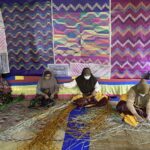
Apuh Ambalang was seated near the entrance, entertaining requests for photographs. Around her, several magtetenun, or weavers, including children, were busy working on their looms.
Apuh Ambalang herself learned the craft at a young age from her mother, who was previously regarded as the best weaver in Basilan. She mastered the most intricate categories of the weave — the sinalu’an and the seputangan.
During my first visit, I was taken through the entire process. I saw how laborious it is to finish a single weave and how difficult it is to master it. From the paghani, or the warping process, to the pagpeneh, or the making of the design, to the actual weaving, it takes weeks to months to finish one.

I am in awe of girls who pursue this craft. It requires tenacity, skill, passion, and dedication.
My first time visiting Basilan was in 2018. During that time, I also had the opportunity to meet and listen to Lamitan’s other GAMABA, Yakan folk musician Uwang Ahadas, perform. He granted a private performance to our small group of two. It was surreal.
Yes, Lamitan City is home to not just one but two GAMABAs. It is the only city or municipality in the country with that distinction, a testament to its rich heritage and culture. Sadly, the reputation of being an unsafe city still precedes it, so few get to experience its rich tradition firsthand.
Habi
Aside from the GAMABA weaving center, we also visited the Basilan School of Living Tradition in Isabela City, which also safeguards and showcases the talent and intricate work of Basilan’s Indigenous Groups, including the tennun.
We also visited the tennun weavers of the Yakan Village in Zamboanga City.

The Yakan Village was my first exposure to this textile style. The village is a collection of stalls selling woven goods and other souvenirs to tourists visiting Zamboanga City. The weavers there are also from Basilan and migrated to Zamboanga City. They are distant relatives of Apuh Ambalang. Guests in this village can also watch a tennun being woven.
We also went to ZamSulu Crafts in Zamboanga City, which showcases pis siyabit, the weaving tradition of the Tausugs; Kumala Weavers in Kumalarang, Zamboanga del Sur, who have a century-old tradition of producing eye-catching mats; and the Subanen weavers of Lapuyan, Zamboanga del Sur, who train differently-abled persons to weave.

Alberto Gadia, the TPB market specialist, said, “TPB includes indigenous weaving communities to help in the preservation of their intangible and tangible cultural heritage and, at the same time, help them in their livelihood.”
He added, “The pandemic has caused severe economic distress by shutting down all tourism activities, which affects the income-earning opportunities of the developing community-based tourism sites and attractions.”
Follow #TeamOutofTown on Facebook, Twitter, Instagram, Bloglovin, and Pinterest for more travel ideas.
Also read:
- Best Places To Swim In The Philippines With The Clearest Water
- Things To Do And See In Zamboanga City